The Crawler Goes In So Nobody Has To. That Solves One Problem, Not Two.
A robotic inspection crawler removes the human entry hazard from a tank or vessel, but it does not, by itself, satisfy an integrity assessment that requires quantitative wall-thickness data. Buy it for the exposure it eliminates, not for the assessment it cannot finish.
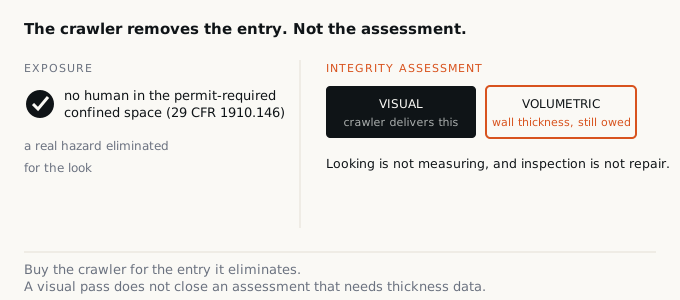
There is a moment in every confined-space program where the safety case and the engineering case get quietly confused for each other. A magnetic-wheeled crawler climbs a tank shell, or a small submersible drops into a vessel still holding product, and sends back clean video. Nobody put on a harness. Nobody signed an entry permit. The footage looks like an inspection. So it is tempting to close two questions at once: is my crew safe, and is my tank fit for service. Those are different questions, and the machine only answers the first one.
The exposure case is real, and it is the strong part
Start with what the crawler genuinely earns. In the United States, entering a tank, vessel, or pipe usually means entering a permit-required confined space under OSHA 29 CFR 1910.146. That framework exists because these spaces kill people in predictable ways: hazardous atmospheres, engulfment, and configurations an entrant cannot self-rescue from. NIOSH has documented the pattern for decades, including the grim second-order effect that a large share of confined-space deaths are would-be rescuers who go in after the first victim (NIOSH Publication 86-110).
A crawler that performs the visual inspection from inside the space, while your people stay outside it, removes the entrant from that hazard entirely. This is not a marginal control layered on top of the permit. It is elimination, the top of the hierarchy: no entrant, no atmosphere exposure, no engulfment path, no rescue scenario. If the only reason a person was going into that space was to look, and a machine can look instead, you have deleted the highest-consequence hazard in the job. That is worth doing on its own terms, and it is worth doing even if nothing else about your program changes.
So the skepticism that follows is not about whether crawlers reduce exposure. They do. It is about the sentence people say next.
Looking is not measuring
The sentence is some version of: “We inspected the tank with the robot, so we are covered.” Here is where the visual case and the integrity case separate.
A camera, however good, gives you surface condition. It shows corrosion products, coating failure, obvious pitting, weld appearance, deformation, debris. That is real information and it belongs in the record. But an integrity assessment for a storage tank is not asking how the wall looks. It is asking how much sound metal is left, and whether the remaining thickness satisfies the minimum required for continued service.
That is a volumetric question, and it is answered with quantitative thickness data, typically ultrasonic measurements taken across a defined grid, then used to compute corrosion rates and remaining life. In the United States, aboveground storage tanks built to API 650 are maintained in service under API Standard 653, which is built around exactly this kind of measured, comparative thickness data rather than around how the plate photographs. A picture of a wall and the thickness of that wall are not the same measurement, and one cannot be inferred from the other with the confidence an integrity calculation requires.
This is the falsifiable point, stated plainly: a crawler removes the entry hazard for inspection, but a visual pass does not by itself satisfy an integrity assessment that depends on quantitative wall thickness. If your crawler carries only a camera, you have completed the look and not the assessment. Some crawlers do carry ultrasonic probes and can take readings, which narrows the gap, but only to the extent of coupling quality, probe contact, and whether the grid coverage actually matches what the integrity code expects. The platform changes how the reading is taken. It does not change whether a reading is required.
Diagnostic
Before you sign the crawler into your inspection plan as a substitute rather than a supplement, separate the two claims it is making. For the specific asset in front of you, does your continued-service decision depend on quantitative wall-thickness data, and if so, does this platform actually capture that data to the coverage your governing code requires, or does it only capture pictures? If the honest answer is pictures, the crawler has bought you exposure reduction, which is valuable, but it has not bought you the assessment, and no amount of clean footage will close that gap.
And inspection is not repair
There is a second, quieter conflation worth naming. Even a crawler that carries full thickness instrumentation only tells you the state of the asset. It does not fix anything. If the data comes back showing wall loss past the acceptable minimum, the tank still has to be taken out of service and repaired, and that repair may well require the entry you were trying to avoid. The robot can defer human entry. It cannot always eliminate it across the asset’s whole life. Pretending otherwise turns a good exposure control into a false promise, and false promises in safety have a way of getting discovered at the worst time.
What “what works” looks like here
The clean version of this technology in a program is unglamorous and correct. The crawler is scoped as an exposure control for the visual portion of the inspection, and it is excellent at that job. The integrity assessment is scoped separately, against the actual governing standard for the actual asset, and it is honest about whether the data being collected is volumetric or only visual. Where thickness data is required, either the platform captures it to the required coverage or a separate method does, and that is written down as a requirement rather than assumed away because the video looked thorough.
Compliance-minded programs will be tempted to let the impressive footage stand in for the boring numbers, because the footage is easy to show an auditor and the numbers are hard to gather. That temptation is exactly the trap. The permit you did not have to issue is the win. The measurement you still owe is the work. Keep them separate, and the crawler is one of the better exposure reductions to reach the floor in years. Blur them, and you have automated the looking while quietly skipping the knowing.