The sling tag tells you how it was born
Take ten slings off the rack and run OSHA's own removal criteria against them, starting with whether the identification is legible. The count that should already be out of service tells you whether the daily inspection is a decision or a formality.
The rack sits at the end of the bay. Six pegs on a welded frame, wire rope on the left, synthetic web in the middle, a chain sling on the far peg because nobody reaches for it unless they have to. A rigger lifts a web sling off a peg, runs it through his hands once on the walk to the load, hooks up, and signals. Four seconds. That was the inspection.
Ask him why he trusted the sling and he will show you the tag.
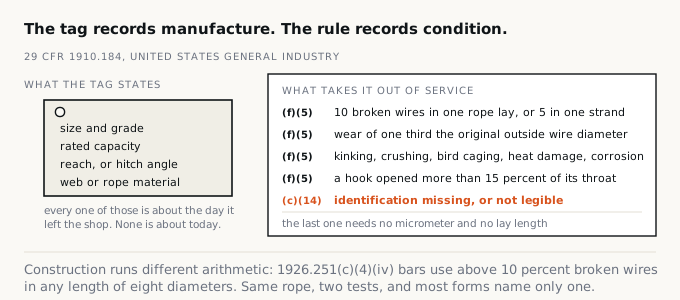
The tag is real information, and it is not the information he needs. It is the manufacturer’s statement of how this assembly was built and what it was rated for on the day it left the shop. Under United States OSHA general industry rules at 29 CFR 1910.184, an alloy steel chain sling must carry size, grade, rated capacity and reach. A wire rope sling must state the safe working load for the hitches used, the angle it is based on, and the number of legs. A synthetic web sling must show rated capacity for each hitch and the web material. Every one of those facts is about manufacture. None is about condition. The tag does not know this sling spent August wrapped around plate edges, or took a spatter shower from the welding bay next door.
The rule already wrote your inspection criteria
OSHA did not tell employers to look the slings over and use their judgment. It wrote numbers.
Section 1910.184(d) requires that each day before being used, the sling and all fastenings and attachments be inspected for damage or defects by a competent person designated by the employer, with additional inspections during use where service conditions warrant, and damaged slings removed immediately. The rule then tells you what damaged means, per type, in measurable terms.
For wire rope slings, 1910.184(f)(5) requires immediate removal for ten randomly distributed broken wires in one rope lay, or five broken wires in one strand in one rope lay. Also for wear or scraping of one third the original diameter of outside individual wires, for kinking, crushing or bird caging, for heat damage, for corrosion, and for hooks opened more than 15 percent of the normal throat opening at the narrowest point.
For alloy steel chain slings, 1910.184(e)(8) sends you to Table N-184-1, the minimum allowable chain size at any point of a link. A half inch chain comes out of service at 25/64 of an inch.
For synthetic web slings, 1910.184(i)(9) lists acid or caustic burns, melting or charring of any part of the sling surface, snags, punctures, tears or cuts, broken or worn stitches, and distortion of fittings. For metal mesh, 1910.184(g)(9) sets a 25 percent reduction in wire diameter from abrasion or 15 percent from corrosion. For fibre rope, 1910.184(h)(5) lists powdered fibre between strands, variations in the size or roundness of strands, and discoloration or rotting.
Notice what those criteria demand. OSHA made it explicit in a 1994 letter of interpretation on the wire rope criteria, which walks an inquirer through measuring worn outside wires with a micrometer against the original diameter. The agency’s own reading is that the test is a measurement. A hand run down a sling on the walk to the load cannot produce these numbers.
The missing tag is the cleanest read you have
There is one criterion that needs no micrometer and no lay length. Section 1910.184(c)(14) states plainly that employers must not use slings without affixed and legible identification markings, a requirement OSHA rewrote in its Standards Improvement Project Phase III final rule of June 2011. Missing tag, sunburnt tag, tag worn smooth by the load, tag someone wrote over with a marker. Same answer. The sling is out.
This criterion tells you the most about your programme, because it takes no skill to apply. If the rack holds slings whose tags cannot be read, the daily inspection is not happening, or it is happening and the answer is being overruled. The overrule is silent and it is reasonable in the moment: the job is moving, the replacement is in another building, and the sling looks fine.
Chain slings are the exception, the only type with a paper trail. Section 1910.184(e)(3) requires a thorough periodic inspection at intervals no greater than 12 months, and a record of the most recent month each chain sling was thoroughly inspected, available for examination. If that record does not exist, the gap is not interpretive.
The diagnostic
Go to one rigging rack this week and pull ten slings at random, with no warning. Run the 1910.184 criteria for each type, starting with the easiest: is the identification present and legible enough to read the rated capacity and hitch? Then look for the specific defects the rule names. Put the failures in one pile and ask whoever performs the daily inspection: which of these did you look at this morning, and what would you have had to see to pull one? If the pile is empty and the answer is specific, your inspection is a decision. If the pile holds three or four and the answer is that they all looked all right, it is a formality, and the tag has been doing work it cannot do.
Say which rule you are under
The criteria differ by jurisdiction, and the difference is the wire rope. United States construction work sits under 29 CFR 1926.251: inspection prior to use on each shift at 1926.251(a)(1), a daily competent person inspection at 1926.251(a)(6), legible identification markings at 1926.251(a)(2)(iii). Its synthetic web and fibre rope removal lists match general industry. Its wire rope test does not. Section 1926.251(c)(4)(iv) prohibits use if, in any length of eight diameters, visible broken wires exceed 10 percent of the total. That is a proportion over a fixed length, not a count per rope lay. A crew that moves between a plant and a construction project works to two different arithmetic tests on the same rope, and most inspection forms name only one.
The consensus standard is ASME B30.9, now in its 2025 edition. Note that 1910.184 does not incorporate B30.9 by reference. The only document the sling rule pulls in is ASTM A391-65, at 1910.184(e)(4), for chain proof testing. The federal floor is anchored to a 1965 specification while the consensus standard has moved repeatedly since. Meeting the floor is not the same exercise as meeting current practice.
The Bureau of Labor Statistics counted 357 fatal occupational injuries from being struck by a propelled, falling or suspended object in 2024, down from 394 in 2023. That category is not sling specific and is not a sling failure count. It is the bucket a dropped load lands in.
A sling failure is smaller than the statistics suggest. In Wyoming FACE 93WY010, a crew unloading a three quarter ton stack of sheet steel rigged it in a basket hitch with two nylon slings of different lengths. The load went up unbalanced, the longer sling slipped off its board support onto the cut edge of the sheet metal, and the edge sliced through the webbing. The load dropped, swung, and struck a 40 year old worker in the chest. He died of massive chest injuries. That sling was serviceable when it came off the peg. It became a removal case partway through one lift, which is why 1910.184(d) requires additional inspections during use, and why 1910.184(c)(7) requires slings to be padded or protected from the sharp edges of their loads.
Print the removal criteria for each sling type you own and bolt them to the rack, at eye height, where the sling is selected. Not in the binder, not in the toolbox talk deck. At the rack. Criteria are useless anywhere the decision is not being made.