The green tag was true when it was hung
A scaffold tag records one competent person's judgment at handover. OSHA requires an inspection before each work shift, because the hazard is what three trades did to the scaffold since.
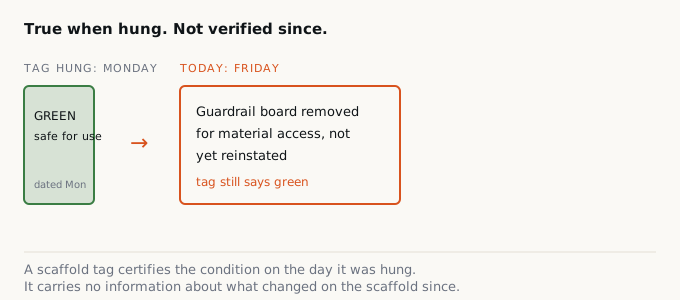
The scaffold tag is one of the most trusted objects on a construction site, and it is trusted for a reason. Someone qualified looked at this structure, found it sound, and signed for it. That is real information. The trouble starts with what people believe the tag covers.
A tag is a timestamp. It says: at the moment this was hung, by the person who hung it, this scaffold was fit for use. It says nothing about what happened at 2 p.m. when a pipefitter pulled two planks to get a spool through, or when an electrician removed a mid-rail to land a tray and put it back one bolt loose, or when a bricklayer loaded three pallets of block onto a bay rated for far less. Those changes do not remove the tag. The tag is still green, still legible, still signed. And the scaffold underneath it is no longer the scaffold that was inspected.
What the standard actually requires, and what it does not
In the United States, scaffolds sit in 29 CFR 1926 Subpart L. The provision that carries the weight here is 1926.451(f)(3): scaffolds and scaffold components “shall be inspected for visible defects by a competent person before each work shift, and after any occurrence which could affect a scaffold’s structural integrity.”
Read that twice, because two phrases in it are routinely lost.
Before each work shift. Not weekly, not at handover, not when the tag expires. Every shift, before people get on it. OSHA has addressed the practical scope of this in its interpretation on daily scaffold inspection, including the point that on large systems the inspection applies to the scaffold areas that will actually be used during the coming shift. That is a workable narrowing. It is not a waiver.
After any occurrence which could affect structural integrity. This is the clause that covers exactly the situation the tag cannot: a modification, an impact, a load change, a weather event. Something happened, so the previous inspection no longer governs.
Now the part that surprises people: the federal standard does not require the tag. There is no tagging provision in Subpart L. Tagging is an industry convention, and a useful one, but it is a communication tool layered on top of the requirement, not the requirement itself. 1926.451(f)(7) requires that scaffolds be erected, moved, dismantled, or altered only under the supervision and direction of a competent person, and 1926.454 requires that users be trained by a qualified person to recognise the hazards.
So a site can run a flawless tagging system, with colour-coded tags, laminated cards, and a log, and still be out of compliance every single shift, because nobody is doing the pre-shift look. And a site with no tags at all can be fully compliant. The tag is evidence of an inspection. It is not the inspection.
What actually goes wrong between tags
The failures worth walking for are mundane and repeat everywhere.
Planks removed for access and replaced without being secured or without full bearing. Guardrail sections taken out for a lift and put back with a single pin. Mud sills that were level on dry ground and are now sitting in a rut after rain, throwing a leg out of plumb. Base plates that have lifted because the ground settled. Ties removed by another trade because they were in the way of a duct run, which is the one that turns an inconvenience into a collapse. Loads accumulating: material staged on a bay, then more material, then a welding machine, with nobody tracking against the rated capacity. Debris and ice on platforms.
None of these produce a torn tag. All of them produce a different scaffold.
The other pattern is ownership. Scaffolds are usually erected by one contractor and used by several others. The erector hangs the tag and leaves. The users assume the tag is a warranty from a party who is no longer on site and has no visibility of what has happened since. Under a multi-employer arrangement the trade about to climb still owns the decision to climb, and the competent-person inspection before that shift is where that decision gets made.
Field check
Walk to any tagged scaffold your people are about to use and ask, before anyone climbs: who performed the competent-person inspection for this shift, what did they find, and what has changed on this structure since the tag was hung? Then verify by looking rather than by reading the tag. Count the planks and check they are secured and fully bearing. Put a hand on every guardrail and mid-rail in the bay being used. Look down at the base for settlement, ruts, water, and plates that have lifted. Look for ties that another trade may have pulled. Compare what is stacked on the platform against the rated capacity. If the only answer available is "it's got a green tag," you have a record of an inspection that happened at a moment you cannot date, and no inspection for today.
Hang the tags. They are a good habit and they communicate fast. Just be clear on what they are: a note about the past, on a structure that changes every time somebody works on it.