Robots Can Now Sniff for Leaks. Nobody Has Certified How Well.
Autonomous mobile robots are increasingly built to carry gas sensors and thermal cameras on patrol routes, but the standard that certifies the robot's movement says nothing about the payload's detection reliability, and almost no site is yet asking what the patrol interval actually costs in coverage.
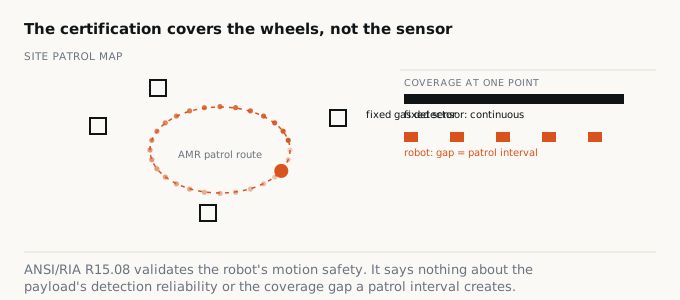
A wheeled or legged robot rolls past a compressor skid at 0400, its thermal camera logging a routine temperature reading and its gas sensor registering clean air. It will not pass that skid again for another 40 minutes. Somewhere in that interval, a fitting could start weeping gas, run for half an hour, and stop before the robot returns, and the patrol log would show nothing wrong at that location all night.
This is not a hypothetical against the technology. Equipping ground robots that were already validated for safe navigation with gas sensors and thermal imaging, and sending them on roving patrols to supplement or replace fixed point sensors, is a real and growing practice at industrial sites. It is also a practice that has outrun the question a compliance-minded EHS director needs answered first: what does “patrolled” actually buy you, in coverage, compared to what you already have fixed in place.
What the robot’s certification actually says
Autonomous mobile robots (AMRs) and legged inspection platforms used in industrial settings are increasingly built or retrofitted to ANSI/RIA R15.08, the American National Standard for Industrial Mobile Robots, published in two parts covering the robot itself and the requirements for the robot’s system and application (ANSI webstore, R15.08-1; R15.08-2). The standard’s job is to certify that the robot moves safely around people: collision avoidance, velocity limiting, emergency and protective stop functions, and presence-sensing for speed and separation (summary via AGV Network; The Robot Report).
Nowhere in that scope is a requirement about what the robot is carrying. R15.08 does not test, rate, or certify a gas sensor’s accuracy, a thermal camera’s resolution, or the reliability of either while mounted on a moving chassis. A robot can be fully R15.08-compliant and functionally blind to a leak it just drove past. That is not a flaw in the standard; motion safety and detection performance are different engineering questions, verified by different bodies, and R15.08 was never written to answer the second one. The problem is that a site rolling out a sensor-equipped patrol robot can walk away from the safety sign-off with the impression that the whole system has been vetted, when only the wheels and the stopping distance have been.
The practice is real, and it is moving fast
This is not a paper exercise. Robotics manufacturers have publicly announced gas-leak and presence-detection payloads for legged inspection platforms aimed at energy, petrochemical, and metals sites, combining acoustic imaging with modular gas sensors to cover “areas that are difficult and costly to reach with traditional static sensors” (The Robot Report, 2025). Case studies from legged-robot manufacturers describe deployments in refinery environments where a robot carries “modular sensors for gas detection, thermal imaging, and visual inspections” on autonomous waypoint routes, running continuously across day and night shifts (industrial inspection case study). Peer-reviewed work on thermal tracking for leak inspection with mobile robots goes back over a decade, and the applied literature on vision- and ultrasound-based gas and arc hazard detection is active in 2025 (MDPI, thermal tracking in mobile robots; arc/gas hazard detection paper, 2025). The pitch is consistent across the space: continuous, uneventful coverage of hard-to-reach or hazardous areas without a person walking the route. That is a genuine capability, not theatre. It is also, by definition, coverage that is not continuous at any single point.
What “coverage” means when the sensor is fixed
The gas-detection industry has already done serious work on what fixed-sensor coverage requires, and it is more rigorous than most EHS programs treat it. ISA-TR84.00.07 lays out a performance-based method for evaluating fire and gas system effectiveness in process areas, and it is blunt about the stakes: historical detection rates for fixed systems have run around 60 percent effective in industry studies, and the technical report shows that a coverage or detection-effectiveness factor below 90 percent collapses the system’s risk reduction factor to under 10, meaning even fixed, always-on networks can underperform badly if placement is not analyzed with real rigor rather than assumed (ISA-TR84.00.07 preview). Separately, the trade literature notes there is no single national or international rule on the exact number, spacing, or placement of gas detectors for the large majority of installed systems; sites, safety engineers, and process specialists arrive at spacing collaboratively, using leak-point proximity and area-monitoring principles rather than a fixed formula (gasdetection.com placement guidance). Even with that variability, a fixed point or area detector’s coverage of its assigned spot is continuous, bounded only by its own sensor response time. OSHA’s guidance on direct-reading gas monitors underscores that response reliability is not automatic even for a stationary instrument: calibration drift, sensor degradation, and internal damage invisible on inspection are why the agency and industry consensus bodies call for daily bump testing before use (OSHA SHIB 09-30-2013). A moving sensor inherits every one of those reliability questions and adds a new one: it is only at the hazard for the seconds it happens to be passing through.
The math nobody is asking for
Gas sensors, whatever the technology, take real time to respond. T90 response times (the time to register 90 percent of the true concentration) are commonly specified in the range of roughly 15 to 30 seconds under recognized sensor performance standards (response-time testing overview). A robot moving past a leak source at typical patrol speed may be in the plume for less time than its sensor needs to register a reading at all, not just late, but absent. And even when the sensor does register, the point it just cleared will not be checked again until the robot completes its loop. A 30- or 45-minute patrol interval means the maximum time-to-detection at any given point on the route is the interval itself, not the sensor’s response time. That is a fundamentally different coverage profile than a fixed detector at the same point, and under the United States’ OSHA General Duty Clause, an employer is expected to keep the workplace free of recognized hazards using feasible, known methods (OSHA interpretation, General Duty Clause elements); a hazard’s likelihood of causing harm is inseparable from how quickly it would actually be caught.
None of this makes roving sensor patrols a bad idea. For hard-to-instrument areas, large open yards, or supplementary visual and thermal screening where fixed sensors were never installed, a patrol robot can add real coverage that did not exist before. The problem is treating it as a drop-in substitute for a fixed network without running the numbers on what the substitution actually costs.
The diagnostic
Before relying on or piloting a roving AMR sensor patrol to substitute for or supplement fixed-point gas or thermal monitoring at a specific location, get three numbers in writing from whoever is proposing it: the patrol interval at that exact location, the sensor's rated response time at the platform's typical patrol speed, and the calculated maximum time-to-detection those two numbers produce together. Then compare that number, point by point, against the coverage your existing fixed network already provides at that same location. If nobody can produce that comparison, what is the maximum time a leak at this specific point could run undetected before the robot returns, and is that number better or worse than what you have today?
The robots are not the risk here. The unasked question is.