The Rack Is Only As Strong As Its Worst Upright
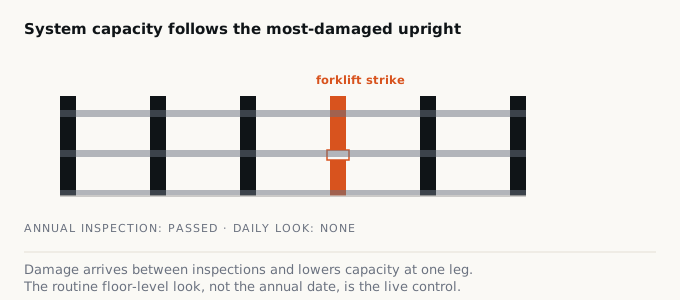
A racking system's capacity is governed by its most-damaged upright. A facility with a formal annual inspection but no routine floor-level look is running on residual capacity it has never measured.
A steel storage rack does not warn you before it fails. It absorbs a forklift clip, takes a dent in a column, leans a degree or two out of plumb, and then it keeps holding load exactly as it did the day before. Nothing squeals. The pallets stay up. That is the dangerous part. A damaged rack does its job right up to the moment it does not, and by then the failure is not a bent post, it is a collapse with everything above it coming down.
Capacity lives in the weakest column
The reason a small amount of damage matters so much is structural, not bureaucratic. An upright frame is a slender steel column carrying a compressive load, and a slender column’s strength depends on its geometry staying true. Put a dent, a bow, or a kink in it and you have not removed a fraction of its capacity, you have changed how it buckles. A column that is bent has a lower load at which it becomes unstable, and instability is not graceful. It does not sag. It goes.
That means the honest way to describe a rack’s strength is not the rating on the load sign. It is the current condition of its most-damaged member. A run of racking with one badly struck upright is not a strong system with one weak spot. It is a system whose real capacity is set by that weak spot, because that is where it will let go first, and when it lets go the load redistributes onto neighbors that were never designed to catch it. This is the falsifiable point in plain form: the strength of the system is governed by its worst upright, so if you have not looked at the uprights, you do not know what the system can hold.
The standard assumes someone is looking
In the United States, the consensus standard for these structures is ANSI MH16.1, developed by the Rack Manufacturers Institute and covering the design, testing, and utilization of industrial steel storage racks. It addresses damaged members directly, because the people who wrote it know that a rack in service is a rack getting hit. The standard’s world is one where damage is found and acted on, not one where a rack is installed and forgotten.
There is no OSHA regulation numbered specifically for rack inspection frequency. What there is, in the United States, is the General Duty Clause, Section 5(a)(1) of the OSH Act, which requires an employer to furnish a workplace free from recognized hazards likely to cause death or serious physical harm. A struck, leaning, load-bearing upright is a recognized hazard by any reasonable reading. The obligation to find it before it finds you is already there. The standard tells you what good looks like. The General Duty Clause tells you that noticing is not optional.
Annual is not the same as attended
Here is where a lot of otherwise diligent facilities have a blind spot. They commission a formal inspection, often annual, sometimes by a specialist, and they file the report. That inspection is genuinely valuable. It catches slow, systemic problems: anchors working loose, cumulative overloading, frames drifting out of plumb over seasons. But it is a snapshot. It describes the racking on one day, and forklift damage does not schedule itself around that day.
A rack can pass a clean inspection in March and take a hard corner strike in April. For the eleven months until the next formal look, that damage is invisible to the paperwork. The system is now running on residual capacity that no one has measured, and the load sign on the end of the aisle still reads the original number as if nothing happened. The annual inspection is a control against slow decay. It is almost no control at all against the fast, random event that is a lift truck and a column meeting at speed.
Walk one aisle and count
Pick your busiest pick aisle, the one where forklifts turn most. Walk its full length at eye level to the baseplates and lower uprights, and count the columns that are dented, bowed, rubbed shiny from contact, or sitting on a cracked or lifted anchor. Then find out when a human last did exactly that walk, not a form, a walk. If the honest answer is the annual inspector, ask: between formal inspections, who is looking at the uprights often enough to catch damage before the load finds it?
The routine look is the missing control
The fix is not more engineering. It is a short, routine, floor-level look that runs on a cadence closer to how often the racks actually get hit, which in a busy facility is daily, not yearly. It does not require a specialist. It requires someone whose job it is to walk the aisles at the height where forklifts do their damage, know what a compromised upright looks like, flag it, and get the load off it until it is repaired or replaced to the standard.
The people who work in the aisles are already there and already see the damage happen. Turning that ambient awareness into a named responsibility, with the authority to down-check a bay, is the whole intervention. It closes the gap between the annual snapshot and the daily reality.
The rack will keep holding load whether or not you look. That is precisely the problem. Compliance is satisfied by the annual report in the file. Safety is decided by the worst upright in the building, and the only way to know which one that is, is to go and look before it tells you the hard way.