Same-Level Falls Are a Design Output, Not a Lapse
Plot last year's same-level fall cases by location, shift and task instead of by person. If they cluster, the cause is a surface, a drain, a light level or a route, because carelessness does not cluster by location.
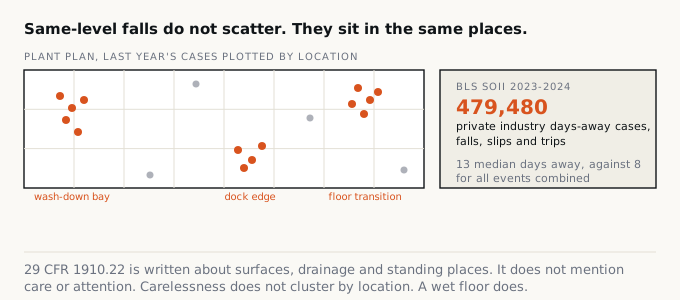
A pattern that turns up in register after register runs like this. A wash-down bay drains toward a doorway. That doorway opens onto the aisle every pallet leaving the line travels down. Over eight months four people go down within twenty feet of the threshold. Three were carrying something with both hands. All four investigations close the same way: operator reminded to watch footing, slip-resistant footwear reissued, case closed.
Four separate failures of attention, in one doorway, in one direction of travel. That is not a finding about four people. That is a finding about a doorway.
The standard is written about the floor
In the United States, federal general industry walking-working surfaces are governed by 29 CFR 1910.22, and the text does not mention attention, care or footwear once. It requires that all places of employment, passageways, storerooms, service rooms and walking-working surfaces are kept in a clean, orderly and sanitary condition. It requires that the floor of each workroom is maintained clean and, to the extent feasible, dry. It requires that walking-working surfaces are maintained free of hazards such as sharp or protruding objects, loose boards, corrosion, leaks, spills, snow and ice.
Then 1910.22(a)(2) does something specific. When wet processes are used, drainage must be maintained and, to the extent feasible, dry standing places such as false floors, platforms and mats must be provided. That is a design obligation, triggered by the process, owed to the place. It is not a behaviour obligation owed by whoever happens to be standing in it.
Paragraph (d) goes further. Walking-working surfaces must be inspected regularly and as necessary and maintained in a safe condition. Hazardous conditions must be corrected or repaired before an employee uses the surface again, and where the repair cannot be made immediately, the hazard must be guarded so nobody uses the surface until it is fixed. Note the default the standard reaches for: guard the place, not warn the person.
That is federal OSHA. State Plan jurisdictions must be at least as effective and may go further, so a multi-site program cannot assume the federal floor is the ceiling.
Now compare the corrective action most registers actually record. A reminder and a boot. Neither appears anywhere in the standard.
Carelessness does not cluster
The volume is not marginal. Over the two-year 2023-2024 period, the BLS Survey of Occupational Injuries and Illnesses counted 479,480 private industry cases involving days away from work caused by falls, slips and trips, an annualized rate of 22.6 per 10,000 full-time equivalent workers, out of 1,834,600 days-away cases from all events. That is roughly one in four. The median absence for a falls, slips and trips case was 13 days, against 8 days for all events combined. These cases cost more days than the average case they sit alongside.
Most of them happen on the level. NIOSH’s guidance for wholesale and retail trade states that 75 percent of total slip, trip and fall injuries in that sector occur on the same level. Its healthcare workbook reports that the lost-workday injury rate from same-level slips, trips and falls in hospitals was 38.2 per 10,000 employees, 90 percent above the 20.1 rate for all other private industries combined, using BLS figures for 2008.
The interesting part of that workbook is the hazard list. NIOSH names ten: contaminants on the floor, poor drainage from pipes and drains, indoor walking surface irregularities, outdoor walking surface irregularities, ice and snow, inadequate lighting, stairs and handrails, stepstools and ladders, tripping hazards such as clutter and loose cords, and improper use of floor mats and runners. Every one of the ten is a physical condition or a piece of equipment. Not one is a personal attribute. Slip-resistant footwear appears in the document as one component of a prevention program, not as the program.
Inadequate lighting sits sixth on that list, which exposes something awkward. Section 1910.22 sets no illumination figure at all. Federal OSHA does publish minimum levels, but for construction: 29 CFR 1926.56 Table D-3 requires five foot-candles for indoor warehouses, corridors, hallways and exitways. A general industry warehouse aisle where people walk carrying loads has no equivalent federal number. Compliance is not safety, and on this one compliance is not even a measurement.
The register already holds the answer
The method is not new and it is not ours. The NIOSH workbook instructs employers to read the narrative descriptions in their own claims and incident reports to identify what types of incident are most common and, specifically, the locations where multiple incidents have happened over the years. It calls them injury hot spots. That instruction is the whole test.
Four axes are enough. Location, to the bay or threshold rather than the building. Shift and clock time, because wash-down schedules, handovers and the first half hour after a break are conditions, not moods. Task, because reaching, crouching and carrying change what a body can recover from. Direction of travel, because a wet-to-dry transition is a hazard in one direction and unremarkable in the other.
A person carrying a tote with both hands has no free arm to catch with and a degraded sightline. That is not a lapse. That is a route the load was never designed for. NIOSH’s retail guidance addresses it as a design problem, telling employers to confirm the walkway is unobstructed before large materials are moved and to push rather than pull carts so the line of sight stays open.
The evidence that acting on hot spots works is in the same body of research. Three acute-care hospitals implemented a comprehensive slip, trip and fall prevention program between 1996 and 2005, and their total related workers’ compensation claims fell 59 percent.
The diagnostic
Pull every same-level fall from the last twelve months and re-sort the register: location to the nearest threshold, clock time, task in hand, direction of travel. Drop the name column entirely. Then ask do more than two cases share a location, or a location plus a time of day? If they do, you are looking at a surface, a drainage path, a light level or a route, and 1910.22 already obliges you to fix it. If they scatter evenly across the site with no repeat location and no time signature, the design case is unproven here and the honest next step is better narratives, not a stronger conclusion. If you cannot re-sort the register at all because the location field says "warehouse", that is the first finding.
Match the corrective action to the cluster
Each axis points somewhere different. A location cluster downstream of a wet process goes straight to 1910.22(a)(2): is drainage maintained there, and was a dry standing place ever provided. A cluster at one clock time usually points at a wash-down cycle, a shift handover, or a lighting level that fails after dusk. A cluster by task points at the route and the load, which means changing where things travel or how they are carried, not telling people to be careful while carrying them.
None of those corrective actions can be written on a toolbox talk. All of them are closable. All of them survive the person leaving.
The register you already have will answer this in an afternoon. If four cases sit in one doorway, the question is whether that doorway is downstream of a wet process, and whether drainage and a dry standing place were ever provided. If they were not, the reminder sitting in the file was never a corrective action. It was a record that nobody looked at the floor.