A Falling Recordable Rate Does Not Tell You Which Way It Fell
A dropping recordable rate is equally consistent with safer work and with more aggressive classification. Only case-level review of the decisions, not the total, can tell the two apart.
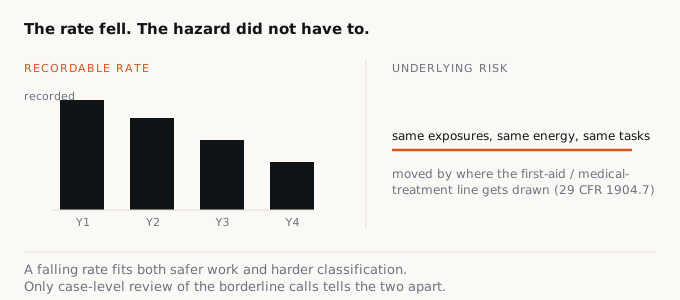
Your recordable rate went down this year, and the congratulations are already being drafted. Before they go out, sit with an uncomfortable fact: the number that fell can fall for two completely different reasons, and the number itself cannot tell you which one you are looking at. One reason is that fewer people got hurt. The other is that the same injuries got classified differently. A lower TRIR is consistent with both, and the total on the log will never separate them for you.
This is not the familiar small-numbers complaint, the argument that TRIR is statistically noisy at low injury counts. That is real and it is a different article. This is about something the noise argument never touches: the discretion baked into the recording decision itself, and the steady pressure on that discretion to point one way.
Where the discretion lives
In the United States, whether an injury lands on the OSHA 300 Log is governed by 29 CFR 1904.7, the general recording criteria. A case is recordable if it involves one or more of a specific set of outcomes: death, days away from work, restricted work or transfer to another job, medical treatment beyond first aid, or loss of consciousness (plus certain diagnosed conditions). OSHA’s own recording overview lays out the same set of triggers.
Read that list and you find the discretion hiding in plain sight. Death and loss of consciousness are binary. The others are not. Each of the remaining triggers is a line, and every line is a place where a defensible judgment can be made on either side.
Take medical treatment beyond first aid. Section 1904.7 defines recordability against a specific, closed list of treatments that count as first aid, and OSHA has stated that the treatments on that list remain first aid regardless of who administers them, so even a physician providing a listed treatment does not, by that fact alone, make the case recordable. That is a real, legitimate boundary. It can also be approached deliberately: keep the intervention on the first-aid side of the list and the case does not record. Nothing improper is required. The line is the line, and staying on the near side of it is a decision, not a discovery.
Take restricted work. The standard treats days of job transfer or restriction as recordable and counts them much like days away, with at least one day counted for such cases. But whether an injured worker is placed on genuine restricted duty or assigned meaningful work that removes the functions they cannot perform is, again, a management decision made near a line. Aggressive early return-to-work and light-duty programs can be excellent for the injured worker and also move where the case sits in the framework. Good for the person and favorable to the number are not mutually exclusive, which is what makes the number so hard to read.
Why the total cannot answer the question
None of this requires fraud. Fraud exists, but it is not the interesting case. The interesting case is that the recording criteria are a system of defensible boundaries, and a defensible boundary under sustained pressure gets approached from the favorable side more and more often. Case management, early intervention, careful reading of the first-aid list, and structured light duty are each legitimate. In aggregate they can lower the recordable count with no change in how many people are actually hurt or how badly.
So the rate drops. The steering committee sees a line going down and reads it as safer work. But the same downward line is what you would see if the injury picture held flat and the classification simply got sharper. The total is a sum of many individual decisions, and summing them destroys the information you would need to tell improvement from reclassification. The count was never designed to carry the reasons.
This is the compliance-is-not-safety spine at the level of the metric itself. You can run a fully lawful recordkeeping operation, every classification defensible, every case documented, and still produce a falling rate that tells leadership a story about risk that the risk did not authorize. The log is compliant. The inference drawn from it is where the theatre begins.
Case-level audit
Take every case from the last two years that landed just on the non-recordable side of a line, the first-aid-only treatments and the restricted-duty placements that avoided a day-away count, and read them as a set. Then ask the question the total can never answer: if a stranger reviewed these borderline cases with no knowledge of our rate, would they classify them the same way we did? If the borderline cases cluster suspiciously on the favorable side, your rate fell for a reason that has nothing to do with anyone being safer.
What actually works
Stop reading the rate as a verdict and start reading it as a question.
Audit the borderline cases, not the totals. The signal is not in the aggregate, which is exactly where reclassification hides. It is in the distribution of the close calls. A safety operation that is genuinely improving and one that is merely reclassifying will produce similar totals and very different piles of borderline cases. Read the pile.
Track leading exposure data alongside the lagging count. If your recordable rate falls while observed high-energy exposures, near-misses, and serious-injury-potential events hold flat or rise, the two are telling different stories, and the lagging number is the one more easily massaged. Divergence between them is the tell.
Separate the reward from the number. When bonuses, site rankings, or public targets ride on the recordable rate, you have attached an incentive to the classification decision, and the decision will feel it. Rewarding low numbers rewards whatever produces low numbers, and reclassification does that just as reliably as safety, at far lower cost. The metric you celebrate is the metric you corrupt.
A falling recordable rate is good news or it is nothing at all, and the rate itself will never tell you which. Only the cases will. If you are not reading them, you are not measuring safety. You are admiring a number that was built, in part, by people who knew you were watching it.