The limit you measure against was set in 1968
Re-score your last 12 months of personal sampling against the NIOSH REL and Cal/OSHA columns of OSHA's own annotated tables. The count of results that flip from pass to fail is the size of the gap between your compliance record and your exposure control.
A solvent wipe operation in a plant outside Memphis returns a personal sample at 120 ppm n-hexane, eight-hour time weighted average. The hygienist files it as compliant and moves on, correctly. The federal permissible exposure limit for n-hexane in 29 CFR 1910.1000 Table Z-1 is 500 ppm. The result is under a quarter of it.
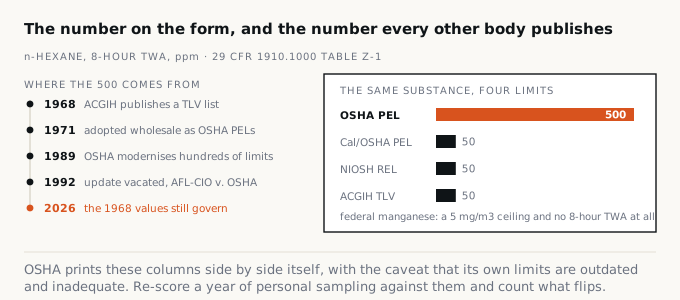
Run the same operation, with the same result, in Fresno, and it is a violation. California’s 8 CCR 5155 Table AC-1 sets the n-hexane PEL at 50 ppm with a skin notation. The NIOSH recommended exposure limit is also 50 ppm, and the pocket guide entry names the reason: peripheral neuropathy, numb extremities, muscle weakness. The ACGIH TLV is 50 ppm as well.
Four bodies looked at the same chemical. Three landed on 50. One landed on 500, and that is the one your programme is measured against.
The clock stopped in 1971
This is not a scandal. It is arithmetic on a statute.
Section 6(a) of the OSH Act let the new agency adopt existing federal and national consensus standards wholesale, without rulemaking, in a short window after 1970. As the agency describes on its own annotated PELs page, most of the limits in the Z tables were taken from the Walsh-Healey Public Contracts Act, which had in turn taken them from the 1968 threshold limit values of the American Conference of Governmental Industrial Hygienists. Comparable limits were adopted for shipyards at 29 CFR 1915.1000 and construction at 29 CFR 1926.55.
Paragraph (f) of 1910.1000 states that the exposure limits specified have been in effect since May 29, 1971.
That is the toxicological basis of most American air monitoring: a list assembled before the Clean Air Act existed, and before almost every exposure study your consultant will cite at you.
One attempt, and the snap back
OSHA tried once, at scale. The January 1989 Air Contaminants final rule at 54 FR 2332 lowered 212 existing PELs and set new PELs for 164 previously unregulated substances.
Industry and labour both challenged it, for opposite reasons. The Eleventh Circuit vacated the whole rule in AFL-CIO v. OSHA, 965 F.2d 962 (11th Cir. 1992), holding that OSHA had not made substance-by-substance findings of significant risk and feasibility. OSHA’s June 1993 Federal Register notice implementing the decision records what happened next: compliance officers stopped enforcing the new limits on March 23, 1993, and Table Z-1-A was removed from the CFR, replaced by a Table Z-1 containing “the exposure limits which were included in Table Z-1 before 1989.”
The same notice contains a sentence most EHS directors have never read. OSHA wrote that it “continues to believe that many of the old limits which it will now be enforcing are out of date (they predate 1968) and not sufficiently protective of employee health based on current scientific information and expert recommendations.”
The regulator said, in the document restoring the limits, that they were wrong. They have not moved since. NIOSH keeps the vacated 1989 values published as Appendix G of the Pocket Guide, under the heading “Exposure Limits NOT in Effect.”
Jurisdiction matters here. The 1993 notice states that the Eleventh Circuit decision did not directly bind the 25 states then operating approved state plans, because their standards were adopted under state law, and that some states continued to enforce the 1989 standard or an at least as effective equivalent. If you run sites in more than one state, your enforceable limit for a given substance is not necessarily the federal one.
The regulator publishes the gap itself
OSHA now maintains annotated Z tables that print the OSHA PEL, the Cal/OSHA PEL, the NIOSH REL and the ACGIH TLV in adjacent columns. The framing is unusually direct for a federal agency: OSHA “recognizes that many of its permissible exposure limits (PELs) are outdated and inadequate for ensuring protection of worker health,” and recommends employers consider the alternative limits because exposures above some of them “may be hazardous to workers, even when the exposure levels are in compliance with the relevant PELs.”
That is this publication’s spine, stated by the agency that writes the citations.
Read across a row and the gap stops being abstract. Manganese compounds and manganese fume, as Mn, carry a federal ceiling of 5 mg/m3 in Table Z-1 and no eight-hour TWA at all. Cal/OSHA sets an eight-hour PEL of 0.2 mg/m3. The NIOSH REL is 1 mg/m3 with a 3 mg/m3 short term limit. The ACGIH TLV is 0.02 mg/m3 respirable. A welding cell running at 1.5 mg/m3 across a shift is not merely compliant federally, it is not even measured against a number that exists.
Coverage explains why nobody fixes this piecemeal. In its 2014 Request for Information on chemical management, OSHA put its own reach at “occupational exposure limits for only about 470 substances.”
The diagnostic
Export every personal exposure sampling result from the last 12 months, with substance, sample duration and eight-hour TWA. Put them in one sheet against four columns from OSHA's annotated Table Z-1: OSHA PEL, Cal/OSHA PEL, NIOSH REL, ACGIH TLV. Mark each result pass or fail in each column. Then ask: how many results that passed the OSHA PEL fail the NIOSH REL or the Cal/OSHA PEL, and which tasks and which people do they belong to? Zero flips means your operations genuinely sit well below the old limits and the obsolescence argument does not reach you. A handful means you have a named, bounded list of tasks where your compliance record and your exposure control have come apart, and you can decide each one on its merits. A large share flipping, concentrated in a few jobs, means your internal action level, not the PEL, is the number that needs rewriting.
Two honest limits. NIOSH RELs are stated as up to 10-hour TWAs over a 40-hour week, not eight-hour TWAs, so the comparison is directional rather than exact. And the annotated tables are a snapshot with a stated access date, not a live feed. Treat a flip as a flag for review, not a finding.
The General Duty Clause is not the backstop you think
The usual reassurance is that section 5(a)(1) catches what the PELs miss. Read OSHA’s enforcement policy first.
The November 2018 memorandum to regional administrators on respiratory hazards not covered by PELs sets out the four elements the Review Commission and the courts require: an uncontrolled hazard employees were exposed to, recognition of the hazard, likelihood of death or serious physical harm, and a feasible and useful method of correction. It then instructs area directors that 5(a)(1) citations “are not based solely on evidence that a measured exposure exceeded a recommended occupational exposure limit,” and that proving serious physical harm “must include more than just the fact that a measured exposure exceeded a TLV or REL.” Where the evidence falls short, the area office issues a hazard alert letter, which carries no penalty.
So be precise. OSHA cannot cite your Tennessee plant for exceeding a NIOSH REL. This is not a compliance argument. It is an exposure control argument, and it is stronger for being separated from enforcement rather than dressed up as it.
There is one structural trap left. Paragraph (e) of 1910.1000 requires that engineering and administrative controls be determined and implemented first, wherever feasible, to keep exposures “within the limits prescribed in this section.” The hierarchy of controls, as written into the standard, is anchored to the 1968 number. A plant that engineers precisely to the PEL has done exactly what the regulation asks and has built its ventilation to a target three bodies have independently judged too high.
The sampling was correct. The lab was correct. The report was correct. The number at the bottom of the page is the oldest thing in the building.