The Card Says Certified. The Machine Says Otherwise.
An operator certified on aerial lifts can still be untrained on the specific unit in front of them. Familiarization on that unit, not the wallet card, is the control that closes the gap.
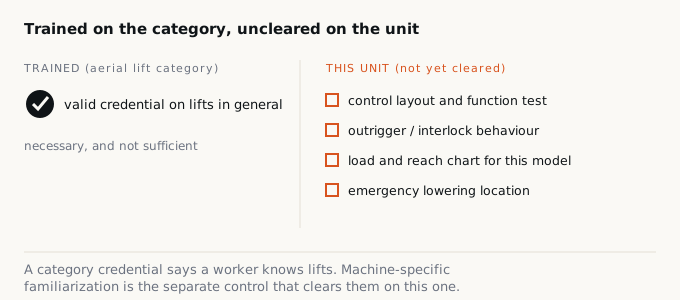
A laminated card in a wallet is a comforting thing. It says the person holding it was trained, tested, and cleared to run a lift. On most sites it is treated as the end of the question. Someone asks “is that operator qualified,” the card comes out, and everyone moves on. The trouble is that the card answers a general question, and the machine parked at the base of the work presents a specific one. Those are not the same question, and the gap between them is where people get hurt.
Certified on a category, not a control panel
Operator training, done properly, teaches the fundamentals that carry across a whole class of equipment: how a boom lift behaves differently from a scissor lift, why a platform load rating is not a suggestion, what happens to stability when you extend and rotate at the same time, how wind and slope and soft ground conspire against you. That knowledge is real and it transfers. A well-trained operator understands the physics of working at height regardless of the badge on the machine.
What that training cannot teach is the unit that arrived on the truck this morning. It cannot teach which of two nearly identical control layouts puts the drive function where the boom function used to be. It cannot teach the quirk in this model’s tilt alarm, the location of this machine’s emergency lowering valve, the fact that this platform’s rated capacity drops sharply once the jib is deployed. Those are properties of the specific unit, and they are learned on the specific unit or not at all.
In the United States, OSHA’s construction standard for aerial lifts, 29 CFR 1926.453, requires that only trained and authorized persons operate an aerial lift, and it ties the equipment back to the older ANSI A92.2 design consensus. It sets the floor. It does not, on its own, spell out the machine-specific step that the current consensus standards make explicit.
Familiarization is a named control, not a courtesy
The current ANSI A92 suite draws the line clearly. The safe use standard, ANSI/SAIA A92.22, and the training standard, ANSI/SAIA A92.24, treat general training and familiarization as two separate obligations that both have to be met before someone runs a MEWP. Training is the transferable knowledge. Familiarization is the handoff for the actual model in front of the operator: confirming the manuals are present in their enclosure on the machine, and walking the specific controls, features, devices, and operating limits of that unit.
Read those two obligations side by side and the falsifiable point falls out. A worker can hold a valid training credential and still be, by the standard’s own logic, not cleared to operate the particular lift they are about to board. The credential and the clearance are different states. Familiarization is the step that moves a person from the first to the second, and it is fast: minutes with the manual and the actual controls, not a classroom.
That speed is exactly why it gets skipped. The lift shows up, the schedule is tight, the operator has run “one just like it” before, and the familiarization is quietly folded into a nod. The problem is that “just like it” is doing enormous work in that sentence. Two machines from the same category, even the same nominal class, can put a directional control, a capacity limit, or an emergency function in a different place. Muscle memory built on the last unit becomes a liability on this one, and the moment it matters is the moment there is no time to look it up.
Run this at the base of the lift
Pick any operator about to board a MEWP and ask them, without touching the machine, to point to three things on that specific unit: the emergency lowering control, the platform capacity as rated for the configuration they will actually use, and the function of every switch they cannot immediately name. If they can point to a valid card but not to those three things, has this operator been familiarized on this machine, or only trained on machines like it?
What holds up on a real site
The sites that close this gap tend to do the same unglamorous things. They treat every new unit, and every operator new to a unit, as a familiarization trigger rather than assuming the wallet card covers it. They keep the operator manual physically on the machine, in its enclosure, because familiarization to the standard is partly a manual check and you cannot check a manual that lives in an office. They log familiarization against the machine and the person, not just the training class, so the record answers the specific question a supervisor should be asking.
None of this replaces training. A familiarization walkaround on someone who never learned why a boom lift tips is theater. The point is that training and familiarization are two controls doing two different jobs, and the second one is the one that most often goes missing because it looks optional. It is not optional in the consensus standard, and it is not optional in the physics.
The card tells you what the operator knows in general. The machine is asking whether they know it. Compliance signs off on the first. Safety depends on the second, and the second takes about five minutes that nobody thinks they have until the platform is already thirty feet up.