Your LOTO periodic inspection was a document review
Pull last year's lockout/tagout certifications. If you cannot tie each one to a named machine, a named authorized employee, and a date on which someone watched that employee isolate it, you ran a document review, not the periodic inspection 29 CFR 1910.147(c)(6) describes.
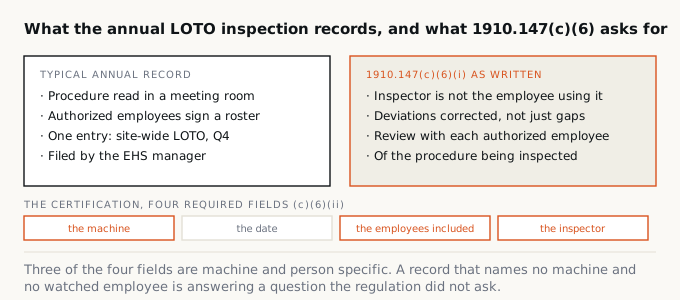
A plant in the US Midwest books a conference room for a Thursday in November. Forty energy control procedures go up on screen, one per slide. The maintenance leads confirm each one still matches the equipment. Two get corrected on the spot because a disconnect moved during a line rebuild. A sign-in sheet goes round. The file is saved as “Annual LOTO Audit 2026” and the calendar year closes clean.
Almost nothing in that room was wasted. Procedures were checked against reality, two errors were caught, and the people who use the procedures were in attendance. It was a useful morning.
It was also a different activity from the one the regulation describes, and the gap between the two is where the enforcement risk and, more usefully, the actual learning both sit.
The standard is written in the language of activity, not of paperwork
In United States general industry, 29 CFR 1910.147(c)(6) sets out the periodic inspection. Read the four subparagraphs as a sequence rather than a list and the shape of the thing changes.
Paragraph (c)(6)(i)(A) says the inspection “shall be performed by an authorized employee other than the ones(s) utilizing the energy control procedure being inspected.” Note the present participle. The regulation assumes somebody is using the procedure at the time, and it disqualifies that person from inspecting it. A document review has no one utilizing anything, which makes the disqualification meaningless. The clause only does work if there is an application to watch.
Paragraph (c)(6)(i)(B) says the inspection “shall be conducted to correct any deviations or inadequacies identified.” Deviations from a procedure are behaviours. You can find an inadequacy in a document by reading it. You cannot find a deviation from it.
Paragraph (c)(6)(i)(C) requires, where lockout is used, “a review, between the inspector and each authorized employee, of that employee’s responsibilities under the energy control procedure being inspected.” Where tagout is used, (c)(6)(i)(D) extends the same review to affected employees as well, plus the tag limitations in (c)(7)(ii). The review is a component, not the whole. It sits alongside something else.
OSHA’s own current guidance says what that something else is. The agency’s lockout/tagout eTool states that the periodic inspection “consists of two requirements,” the first being that “the inspector must observe a representative sample of authorized employees performing the servicing and maintenance operation using the lockout/tagout procedure,” the second being the review of responsibilities. An interpretation letter from 2004, now carried in OSHA’s archive, put it more bluntly: the inspections “must provide for the demonstration of the procedures and must be performed while authorized employees perform servicing and/or maintenance activities on machines or equipment.”
Two components. Most sites run one of them and file it as both.
The certification is the tell, and it is already in your drive
You do not need an auditor to find out which one you ran. The evidence is a records request away, because paragraph (c)(6)(ii) tells you exactly what the certification has to contain: “the machine or equipment on which the energy control procedure was being utilized, the date of the inspection, the employees included in the inspection, and the person performing the inspection.”
Four fields, and three of them are machine-and-person specific. The certification is not a statement that the programme was reviewed. It is a statement that a named person watched named people work on a named asset on a named day. If your certification records say “site-wide LOTO programme, Q4, all authorized employees, EHS manager,” they are not wrong so much as they are answering a question the regulation did not ask.
This is the cleanest self-test in the standard, and it costs an afternoon. Sort last year’s certifications. Count how many name a specific machine. Of those, count how many name individual employees rather than a department or a shift. The ratio is your answer.
One annual audit cannot stretch across a hundred procedures
The common structural objection is scale. A refinery or a large fabricator may hold several hundred written procedures. Observing an application of each, annually, is not a real plan.
OSHA has addressed that, and the answer is more permissive than most EHS directors assume, but it is permissive in a specific direction. The 2004 interpretation allows an employer to group procedures for inspection purposes where the machines share the same type and magnitude of hazardous energy and the same or similar controls, provided the grouped procedures share intended use, shutdown and isolation steps, device placement and transfer steps, and verification requirements. The employer then inspects a representative number of authorized employees implementing a procedure within each category. The letter also suggests rotating which individual procedure gets picked from each group year to year, so that over time the whole set is covered.
That is a sampling frame. It is not a waiver. Grouping reduces the number of observations you owe; it does not convert an observation into a reading. And because the grouping test is about energy type and control similarity, a category built for administrative convenience (all procedures in Building 4) will not hold. The grouping has to be defensible on engineering grounds, not on org chart grounds.
The diagnostic
Open last year's LOTO certification file and pick three records at random. For each one, ask: can I name the machine, the date, and the authorized employee whose isolation was physically watched, and can I name who watched it? If all three records answer cleanly, your periodic inspection is an observed activity and your grouping logic is the next thing to check. If the records name a programme rather than a machine, or name a department rather than a person, you have a document review with a certification stapled to it, and the fix is scheduling rather than rewriting: attach the inspection to work that was already going to happen. If you cannot locate the certifications at all, that is the smaller problem and the faster one to solve.
The person holding the clipboard has to be qualified on that machine
There is a second constraint that quietly rules out the way many sites staff this. Paragraph (c)(6)(i)(A) requires an authorized employee, and 1910.147(b) defines that as a person who locks out or tags out machines in order to perform servicing or maintenance on that machine or equipment. An OSHA interpretation from 1994, also archived, reads the inspector role as requiring “a qualified person who has been trained and has demonstrated proficiency, in compliance with 1910.147(c)(7), to perform servicing and maintenance on the machine or equipment to be inspected.”
An EHS coordinator who has never isolated that press is not, on that reading, eligible to inspect that press procedure. The role belongs to a maintenance peer from another line, another shift, or another trade. Which is inconvenient for the org chart and useful for the finding quality, because a peer knows which step people skip.
Lockout/tagout sat fifth on OSHA’s top ten most frequently cited standards for fiscal year 2024, which means inspectors arrive at this subject already fluent. But the citation exposure is the smaller reason to change how this runs. The larger one is that an observed isolation is the only moment in the year when you find out whether the verification step in (d)(6) actually happens, or whether people have learned that the machine is always dead by then.
So the practical move for the next cycle is a scheduling change, not a documentation change. Ask maintenance planning for the twelve-month outage and shutdown calendar, mark the jobs that exercise each procedure group, and assign an authorized peer inspector to each one before the work is scheduled. The inspection stops being an event you have to create and becomes a job you attend. And paragraph (c)(7)(iii)(B) then does its part: whenever an inspection reveals a deviation or a gap in knowledge, retraining is triggered, which is the only mechanism in the standard that turns a finding into a changed behaviour.