The minor servicing exception has four tests, and most sites only run three
United States general industry lockout/tagout lets you skip lockout for minor servicing only if all four conditions hold together, and the fourth, alternative measures that provide effective protection, is the one OSHA says the employer must prove case by case.
An operator has a hand inside a machine that is still live, and someone explains that this one is minor servicing. The paperwork usually agrees. It is usually wrong, and wrong in the same place every time.
Under United States general industry rules, the lockout/tagout standard at 29 CFR 1910.147 covers servicing and maintenance where unexpected energization could injure someone. Paragraph (a)(2)(ii) excludes normal production operations, then pulls servicing during production back in whenever a guard must be bypassed or a body part enters the point of operation. The Note beneath it is the escape hatch: minor tool changes, adjustments and other minor servicing activities are not covered “if they are routine, repetitive, and integral to the use of the equipment for production, provided that the work is performed using alternative measures which provide effective protection.”
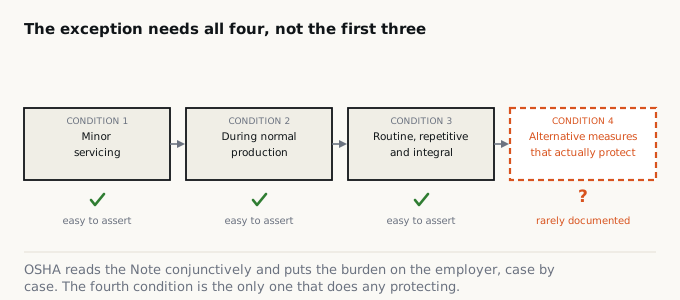
That sentence is conjunctive. Four conditions have to hold at once, and they are not equal.
Three conditions sort the task, one protects the person
Minor. During normal production. Routine, repetitive and integral. Those three sort a task into a bucket; none of them changes the energy in the machine. The fourth is the only one that touches the hazard, and the only one written as a proviso rather than a description.
OSHA is explicit about who carries the fourth. In a May 4, 2007 interpretation letter, it stated that “an employer bears the burden of demonstrating, on a case-by-case basis, that the minor servicing exception applies.” Case by case, not policy by policy. The current enforcement directive, CPL 02-00-147, says it in reverse: employees on energized equipment count as outside the hazardous area only where the task meets “each and every element of the minor servicing exception criteria,” effective protection included.
Most exception files rest on the first three tests. Ask what the alternative measure is and you get a habit, not a device: the operator knows to hit stop, nobody else works that line, it has never gone wrong.
An alternative measure is hardware, not habit
OSHA’s December 28, 2006 letter sets three conditions before a disconnect or control switch counts as effective protection: designed and applied in accordance with recognized and good engineering practice, controlling all the hazardous energy and placed in the off position, and under the exclusive control of the employee performing the task. CPL 02-00-147 reads exclusive control narrowly: the employee has the authority to, and is continuously in a position to, prevent others from re-energizing.
Control circuits get less benefit of the doubt than sites assume. In a January 25, 2008 letter, OSHA said reliance on a programmable logic controller for a safety function “is presumed to be ineffective employee protection,” and that an employer must rebut that presumption with a system hazard analysis before the agency would accept it. Meeting a consensus standard does not settle it: OSHA restated in October 2024 that only standards incorporated into an OSHA rule are a means of compliance.
The one test
Take the three tasks your site most often runs without lockout under this exception. For each, write down the device that prevents energization, who holds exclusive control of it, and when it was last verified. Then ask could you hand an inspector a device and a record, or only a description of the task?
Jam clearing and blade changes usually fail
The two tasks filed under this exception most often are the two that fail it.
Unjamming appears in the definition of servicing and maintenance at 1910.147(b), next to lubrication, cleaning and tool changes. It is in scope unless the exception is earned. CPL 02-00-147 lists reaching around guards during press roller cleaning or conveyor unjamming on energized equipment as employee exposure, not as excepted work.
Blade and die work fails earlier, on the production clause. The same directive treats a trimmer knife blade changed monthly as “a non-routine set-up activity that does not occur during the normal production operations,” and the 2006 letter reaches the same result for a grinding wheel change: the machine is off, grinding has stopped, a guard comes away. Setting up is its own defined term in 1910.147(b), and work done to prepare a machine to produce cannot also be work done during production.
The exception buys one task, not a program
Paragraph (c)(4)(i) still requires documented, machine-specific energy control procedures for everything the exception does not reach, subject only to its own eight-element carve-out. OSHA’s lockout/tagout eTool puts the boundary plainly: if the exception is not met in full, the standard applies and the machine must be de-energized. Paragraph (a)(1)(ii) keeps construction, agriculture, maritime employment and oil and gas well drilling and servicing outside 1910.147, and state plan jurisdictions enforce their own versions.
A site can be completely right that a task is minor, routine, repetitive and integral, and still have nothing between a hand and a moving part. Three conditions describe the work. Only the fourth describes the protection, and it is the one nobody writes down.