Ten doors, before the first forklift goes in
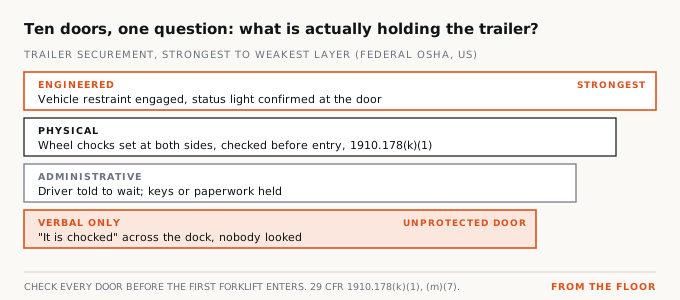
Before a forklift enters any trailer, record at ten doors which securement is actually in place and whether the truck driver and the dock agree on its status. Any door where the status is verbal only is an unprotected door, whatever the audit says about chocks.
A forklift operator drives onto the trailer floor to start the unload. The truck driver, finished with paperwork and running behind, releases the brakes and pulls away. The gap opens. The forklift goes with it.
This sequence is the standard dock event, and OSHA’s records contain a version of it. A summary of forklift fatalities investigated by OSHA describes a 1998 case in which a stand-up forklift operator was driving into a tractor trailer to start unloading when the truck driver pulled away from the dock. The forklift fell back onto the operator. The page gives no cause statement from OSHA, and one case is not a rate. It is, though, the shape of the hazard.
Scope: federal OSHA, general industry. State plans, and rules that apply to drivers rather than the dock employer, may differ.
What the rule says, and what it quietly leaves out
29 CFR 1910.178(k)(1) says: “The brakes of highway trucks shall be set and wheel chocks placed under the rear wheels” to prevent rolling while powered trucks are boarded. Paragraph (m)(7) repeats it: brakes set and wheel blocks in place during loading and unloading. Paragraph (m)(7) also requires checking the trailer floor for breaks and weakness before driving on.
Two caveats matter for a multi-site program.
A mechanical restraint can stand in for chocks. OSHA’s long-standing instruction on 1910.178(k)(1) and (m)(7), dated 1981, says a device that secures the truck or trailer to the dock, giving protection equivalent to chocks, is treated as a de minimis matter when chocks are not used. The conditions: it must effectively prevent movement during loading, unloading and boarding, be installed, maintained and used as its maker recommends, and damaged equipment must come out of service. The page does not say whether the directive has since been superseded, so confirm current status with counsel.
Commercial vehicles are a split jurisdiction. In a 2011 interpretation, OSHA stated that federal motor carrier rules preempt its chocking requirements for commercial motor vehicles, and withdrew earlier chocking guidance. The same letter says the employer must still comply with OSHA standards to keep forklift operators out of a trailer when a driver pulls away, and that operators must not drive onto a backed-in trailer unless it is “properly secured or restricted from movement prior to boarding.” It names operator training as the employer’s central control and does not discuss restraint systems.
Read together: the rule sets a floor for chocks, a restraint can satisfy the same purpose, and the real obligation is that the trailer cannot move while someone is inside. Which piece of paper applies to which party is a legal question. The physics is simpler.
Why the chock fails in practice
A chock is a passive object that depends on three things: someone placing it, correct placement against the tire, and enough friction between tire, chock and pavement.
- Placed by whom? At many docks the driver is expected to chock and the dock crew assumes it was done. Both assume.
- Placed correctly? A chock set loosely, on the wrong wheel, or on a worn rubber face does little.
- Friction. On ice, wet concrete, or fines and grit, a chock can slide. The OSHA letters reviewed do not address ice, so this is engineering reasoning, not a quoted finding.
- Removed early. The driver pulls a chock to be ready to leave. This is not malice. It is a timing habit.
And the site audit usually checks one thing: is there a chock at the door? Present is not placed. Placed is not holding.
Where the layers sit
In the hierarchy of controls, a chock is a work practice with a physical object attached. A restraint that engages the trailer’s rear-impact guard is an engineered control: it does not depend on someone remembering at 3 a.m. A light or signal system that shows the dock side and the driver side the same status is a communication control that lets both parties see the restraint state, so the driver is not guessing whether the forklift is inside.
None is perfect. Restraints engage hardware on the trailer, so a damaged or non-standard rear guard can defeat them. Lights can show green while the device is bypassed. Keep chocks as a backup; do not treat them as the primary.
A visual check of trailer position by the operator before entering catches the failure all three miss: the trailer has crept away from the dock face, leaving a gap. Look at the dock leveler lip. Look at the gap. This takes two seconds.
The NIOSH forklift Alert is a general reference, and its text on trailers at docks was not found; its dock recommendation concerns repairing cracks and crumbling edges. A state FACE report on a forklift falling off a deteriorating dock is a reminder that the edge itself is a separate hazard. This article does not duplicate the pedestrian and aisle separation material already published here.
The ten-door observation
Stand where you can see the doors but not interfere. For ten trailers at ten doors, before the first forklift enters, record:
| Observation | Record |
|---|---|
| Chock in place? Where? | Y/N, wheel, snug or loose |
| Restraint engaged? | Y/N, indicator state |
| Light or signal at dock and at driver side | Both agree, one only, none |
| How did the operator learn status? | Light, saw it, was told, assumed |
| Did the driver say they were secured? | Y/N, and does the dock say the same |
| Gap between trailer and dock face | Visual, ok or not |
Any door where the only evidence is “the driver said so” is verbal only. Count it as unprotected.
The diagnostic
Observe ten trailers at ten doors, across at least two shifts and including a wet or cold day if you have one. Before the first forklift enters each trailer, record which securement is in place (chock, restraint, both, neither), whether the driver-side and dock-side signals match, and whether the operator confirmed trailer position by looking. Score each door protected only if a physical securement is in place and both sides agree on its state without being told. Doors where the status is verbal only are unprotected doors. At how many of your ten doors could the trailer have left with the forklift inside, and nobody would have been wrong to say it was secured?