A year of forklift checklists with no defects is not a clean fleet
Pull twelve months of pre-shift forklift checklists and compute defects reported per 1,000 exams and the share that ended in a tag-out. Then compare against maintenance work orders for the same trucks. If the work orders show faults the checklists never recorded, the daily examination is not happening.
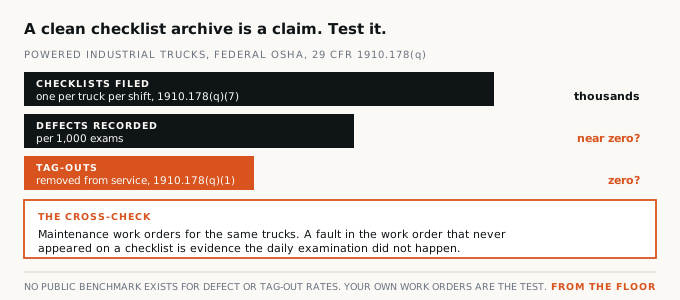
Open the checklist archive for a warehouse with forty trucks. Twelve months, two shifts, roughly twenty thousand completed forms. Every box is ticked. Horn, brakes, steering, forks, hydraulics, tires, all “OK.” A handful of entries say “minor, reported.” No truck was ever tagged out by an operator.
An auditor sees completeness and moves on. A skeptic sees a result that no fleet of working machines produces.
Scope note: everything below is federal OSHA, general industry, 29 CFR 1910.178. State plans and other jurisdictions may differ.
What the rule actually asks for
The text is short. Under 29 CFR 1910.178(q)(7), industrial trucks “shall be examined before being placed in service,” must not be placed in service if the examination shows any condition adversely affecting safety, and the examination is required at least daily, or after each shift for trucks used around the clock. Paragraph (q)(1) adds that a power-operated truck “not in safe operating condition shall be removed from service,” and that repairs are made by authorized personnel.
Notice what is missing. The standard does not say “complete a checklist.” OSHA has said so directly. In a 2004 letter, the agency stated there is no specific requirement that a checklist be used, and in a 2000 letter that there is no requirement the examination be recorded in writing. A 2005 letter adds that defects must be reported and corrected immediately.
So the checklist is your own artifact. OSHA asks for an examination and a consequence. You added the paper. If the paper cannot show either, it proves nothing the regulator asked for.
Why zero defects is a finding, not a good news story
Forklifts work hard. They carry loads, take impacts, and run through water and grit. Tires wear, hydraulic hoses weep, horns fail, seat belts get tucked behind the seat, mast chains stretch. The honest expectation for a fleet this size is a steady trickle of small faults every week.
A record with almost none of that has three plausible explanations:
| Explanation | What it looks like in the data |
|---|---|
| The exam is done and the fleet is unusually healthy | Low defect rate, and work orders also show few operator-detectable faults |
| The form is completed from habit, not from looking | Low defect rate, but work orders show faults on the same days or weeks |
| Operators see faults and do not write them down | Low defect rate, work orders raised by mechanics or supervisors, not operators |
Only the first is good news, and it is the least likely. The other two are both a failure of (q)(7), and the second also leaves a trail of signed forms that say otherwise.
Why would operators skip it? A tag-out takes a truck out of the rotation at shift start. The operator waits for a replacement, or is blamed for lost picks. A defect reported can mean a delay; a defect not reported costs nothing until it does. Where the incentives run that way, the checklist is optimized for completion time. That is a design problem, not a character flaw.
What the national record does and does not tell you
Be careful here, because no public data set we could find reports how many forklift deaths trace to a missed daily exam. It does not exist in the sources reviewed, and nobody should imply otherwise.
What the primary sources do show is context. Powered industrial trucks (1910.178) rank seventh on OSHA’s preliminary FY 2026 list of most frequently cited standards, covering October 1, 2025 to August 31, 2026. The page gives the ranking but no violation count, so no count is quoted here. The NIOSH forklift Alert is dated, but it remains the standard summary: for 1980 to 1994 it reports 1,021 forklift-related worker deaths, led by overturns (22 percent) and pedestrians struck (20 percent). It also repeats the daily examination requirement. And one NIOSH-funded state FACE report on a forklift that fell off a deteriorating dock recommends daily inspections and notes that maintenance there had only been done when a mechanical problem appeared.
That last detail is the pattern. Reactive maintenance and an unexamined daily routine travel together.
The test: checklists against work orders
The comparison is cheap, and it can be run in an afternoon by someone who is not on the floor.
- Pull twelve months of completed checklists, by truck ID. Count total exams and total entries marking any defect.
- Compute defects per 1,000 exams. Do this by truck and by shift. A fleet-wide average hides the zero-defect trucks and the zero-defect shift.
- Compute the tag-out share: of the defects recorded, what fraction led to the truck being removed from service the same day.
- Pull maintenance work orders for the same trucks and period. Sort out the ones for faults an operator could have seen at start of shift: lights, horn, tires, brakes, leaks, steering play, damaged forks, seat belt, backup alarm.
- Match by date. For each such work order, look at the checklist for that truck on the preceding days. Did it record the fault?
There is no national benchmark for the first two numbers that we could verify, so do not borrow one. Your own data is the test. The decisive number is the third one: the share of operator-visible work orders with no prior checklist entry. If a brake fault was repaired on the 14th and the checklists for the 11th through 13th say “OK,” one of the two records is wrong.
What to change if the test fails
Do not retrain on “fill it in carefully.” Change the conditions:
- Make reporting free. A reported defect gets a replacement truck within minutes, not a reprimand. Track that time.
- Have someone observe starts. A supervisor watching ten start-of-shift exams will learn more than a month of forms.
- Close the loop visibly. Show operators the work order that came from their entry.
- Seed the exam. Where practical, have a mechanic note a minor, harmless fault and see whether the next operator catches it.
The diagnostic
For each truck, take twelve months of pre-shift checklists and the maintenance work orders for the same period. Compute defects recorded per 1,000 exams, and the share of recorded defects that led to a same-day tag-out. Then list every work order for a fault an operator could have seen at shift start, and check whether any checklist in the preceding days recorded it. If the checklists are near-empty while the work orders are not, the paper is not evidence of an examination. For how many operator-visible faults repaired last year can you show a checklist entry made before the repair was requested?
Where this sits
This is not about operator competence. The triennial performance evaluation under paragraph (l) is a separate obligation, covered elsewhere on this site, as is separating people from trucks by design. This piece is about whether the examination the standard requires leaves evidence that it happened. A clean record should make you ask a harder question, not a lazier one.