Teleoperated Machines: Ask What Happens When the Link Drops
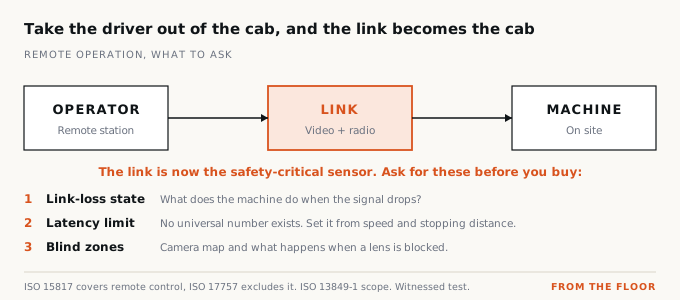
Remote operation takes the driver out of the line of fire but makes the video and radio link the safety-critical sensor; the evidence for link-loss behavior is a witnessed test, not a brochure.
Remote and teleoperated heavy equipment is spreading in mining, quarrying, demolition and hazardous clearing work. The appeal is real. A person who is not in the cab is not under the highwall, not beside the unstable load, not in the dust and heat.
That removes one exposure and creates another. In a conventional machine, the operator’s eyes and body are the sensors. In a remote one, a camera, an encoder and a radio are. The link carries the picture the operator decides from and the command that makes the machine stop. If it degrades, the human is still trusted, but the information is not.
The claim: the question to ask before adopting teleoperation is what the machine does on link loss, a latency spike or a covered camera. The answer you can rely on is a witnessed test on your site, not a supplier’s description.
Remote is not autonomous, and the standards treat them differently
This distinction trips up buyers. ISO 17757:2019, “Earth-moving machinery and mining, Autonomous and semi-autonomous machine system safety,” covers autonomous and semi-autonomous machines and their systems in earth-moving and mining. According to ISO’s own page, it is not applicable to remote control capability. That falls under ISO 15817:2012, “Earth-moving machinery, Safety requirements for remote operator control systems,” which ISO says does not apply to autonomous control systems.
So if a supplier says the machine “complies with the autonomy standard,” that tells you nothing about a human driving it from a screen. The ISO abstract for 15817 that I could read does not say whether it specifies loss-of-signal behavior, and I did not read the full text. Ask for the clause, not the claim.
The functional safety frame
The general machinery standard for control reliability is ISO 13849-1, “Safety of machinery, Safety-related parts of control systems, Part 1: General principles for design.” Its 2023 edition gives a method for designing safety-related control functions, and it uses performance levels. By its own scope it does not define the safety functions or required performance levels for any specific application. That decision is made by a risk assessment.
For teleoperation, the practical consequence is simple. “Stop on link loss” is a safety function. Someone should have assigned it a required performance level, shown how the design meets it, and be able to show you the working. The wider frame is IEC 61508-1, the basic functional safety standard for electrical, electronic and programmable electronic systems. I am citing these by number and scope only. Neither tells you what a good number is, and neither substitutes for a test.
What the regulator gives you
For US federal OSHA, I did not find a general industry or construction rule that sets link-loss or latency requirements for remote-operated mobile equipment, and I am not citing one. What remains is the General Duty Clause, section 5(a)(1) of the OSH Act: employers must provide a place of employment free from recognized hazards that are causing or likely to cause death or serious physical harm. Whether a machine that keeps moving after it loses its operator counts as a recognized hazard under that clause is a legal question I am not answering. I also did not verify any MSHA rule on remote-controlled mining machines, so I leave that out. Outside the United States, the rules differ.
The latency number that does not exist
I found no primary source that sets a universal maximum latency for teleoperated heavy equipment. A figure quoted as industry standard is a figure to ask about. The tolerable delay depends on speed and stopping distance. A machine creeping at walking pace can absorb more lag than one tramming at speed. The site has to set the number from the machine’s own stopping distance, the clearance to people and structures, and the worst latency the link shows under load.
Research on this problem is older than the current product wave. A US Bureau of Mines report in the NIOSH repository, RI 9545, “Teleoperation of a Compact Loader-Trammer” (1994/95), found operators struggled to see obstacles and judge loading beyond about 60 m (200 ft) underground without camera support. It is a historical study of a different technology, so use it as a reminder that the picture is the weak point, not as a design basis.
The diagnostic
The diagnostic
For any remote or teleoperated machine, write five things on one page: the link-loss state (what the machine does, in what time, and what it cannot do), the maximum tolerated latency and who set it, the stopping distance at working speed and at maximum speed, a camera blind-zone map showing what the operator cannot see, and the clearance rule for people on foot. Then watch the trial yourself: cut the link at speed, inject delay, cover a camera, and time the stop against the page. Do not accept a document in place of the observation. When the link drops mid-travel, did you see the machine stop where the page says it will?