The Charging Room Is Gone. The Hazard Moved to the Fuelling Bay.
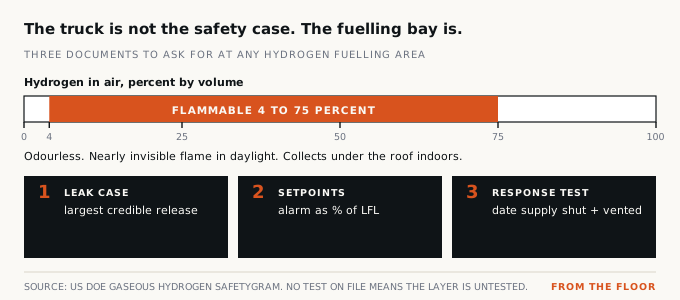
The safety of a hydrogen forklift fleet is set by the fuelling area's detection-and-response design, not by the truck: ask for the documented largest credible release, the detector alarm setpoints as a percent of the lower flammable limit, and the date a response test last shut the supply and ventilated the space; if no such test exists, that layer is untested.
Fuel-cell industrial trucks keep arriving in distribution centers for a simple reason. They swap a battery room for a fuelling point, and the truck does not slow down as the charge falls. The charging room, with its racks, chargers and long dwell times, goes away.
The hazard does not go away. It moves. This piece is about where it moves to, what the evidence says about it, and what is still unproven. Incident data is thin, fleets are growing, and the two facts do not cancel each other out.
What does not change about hydrogen
Three properties drive the whole safety case. The US Department of Energy’s gaseous hydrogen safetygram lists them plainly.
| Property | What the DOE safetygram says |
|---|---|
| Flammable range | 4 to 75 percent by volume in air |
| Odor | None. You cannot smell a leak |
| Flame | Burns with an “almost invisible flame” |
| Ignition energy | ”Extremely low” |
DOE’s hydrogen safety overview adds the practical consequence: leak detection, ventilation and flame detection are design elements, not extras.
The same sources also describe hydrogen as dispersing quickly when released. That helps outdoors. Indoors, under a roof, the safetygram says to ventilate especially near roof areas where hydrogen can collect. A warehouse bay has a ceiling.
So the truck is not the main variable. A sealed, listed, well-maintained truck still gets filled somewhere, and the fill point sits in a building with other people, racking and ignition sources.
Where the rules are thin
Federal OSHA does have a hydrogen standard, 29 CFR 1910.103. It sets location rules by contained volume and ventilation requirements for rooms and buildings that house gaseous systems. It requires that piping be tested gas tight and that systems be kept in safe operating condition.
Paragraph (b), which covers gaseous systems, does not set a gas-detection requirement. The words detector, sensor and alarm do not appear in it; the only leak test is a one-time gas-tight test after installation, at (b)(1)(vi). It is a siting and ventilation standard. We also did not find an OSHA interpretation letter settling how the standard applies to a truck fuelling point.
The truck rule is 29 CFR 1910.178. Its scope paragraph covers trucks “powered by electric motors or internal combustion engines.” Its fuel handling paragraph, (f), points to national codes for liquid fuels and for liquefied petroleum gas. It does not mention hydrogen. Paragraph (g) is titled “Changing and charging storage batteries,” which is the battery-room rule.
A fuel-cell truck drives an electric motor, so scope is arguable. Fuel handling for it has no named paragraph. That is a reading of the text, not an enforcement position, and an OSHA area office could read it differently.
Industry practice fills the gap through model codes. NFPA 2, the hydrogen technologies code, is described in a DOE-funded sensor program review as requiring hydrogen sensors. The same review says there is no deployment guidance for them. This publication does not reproduce code text. The point is narrower: the rule exists, and how to apply it is left to the designer.
What this is not
Two earlier pieces sit nearby, and this one is different from both. The charging-rule piece is about a battery room written for lead-acid and the thermal-runaway hazard that replaced it. The two gas-detection pieces (sensor density and alarm routing) argue that mapping and ownership decide response speed for toxic and combustible gas in general.
This piece asks a narrower question about a single fuelling area. What is the largest release the design must survive, and has anyone ever proved the response works?
What the evidence shows, and its limits
The record is real but small and old.
A DOE program record counted 6,087 fuel-cell material handling units deployed or on order in the US by October 2013, with the industry figure flagged as provisional. We did not find a current public fleet count.
An NREL evaluation deck from the same period reported that most of its safety reports were minor hydrogen leaks: 217 for the trucks and 82 for the infrastructure, mainly from compressor and plumbing. That is a count of reports from a DOE-funded cohort, not an injury rate. It tells you where leaks happen: the fuelling side.
Sandia and SRI tested releases and ignitions in a scaled warehouse-type enclosure, including ventilation and pressure relief mitigation. The public abstract reports no results, so this piece does not characterise them.
One entry in the European incident database records a fuel-cell truck fire near the evaporator pad. Sensor readings stayed far below the flammable limit and the cause was never identified. The lesson it hints at is uncomfortable: a small release can ignite below what a room-level sensor would catch. One case proves nothing, but it shows why the unknowns are real.
Sensors themselves are a weak point. The NREL review reports that about one third of sensors tested were out of specification, and that placement is “mostly” intuition. Treat that as a 2018 finding about a test population, not a verdict on any product.
What is unproven
- Whether setpoints and sensor positions chosen at commissioning still work after racking moves, ceilings change or a bay is reconfigured.
- How often a real shutdown-and-ventilate sequence succeeds on first demand. Public data on this is not found.
- Whether a small ignitable release near the truck is caught by area detection at all.
- Whether current fleet-scale incident reporting is complete. Most evidence is from supported early cohorts.
Ask for three things
The question to put to the people who run the fuelling area has nothing to do with the truck. Ask for the design basis.
The diagnostic
For each site with hydrogen trucks, request three documents from the person who owns the fuelling area. First, the leak case: the largest credible release the design assumes, with the room volume and ventilation rate it was calculated against. Second, the detector setpoints, stated as a percent of the lower flammable limit (for scale, 25 percent of a 4 percent limit is 1 percent by volume; that is an illustration, not a requirement). Third, the record of the last functional test in which a simulated alarm actually closed the hydrogen supply and started ventilation, with the date, the elapsed time and the name of the person who responded. A bump test of a sensor does not count. If no response test exists, treat the layer as untested, and say so in the risk register. When did an alarm last shut off the hydrogen and start the fans at your fuelling area, and who walked to the bay?
Hydrogen fleets may well turn out safer than the batteries they replace. The case is plausible and the data cannot yet prove it. Until a response test has been run, the claim rests on design intent, and design intent is not evidence.