The Alarm Test Proves It Sounds, Not That It Is Heard
A routine alarm test shows the alarm sounds; only a level measurement against measured noise at the worst location shows a worker in hearing protection can perceive it.
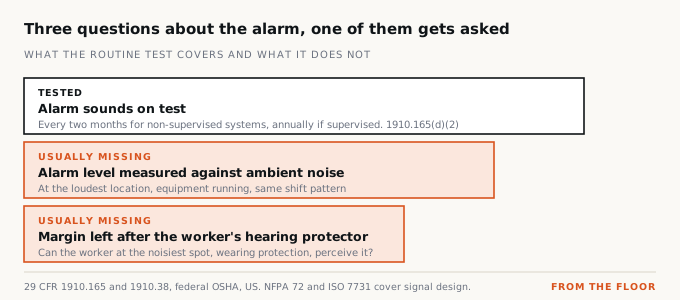
Most sites can show a log of alarm tests. Few can show a number for how much louder the alarm is than the noise at the loudest machine. The first record proves the alarm sounds. Only the second says whether a worker standing there, wearing hearing protection, can perceive it.
This piece is about perception, not about how long evacuation takes or how well people rehearse. Those are separate questions. If the alarm is not perceived at a location, neither matters there.
What the rule actually asks for
Under US federal OSHA general industry rules, 29 CFR 1910.165 applies to emergency employee alarms installed to meet a particular OSHA standard. Paragraph (b)(2) requires the alarm to be capable of being perceived above ambient noise or light levels by all employees in the affected portions of the workplace. It allows tactile devices for employees who could not otherwise recognize an audible or visual alarm. Paragraph (b)(3) requires a distinctive signal.
The standard sets no decibel figure. It sets an outcome: perceived above ambient, by all employees. Outcomes have to be demonstrated, and a horn sounding in a quiet corridor demonstrates nothing about a press line.
Now read the testing paragraph. Paragraph (d)(2) requires a test of the “reliability and adequacy” of non-supervised alarm systems every two months, and (d)(4) requires supervised systems to be tested at least annually. Paragraph (c)(2) requires restoring the system to normal operating condition after each test. Those paragraphs are about whether the system works. The word “adequacy” is the one doing the work, and a function test does not answer it.
29 CFR 1910.38 requires an employer’s emergency action plan to include an employee alarm system that meets 1910.165. So the audibility duty runs through the plan, not around it. This is US federal OSHA general industry only. Other jurisdictions word this differently.
Where the hearing protector enters
29 CFR 1910.95 requires employers to evaluate hearing protector attenuation for the specific noise environments. It is a hearing-conservation rule. It says nothing I could find about warning signals, so the two duties meet only on the floor, in the worker’s ear.
The evidence on that meeting point is thin and old. A NIOSH-published conference paper by Suter (1989) summarized that protectors distorted signal detection most when noise was low to moderate, when wearers already had hearing loss, and when a danger signal was unexpected and mixed with other noise. That is a proceedings paper, not a peer-reviewed study, and I did not find a current NIOSH or OSHA statement that quantifies the effect for a given alarm. Treat it as a reason to measure, not a number to plan with.
One caution runs the other way. A loud site is not automatically a safe-for-hearing-protection-and-alarm site, and a quiet-ish area is not automatically fine. The protector changes the signal and the noise by different amounts at different frequencies. That is why one A-weighted reading is a screen, not an answer.
Why the test cannot answer the question
A routine test is usually run when the plant is quiet, or by someone standing near a panel, or with a listener who is not wearing protection. Each of those choices is reasonable for checking that a circuit works. Each makes the result useless for audibility. The same alarm, at the same output, has a different margin at 6 a.m. with the line idle and at 2 p.m. with every machine running.
That gives the claim its falsifiable edge. If your site has never recorded an alarm level and an ambient level at the same point, with equipment running, then you have no evidence that (b)(2) is met at that point. You have an assumption that passed a function check. An auditor who reads the test log can confirm the test happened. They cannot confirm from it that anyone could hear.
Expect some uncomfortable results. Compressor rooms, press and stamping areas, grinding bays, and spaces behind enclosures are the usual candidates, but I would not guess: measure. A finding of no margin is not a failure of the test program. It is the first honest data the program has produced.
What the standards for signal design add
The design-side reference is ISO 7731 (2003), which covers the physical design principles, ergonomic requirements and test methods for auditory danger signals in public and work areas. Buy and read it before you set any target. I am not printing its margins because I could not read the paywalled text.
The same applies to NFPA 72, which sets audibility levels for fire alarm notification above ambient noise in building systems. The figures and the averaging and duration conditions are in the code. I could not confirm them from a primary page, so read the current edition and do not work from a remembered number. Neither document is a substitute for the 1910.165 outcome test. They are sources for what a defensible margin looks like.
Measuring the attenuation honestly
The label rating on a protector is a laboratory number. OSHA’s fit-testing bulletin reports NIOSH’s statement that the labeled rating is rarely achieved in real workplaces. It also reports that NIOSH’s 2025 update favors individual fit testing over rating-derating methods. I will not tell you a derating formula. Use the manufacturer’s octave-band attenuation data with care, and prefer measured personal attenuation where you have it.
The diagnostic
This week, pick the five noisiest locations with equipment running at normal load. At each one, with the alarm off, record ambient noise at the head height of a worker (A-weighted, with octave bands where your meter allows). Sound the alarm and record its level at the same point. Subtract to get the margin. Where the margin is small, repeat in octave bands and compare against the attenuation data for the protector actually worn there. List every location with no margin, then fix the alarm (more devices, different tone, visual or tactile backup) before you write the next test log. Then ask: at which location could a worker in the protector we actually issue miss our alarm, and what number proves they could not?