The Tag Certifies the Cylinder. Nobody Certified the Person Holding It.
Count the extinguishers with a current inspection tag, then count the named, designated users with a dated hands-on session in the last 12 months. If the two numbers diverge, the programme certifies hardware, not response.
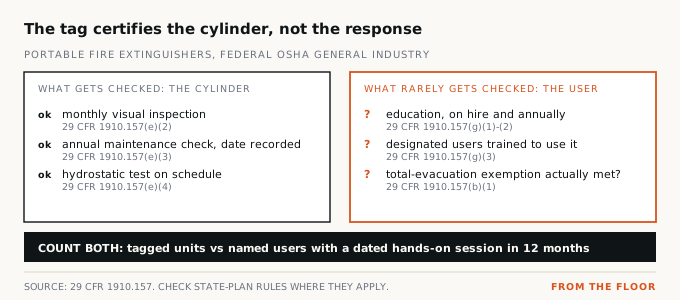
Walk any plant and the extinguishers look immaculate. Pins sealed, gauges in the green, a tag showing this month’s initials and this year’s annual service. It is the most thoroughly inspected safety asset on the floor.
Now ask who is supposed to pick one up, and when that person last discharged one. The silence is the finding.
Two duties that get audited as one
Federal OSHA, general industry, 29 CFR 1910.157 puts two different obligations on the employer, and they have different owners and different evidence.
The hardware duty. Extinguishers must be kept fully charged, operable and in their designated places (c)(4). The employer is responsible for inspection, maintenance and testing (e)(1). Extinguishers are visually inspected monthly (e)(2). They get an annual maintenance check, and the employer records the annual maintenance date and keeps that record for one year after the last entry or the life of the shell, whichever is less (e)(3). Stored pressure dry chemical units that need a 12 year hydrostatic test are emptied and maintained every 6 years (e)(4). Note what the text asks for: a record of the annual date. The tag on the cylinder is the common way to show it, and the practice is widespread, but the tag itself is not what the paragraph quotes.
The people duty. Where the employer has provided extinguishers for employee use, it must also provide an educational program to familiarize employees with the general principles of extinguisher use and the hazards of incipient stage fire fighting (g)(1), on initial employment and at least annually (g)(2). Employees designated to use fire fighting equipment as part of an emergency action plan must be trained in the use of the equipment (g)(3), on initial assignment and at least annually (g)(4).
The first duty produces a tag. The second produces a roster and a date. Most sites audit only the first because it is visible from the aisle.
The exemptions are narrower than they sound
The usual defence is “we are a total evacuation site.” Read the text. 1910.157(b)(1) exempts the employer from the whole section only where there is a written policy requiring immediate and total evacuation on the alarm, an emergency action plan and fire prevention plan meeting 1910.38 and 1910.39, and extinguishers are not available in the workplace. The last condition matters. A site that has evacuation language in its plan and also mounts extinguishers on every column has not met it. A specific part 1910 standard that requires an extinguisher also defeats the exemption.
The second route, (b)(2), applies where an emergency action plan designates certain employees as the only ones authorized to use the extinguishers and everyone else evacuates. On the text, that exempts the employer from the distribution requirements in paragraph (d), not from the training duties. The exemption does not remove the need to train the people you named. It makes the naming mandatory.
Whichever route a site relies on, it needs a written, current plan that says who may fight a fire and who may not. OSHA has said in an interpretation letter that the decision to fight a fire may not be left up to individual employees but must be spelled out in an emergency action plan, with appropriate training tied to it. That letter has an editing note saying parts were revised to remove information that no longer reflects OSHA policy, so use it for that principle only and check current guidance before leaning on its detail.
What “trained” has been taken to mean
The standard’s word for the general program is education. The word for designated users is training. Neither paragraph says “hands-on” in terms. OSHA’s 1993 letter accepted an annual program that included fighting a live fire with an extinguisher, plus annual classroom sessions with a demonstration, as meeting (g)(1) through (g)(4) for employees who are not fire brigade members. It also said that employees designated as an incipient stage brigade must additionally meet 1910.156. We did not find an OSHA letter that sets a minimum for hands-on content, so this article does not claim the regulation requires it. The argument for it is practical: a person who has never felt discharge duration, range and recoil is making a go or no-go decision on a growing fire for the first time, under stress.
What this teardown is not about
Two neighbouring pieces cover different ground. One deals with whether emergency drills reflect real conditions. Another covers fire protection systems that are impaired without anyone recording it. This one is narrower: the portable extinguisher programme, and the gap between a roster of cylinders and a roster of people.
The failure mode
The tag count and the trained-user count come from different systems. Tags live in a facilities or vendor contract and are rarely missed. Training lives in HR or the safety learning system, usually as a one-time orientation slide, and a designated-user list often does not exist. Nobody is accountable for the ratio between them. The programme reads as healthy because the visible half is.
There is a second cost. An untrained, undesignated employee who grabs an extinguisher anyway is acting outside a plan the employer is required to have written. A designated, trained one is acting inside it. Which would you rather defend after a burn injury?
The diagnostic
For each site, make two lists. List A: every portable extinguisher with a monthly inspection entry in the last 30 days and an annual maintenance date within 12 months. List B: every employee named in the emergency action plan as authorized to use extinguishers, with the date of their most recent hands-on session (discharging a unit or live-fire exercise) within the last 12 months. Check that the plan states who may fight a fire and who must evacuate. Also check that general employees received the (g)(1) education at hire and annually, if extinguishers are provided for their use. Compare the counts, shift by shift, since a day-shift roster does not cover nights. If you rely on a total evacuation exemption, confirm no extinguishers are available at the site. How many extinguishers have a current tag, and how many named users have a dated session in the last 12 months? If the two numbers diverge, the programme certifies hardware.
A current tag is evidence about a cylinder. The evidence about a response is a name and a date.