Ten Languages in a Minute Is Not Training in Ten Languages
Machine translation makes multilingual training cheap, but US federal OSHA tests whether workers understood it, and only a bilingual check plus a target-language comprehension test can show that.
Pushing a toolbox talk, a chemical summary or a training deck into ten languages now takes minutes and almost no money. That is a real gain for multi-site employers with mixed workforces. It also moves the hard part. Producing a translation is cheap. Knowing the workers understood it is not.
This piece covers US federal OSHA only. I did not verify the position of Canadian provincial, UK or EU regulators, so I make no claim about them.
What the regulator actually tests
OSHA’s Training Standards Policy Statement, a memorandum dated April 28, 2010 from the then Assistant Secretary to Regional Administrators, says that training required by OSHA standards “must be presented in a manner that employees can understand.” It says an employer “must instruct its employees using both a language and vocabulary that the employees can understand.” If an employee does not speak or comprehend English, instruction must be in a language the employee can understand. If vocabulary is limited, the training must account for it. If employees are not literate, telling them to read materials will not satisfy the obligation. The memo also tells compliance officers to check and verify that training was provided in a format the workers could understand.
Note the verb. The test is whether the worker understood, not whether a translated document exists. A file in the right language is an input. Comprehension is the outcome.
This is a policy memorandum, not a standard. It states how OSHA reads training duties across its standards. It is still the document an inspector will point to.
What the HazCom text says about language
For hazard communication in US federal OSHA general industry, 29 CFR 1910.1200(h) requires “effective information and training” on hazardous chemicals at initial assignment and when a new chemical hazard is introduced. The word “effective” carries the weight, and the 2010 memo is how OSHA reads it.
On documents, the text is narrower than many assume. Under paragraph (g)(2), the chemical manufacturer or importer must ensure the safety data sheet is in English, and the parenthetical says the employer may keep copies in other languages as well. Workplace labels under (f)(10) must be in English, and employers with workers who speak other languages may add the information in those languages. So the SDS and label rules do not require other languages. They do not excuse training that workers cannot follow, either. Your SDS summary in another language is a training aid, and the training duty is judged on comprehension.
What the evidence on machine translation shows, and what it does not
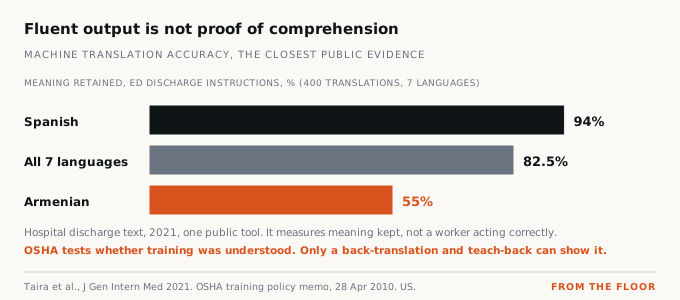
I found one peer-reviewed study that tests this kind of text directly, and it is health-care, not industrial. Taira and colleagues, Journal of General Internal Medicine, 2021, had twenty bilingual volunteers rate a public machine-translation tool on 20 emergency department discharge instruction statements in seven languages, 400 translations in all. Overall, 82.5 percent (330 of 400) retained the overall meaning. By language it ranged from 94 percent for Spanish to 55 percent for Armenian, with Farsi at 67.5 percent. The authors concluded accuracy was inconsistent between languages and should not be relied on for patient instructions. They recommended professionally translated handouts, and an interpreter with teach-back for patient-specific instructions. They also noted their volunteers were long-term US residents who were literate in both languages, so the estimates may be too generous for recent immigrants or people with limited literacy.
Three cautions on using this. It is medical text, not lockout steps. The tool and its successors have changed since it was tested, and I found no equivalent peer-reviewed measurement of current tools on safety content. And the study measured meaning retained, not whether a reader acted correctly afterward.
So the honest position is: I cannot say current tools are inaccurate on your content, and nobody can say they are accurate on it. The error rate is unknown and varies by language, which is the reason to measure it on your own material. Fluent output proves little. A translation can read smoothly and still change a number.
Who is on the other end
BLS Census of Fatal Occupational Injuries, 2024, released February 19, 2026, counted 1,229 fatal work injuries among Hispanic or Latino workers in 2024, a rate of 4.3 per 100,000 full-time equivalent workers. Of those, 842 (68.5 percent) were foreign-born Hispanic or Latino workers. The release does not say which of these workers lacked training in a language they understood, and I will not imply it does. CFOI does not record language of training. The figures show the size of the workforce segment where a translation failure would land, nothing more.
I looked for NIOSH material on non-English-speaking workers and did not verify a specific document to cite, so I leave it out.
The one question
The question is not “which language do we cover.” It is: for the translations we already issued, what evidence do we hold that workers understood them?
The diagnostic
Pick one translated talk in one language, ideally one you already issued. First, have a bilingual competent person who did not produce the translation back-translate it into English, independently, without seeing the original. Second, flag every safety-critical term in the English original: units, numeric thresholds, lockout and verify steps, signal words such as danger and warning. Check each flagged term against the back-translation line by line, and record every mismatch. Third, write five teach-back questions that ask workers to say or show what they would do, for example "what do you check before you remove the lock?" Ask five workers who speak that language, in that language, and score each answer correct or not. Fourth, run the same five questions with a cohort that got the English version and compare. Treat a gap between cohorts, or any wrong answer on a flagged term, as a failed translation to fix before the next talk. Keep the results as your record of comprehension. If you cannot name a bilingual competent person for a language you already train in, how would you know that any workers in that language understood a word of last quarter's training?