Lifting Training Hasn't Been Shown to Prevent Back Injury
Systematic reviews find no demonstrated benefit from lifting-technique training or back belts for preventing back pain, so the lift itself is the control, and the first job is scoring it.
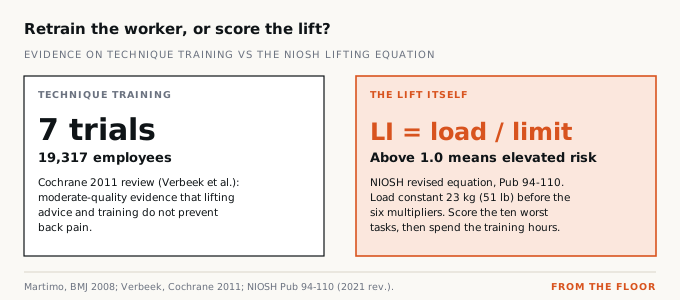
Many sites answer a back injury the same way: retrain the worker on lifting. Bend the knees, keep the back straight, keep the load close. The sessions are cheap to run, easy to document and feel responsible.
The evidence does not show they prevent back injury. That is a narrower claim than “training is harmful” and the difference matters. What the research supports is that the technique session has not been shown to change the injury outcome, and that the characteristics of the lift are where the control sits.
What the reviews found
The 2008 BMJ systematic review by Martimo and colleagues looked at training and lifting equipment for preventing back pain in lifting and handling. Six randomised trials with 17,720 participants met its criteria, and none of the comparisons showed a significant difference. The cohort studies, with 772 participants, also showed no significant results. The authors found no evidence that advice or training in working techniques, with or without lifting equipment, prevents back pain or related disability.
The 2011 Cochrane review by Verbeek and colleagues reached the same place. It reports moderate-quality evidence from seven randomised trials (19,317 employees) that manual material handling advice and training, with or without assistive devices, does not prevent back pain or back-pain-related disability. It also notes that six of the included trials had a high risk of bias and that confidence intervals were wide, so further high-quality studies could narrow the uncertainty.
Read that last point as the authors wrote it. Absence of demonstrated benefit is not proof of no benefit, and neither review shows harm. Training may still earn its place for other reasons: it can help people use the equipment and layout you provide, and it can be a channel for reporting problem tasks. The claim here is only that it should not be your evidence of control.
Back belts
NIOSH’s 1994 back belt review (Publication 94-122) found insufficient evidence that typical industrial belts meaningfully reduce trunk loading during lifting. NIOSH’s summary of later back belt studies states that it found insufficient evidence to recommend belts as a back injury prevention measure, and that later work did not change that view. A 2000 cohort study of retail material handlers found belt use was not associated with reduced back injury claims or low back pain.
The 1994 review also raises two hypotheses, not findings: that long-term belt use might weaken trunk muscles, and that workers might lift heavier loads while wearing a belt. Treat those as questions the research did not settle.
What the evidence points at instead
If technique advice does not move the outcome, the remaining lever is the task. The NIOSH Applications Manual for the Revised Lifting Equation (Publication 94-110, originally 1994, revised September 2021) gives a method. It starts from a load constant of 23 kg (51 lb) and reduces it with multipliers for horizontal distance, vertical height, travel distance, asymmetry, frequency and coupling. The result is the Recommended Weight Limit. Divide the actual load by it and you get the Lifting Index.
The manual says tasks with an index above 1.0 pose an increased risk of lifting-related low back pain for some fraction of the workforce, and that the goal is to design jobs to 1.0 or less. It also says nearly all workers face increased risk above 3.0, and that the shape of the risk function is unknown, so it cannot predict exactly what share of workers is affected at a given index. Do not present a Lifting Index as a pass-fail injury forecast.
The equation has limits. The manual says it does not apply to one-handed lifting, lifting while seated or kneeling, restricted workspaces, unstable loads, lifts combined with carrying, pushing or pulling, or shifts beyond eight hours, among others. Tasks outside those limits need a different assessment, not a forced calculation.
Why the retraining reflex persists
Retraining is attractive because it moves the problem to the person. The fix is visible, quick and inexpensive, and a sign-in sheet exists afterward. Redesigning a task needs capital, engineering time and sometimes a conversation with production. The hierarchy of controls ranks them the other way: changing the work comes before changing the worker.
There is also a measurement trap. Training hours are easy to count, so they become the metric. The Lifting Index is harder to compute, so it goes uncomputed. A site can then report high training completion beside an unchanged injury pattern and read the first as progress. Neither review suggests that completion rate predicts a single fewer back injury.
The regulatory backdrop
In the US, there is no federal OSHA ergonomics standard. Congress used the Congressional Review Act to disapprove the 2001 rule, and OSHA removed it from the CFR effective April 23, 2001. OSHA’s ergonomics FAQ states that employers must keep workplaces free from recognized serious hazards, including ergonomic hazards, under the General Duty Clause, Section 5(a)(1). That is US federal OSHA only; other jurisdictions have specific manual handling rules. Either way, a training record is not a hazard assessment.
The diagnostic
This week, list your top ten manual handling tasks by injury history, near-miss reports and operator complaints. For each, record load weight, horizontal and vertical hand positions at origin and destination, vertical travel, trunk twist, lifts per minute, duration and grip, then complete the NIOSH lifting equation worksheet for it. Rank the tasks by Lifting Index. Next to the ranking, write the training hours spent on each task over the last year. Check any task that is outside the equation's stated limits and assess it another way. Redesign work on the highest-index tasks first: raise or lower the start height, bring the load closer, cut the weight, or split the load. Then ask: where did our training hours go, and does that match the tasks with the highest Lifting Index?