The federal heat rule is still a proposal. Your strictest state rule is not.
List every site by state-plan jurisdiction, then test each site's heat plan against the strictest rule in your footprint. The number of sites that fall short is your budget gap, and it does not depend on what federal OSHA does next.
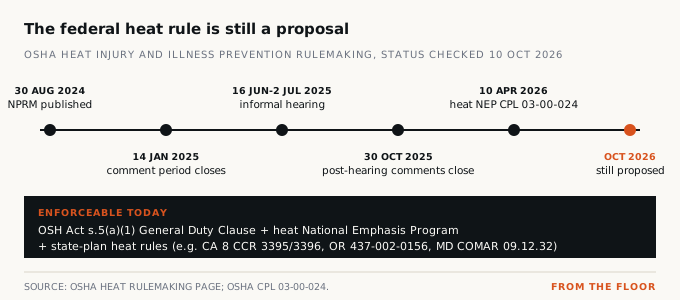
Status line, checked 10 October 2026 (federal OSHA). The heat rule is proposed, not final. OSHA’s rulemaking page records the notice of proposed rulemaking of 30 August 2024, an informal hearing held 16 June to 2 July 2025, and a post-hearing comment period that ended 30 October 2025. That page, as retrieved for this piece, shows no final rule and no withdrawal. The Federal Register and reginfo.gov entries could not be retrieved directly for this piece, so check them before you cite it.
What is verified, and what is only reported
The rule is titled Heat Injury and Illness Prevention in Outdoor and Indoor Work Settings. The dates above come from OSHA itself.
The forward timing comes from trade press, not from an OSHA document that could be read for this piece. Safety+Health magazine reported on 16 September 2026 that the director of OSHA’s Directorate of Standards and Guidance said the agency plans a supplemental notice of proposed rulemaking “in the coming months,” with another comment period to follow. The same report says the latest regulatory agenda anticipated a final rule “sometime late next year,” and quotes the official saying timelines can change. Treat that as a signal, not a schedule.
Here is what that means for planning. A supplemental notice would reopen the text. Whatever you read in the 2024 proposal is not a stable target. Anyone selling you a build to the “final federal rule” today is selling a guess.
The enforcement that exists now
Two things are enforceable without any new rule.
The General Duty Clause. Section 5(a)(1) of the OSH Act requires a workplace free from recognized hazards likely to cause death or serious harm. OSHA’s heat standards page names it as the federal basis today and treats NIOSH heat criteria as recommendations, not a standard.
The heat National Emphasis Program. The revised directive, CPL 03-00-024, took effect 10 April 2026 and is operative for no more than five years unless cancelled or extended. It covers general industry, construction, maritime and agriculture. Its Appendix A lists 55 target industries, and Section XII.A says programmed inspections “shall occur on any day that the NWS has announced a heat warning or advisory for the local area.” An inspector who arrives on a warning day will ask what your program is. If you have a site in a listed industry, your forecast now drives your inspection risk.
The strictest rule in your footprint is the real standard
State plans do not wait for federal OSHA. OSHA’s standards page names heat provisions in California, Colorado (in its agricultural labor rules), Minnesota (indoor places of employment), Oregon and Washington. Maryland adds its own. The ones read directly for this piece differ in ways that matter to a multi-site operator:
| Jurisdiction | Trigger and scope | Notable duty |
|---|---|---|
| California, 8 CCR 3395 (outdoor) | Shade above 80°F; high-heat procedures at 95°F | Close observation of newly assigned employees for first 14 days in high heat areas |
| California, 8 CCR 3396 (indoor) | Applies at 82°F; fuller controls at 87°F, or 82°F with restrictive clothing or high radiant heat | Engineering controls to stay below the targets unless infeasible |
| Oregon, OAR 437-002-0156 | Heat index 80°F indoors or outdoors; high-heat practices at 90°F | Acclimatization plan; re-acclimatize after more than seven days away |
| Maryland, COMAR 09.12.32 (per state summary) | Heat index 80°F, indoors or outdoors; scheduled rests at 90°F and above | Up to 14 days of acclimatization for new or returning workers, with a written schedule |
The specific requirements for Washington, Colorado and Minnesota were not verified beyond what OSHA’s page lists, and Nevada was not verified at all. Do not use this table as a compliance checklist for those states. Read the text.
Why build to the strictest, not the average
A multi-site company usually writes one heat policy and applies it everywhere. There are two ways that goes wrong.
- The policy is written to the federal floor. It passes in states with no heat rule and fails in the states that have one. Each of those sites carries a citation exposure that headquarters cannot see.
- The policy is written to one state’s rule and applied loosely elsewhere. The text says 80°F, the practice says “when it feels hot.”
The cheaper answer is usually a single policy written to the strictest trigger set in the footprint, with a site-specific addendum where a state demands something extra. A rule that exceeds a site’s legal duty costs some shade and water. A rule that falls short costs a citation, or worse. Compliance with the strictest rule is still not safety, but it is a defensible floor to measure real controls against.
The diagnostic
The diagnostic
Build a one-page table with one row per site. Columns: state, state-plan or federal jurisdiction, applicable heat rule (indoor, outdoor, both), lowest trigger temperature or heat index, acclimatization and return-from-absence duty, written plan required, and NEP target industry (yes or no). Mark the row with the strictest trigger set in the company. Then read each site's actual heat plan, not the corporate template, and mark it pass or fail against that strictest row on trigger, shade and water, acclimatization, observation, and emergency response. Count the fails and multiply by the cost to close each one. That count is your budget gap. How many of your sites would fail an inspection on a heat advisory day if the inspector held them to your strictest state's rule?
Do this now, before any federal text moves. If a supplemental proposal appears, you will already know where you stand, and you will be comparing a new text against a tested baseline instead of starting from nothing.
Limits: status checked 10 October 2026 against OSHA’s rulemaking page, the NEP directive, and trade press; confirm against the Federal Register and reginfo.gov before relying on it. State requirements change; read the current text for each jurisdiction.