Your heat thresholds are guarding the wrong week
Pull every heat-illness case on your records and count the days since each worker started or returned. If they cluster in the first week, your thresholds are working on the wrong population, and the site has no rostered ramp-up.
A typical site has a heat plan. It has a trigger, a water point, a shade structure, and a toolbox talk in June. The plan is written for the crew. The person most likely to be hurt is not the crew. It is whoever started Monday.
That is a different problem from the ones we have covered before. “The trigger is the control, not the worker” argues that a measured threshold beats a toughness culture. “The ninety seconds after the wearable goes red” covers what happens once a reading crosses a line. Both assume you know when to act. This piece is about who the threshold is protecting, and who it is quietly failing. The issue is the population at risk, not the trigger.
What the record shows, and what it does not
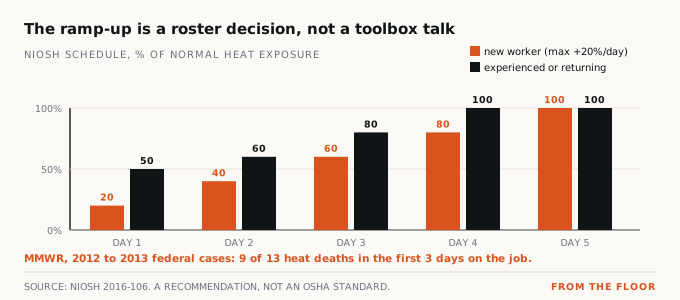
The best public evidence is small, and it should be read that way. A CDC MMWR report on heat illness and death among workers, 2012 to 2013 reviewed OSHA federal enforcement cases cited under the General Duty Clause. It found 20 cases. In 13, a worker died. The report states: “Nine of the deaths occurred in the first 3 days of working on the job, four of them occurring on the worker’s first day.”
Nine of 13 is not a national rate. It is a count from cited federal cases, a sample shaped by which cases OSHA investigated and cited. Treat it as a pattern worth testing on your own data, not a statistic to quote in a board deck. No current OSHA or NIOSH page checked for this piece publishes a cleaner first-week share, so none is claimed here.
The same report found that no provision had been made for acclimatizing new workers at these workplaces. The NIOSH criteria document says the same thing from another angle. Its Executive Summary states that lack of acclimatization is “a major factor associated with worker heat-related illness and death,” and that employers “should have an acclimatization plan for new and returning workers.” The source is NIOSH Publication 2016-106.
What the ramp-up actually is
NIOSH’s acclimatization recommendations give two schedules, both measured as a share of normal work exposure in the heat.
| Worker | Day 1 | Day 2 | Day 3 | Day 4 |
|---|---|---|---|---|
| New | No more than 20% | Add no more than 20% per day | Same | Same |
| Experienced, new to this job or returning | No more than 50% | 60% | 80% | 100% |
NIOSH says workers can keep their acclimatization through a few days away, but “if they are absent for a week or more then there may be a significant loss in the beneficial adaptations,” which can often be regained in 2 to 3 days back in the heat. Oregon’s rule, OAR 437-002-0156, turns that into a trigger for employers: re-acclimatize workers “spending more than seven days away from the job.”
Notice what a schedule is. It is not a training module. It is a roster decision. Day one at 20% means someone else covers the other 80% of the hours and the heaviest tasks. If the roster has no slack, the ramp-up will exist only on paper.
Where the rules put the duty
The jurisdiction matters, so here it is plainly.
- Federal OSHA: There is no final heat standard. The enforceable duty is the General Duty Clause, Section 5(a)(1) of the OSH Act. OSHA’s heat page says workers “will need time to build tolerance (acclimatize…) to the heat” and advises employers to encourage shorter shifts and frequent breaks “during their first few days in warm or hot environments.” That is guidance, not a rule.
- California (Cal/OSHA): 8 CCR 3395 requires a supervisor or designee to closely observe an employee newly assigned to a high heat area “for the first 14 days of the employee’s employment.” Observation is not a graded schedule, but it is a written duty aimed at the first two weeks.
- Oregon: OAR 437-002-0156 requires an acclimatization plan, either the employer’s own or the NIOSH plan in its appendix, and a plan for workers returning from absences of seven or more days.
State plans differ in coverage and detail. Check yours.
Why good thresholds can still miss
A threshold fires on conditions. It does not know who is standing in them. A WBGT reading that is fine for a crew in their third week is not fine for a person on day one, and a work-rest cycle built for the average worker is built for nobody in particular.
Two failure patterns recur on typical sites:
- The Monday start in a hot week. Hiring is driven by project start dates, not forecasts. The new person arrives on the hottest day because that is when the work is.
- The return after time off. Leave, injury, a lay-off between phases, a transfer from an indoor line. These workers are treated as experienced, because they are. They are also unacclimatized.
Neither pattern shows up in a heat-index report. Both show up in an HR roster.
The diagnostic
The diagnostic
Pull every heat-illness case on your records for the last three seasons: first aid, recordables, near misses, medical visits, and any report of dizziness or cramping. For each, subtract the worker's start date, or their last return date after a week or more away, from the date of the event. Bucket the result: days 1 to 3, days 4 to 7, days 8 to 14, later. Then check whether any site has a written, rostered ramp-up that names who covers the reduced hours. If the first-week buckets hold more than their share of cases, or if you cannot compute the date because nobody recorded start or return dates, your thresholds are working on the wrong population. Who, by name, was on their first week in heat last Monday, and what share of normal exposure were they given?
A small count is still a finding. A single serious case on day two is enough to ask why the plan did not see that person. If the dataset is too thin to cluster, run the check forward: list who started or returned this month, and see whether the roster reflects it.
Limits: the NIOSH schedule is a recommendation, not an OSHA standard. The MMWR figures cover 20 federally cited cases in 2012 to 2013. Confirm current state requirements before relying on any provision cited here.