The ninety seconds after the wearable goes red
A physiological monitoring deployment without a written, pay-protected removal rule that names a threshold and an authority will produce fewer alerts over time, not fewer heat casualties. The worker wearing the device controls the signal.
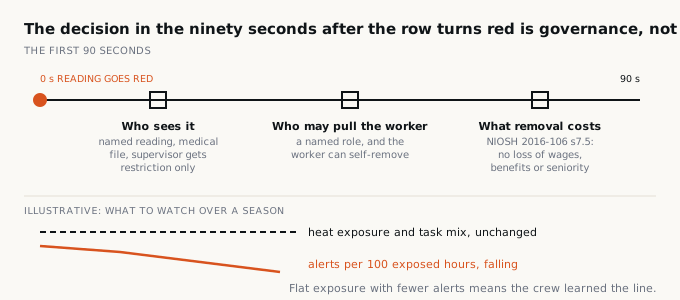
A chest strap on a boilermaker in the fourth hour of a turnaround crosses a threshold. A tablet in the site trailer turns one row amber, then red. The row has a name on it.
Now count ninety seconds. In that window somebody decides whether a specific person stops a specific task, whether the crew loses a body mid-lift, whether the reading gets logged or explained away as a loose strap. That decision has an owner or it does not. That is the whole deployment, and almost none of it is engineering.
The critique that physiological monitoring measures the body instead of fixing the work is well worn, and we have made it here twice. Set it aside. The question is what a program does with an individual reading once it has one. Three things carry that weight, and all three are governance: who sees the reading, who may pull the worker, and what removal costs the worker.
NIOSH already wrote the hard parts
The numbers are not the open question. NIOSH’s Criteria for a Recommended Standard: Occupational Exposure to Heat and Hot Environments (DHHS Publication 2016-106, February 2016) treats physiologic monitoring as an alternative route to its recommended limits, and section 9.4.1 gives a stop rule: oral temperature above 37.5°C (99.5°F), a first recovery pulse count above 110 bpm, or a drop of fewer than 10 bpm from the first to the third recovery count. NIOSH is candid that these are group averages and “may or may not be protective for an individual worker.”
Two other lines get quoted far less and matter far more. Section 9.4 states plainly that physiologic monitoring “requires medical supervision and the consent of the worker.” Section 1.7.3 says that where self-monitoring is used, a workgroup of workers, a responsible healthcare provider and a safety manager should decide the self-monitoring options and the standard operating procedures. NIOSH repeats that structure on its current workplace heat recommendations page, reviewed July 2026. Workers are in the group that sets the rule, not just under it.
Then section 7.5: “Where medical removal or job reassignment is indicated, the affected worker should not suffer loss of wages, benefits, or seniority.”
That is the removal rule, sitting in a NIOSH criteria document for ten years. Most deployments buy the sensor and skip the sentence.
Who is allowed to see the number
A wet bulb globe temperature belongs to a location. A heart rate variability trend belongs to a person, and in the United States that changes the handling. Under Title I of the Americans with Disabilities Act, 29 CFR 1630.14(c) permits a medical examination or inquiry of an employee only when it is “job-related and consistent with business necessity,” and requires that the resulting information be “collected and maintained on separate forms and in separate medical files and be treated as a confidential medical record.” The carve-out for line management is narrow: supervisors may be informed “regarding necessary restrictions on the work or duties of the employee and necessary accommodations.” The EEOC’s enforcement guidance on disability-related inquiries and medical examinations of employees applies that standard.
Read it against a typical dashboard. A supervisor is entitled to know a named worker is off the task for the shift. Holding a rolling chart of that worker’s heart rate is a different thing.
29 CFR 1635.8 adds a genetic information layer: it bars an employer from requesting, requiring or purchasing genetic information, which under GINA includes family medical history, and expressly extends to “medical examinations related to employment.” Enrollment questionnaires drift into family history without anyone intending it.
One caution. The EEOC published a fact sheet specifically on wearables in December 2024. It is no longer discoverable on eeoc.gov and I could not verify whether it was withdrawn, revised or simply unpublished. Treat it as unavailable and build on the regulation and the standing guidance, both still posted. This is United States law, and employment counsel, not a safety team, decides how it applies.
California already built the pay-protected version
The strongest working removal rule in United States law keys to the environment rather than the body, which is why it is instructive. Cal/OSHA’s outdoor standard, 8 CCR 3395(d)(3), says employees “shall be allowed and encouraged” to take a preventative cool-down rest when they feel the need, and that an employee taking one “shall not be ordered back to work until any signs or symptoms of heat illness have abated, but in no event less than 5 minutes.” The indoor standard, 8 CCR 3396, adds a definition with teeth: a cool-down area does not count as one if “employees are deterred or discouraged from accessing or using” it. Discouragement is a compliance defect, not a culture problem.
And the money. Section 3396(d)(3) makes a preventative cool-down rest “the same meaning as ‘recovery period’ in Labor Code subsection 226.7(a),” California’s paid-recovery-period provision. A stated trigger, a named right to self-remove, no cost for using it.
The diagnostic
Pull your written physiological monitoring procedure, or the pilot charter if that is all there is, and find four things on the page: the numeric threshold that triggers removal, the named role with authority to remove, whether the worker may self-remove without that role's approval, and what happens to the worker's pay, hours and productivity metric for the rest of the shift. Then ask one person on the crew who has worn the device: what happens to your day if your band goes red at 2pm? A number and a name back means your alert rate is measuring physiology. A shrug, or the cost of being the one who stopped the lift, means it is measuring willingness to be flagged, and it will fall through the season while your exposure stays where it was.
The federal frame is unsettled, so the rule has to be yours
OSHA’s proposed Heat Injury and Illness Prevention rule was published in the Federal Register on 30 August 2024 under docket OSHA-2021-0009. The informal public hearing concluded on 2 July 2025 and a post-hearing comment period followed. As of this writing no final standard has issued and OSHA has published no timetable, so treat the status as open.
Enforcement is not waiting. OSHA re-signed its heat National Emphasis Program, CPL 03-00-024, on 10 April 2026, effective the same day and operative for up to five years, covering general industry, construction, maritime and agriculture. A program that collects individual physiological data and cannot show what it does when that data goes red is holding evidence it has not acted on.
The people wearing it decide what you learn
The worker controls strap tension, sensor placement, charge state, and the explanation offered when a reading spikes. NIOSH’s own Table 9-1 supplies the alibis: chest strap data is lost “when contact with skin is lost during exertion or excessive sweating,” and an ingestible core temperature sensor may return “only partial shift data if sensor is excreted with bowel movement during the work shift.” Real limitations, and ready explanations for a reading nobody wants recorded.
Adherence is the observable version. A one-year study of 757 workers wearing fitness trackers found that compliance in the second week alone explained 66% of the variance in wearable compliance a year out, and that compliance tracked ease of participation, timely resolution of problems, and whether compensation felt adequate (Martinez et al., JMIR mHealth and uHealth, 2021). That cohort is office workers in a research protocol, not a heat-exposed crew, so read it as a mechanism rather than a rate. Adherence followed what participation cost, and it was set early. An alert that costs a worker hours, or a place on next week’s roster, teaches the crew what the device is for inside a fortnight.
So measure the thing that degrades. Alert counts per hundred exposed hours, by crew and by month, against unchanged WBGT and unchanged task mix. If alerts fall while the work and the weather hold, the deployment has not made anyone cooler. It has taught the crew to stay under the line.