Your Charging Room Is Still Set Up for Acid
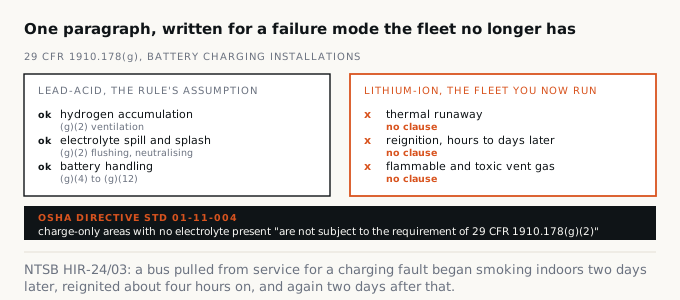
If your battery charging procedure was written for lead-acid and the batteries in the room are now lithium-ion, the site is compliant with a United States OSHA rule aimed at hydrogen and spilled electrolyte while the credible event is thermal runaway, and nothing in the compliance record will flag the mismatch.
Walk into the charging room. The eyewash station is tagged and in date. A neutralizer spill kit sits on the shelf beside a carboy tilter bracket still bolted to the wall. The exhaust fan is interlocked with the chargers. Ten trucks are on charge.
There is not a drop of electrolyte in the room.
The fleet converted to lithium-ion eighteen months ago. The room did not change, because nothing in the compliance file said it had to.
The rule in that room is a lead-acid rule
In the United States, battery charging for powered industrial trucks is federal law at 29 CFR 1910.178(g). Read the clauses, not the summary. Facilities shall be provided “for flushing and neutralizing spilled electrolyte, for fire protection, for protecting charging apparatus from damage by trucks, and for adequate ventilation for dispersal of fumes from gassing batteries.” Elsewhere: check vent caps, prohibit smoking, guard against “open flames, sparks, or electric arcs,” keep metal off uncovered battery tops.
Every control targets a lead-acid failure mode: hydrogen from overcharge, sulfuric acid, an arc across exposed terminals in a hydrogen-rich space. It is a coherent rule about a different battery.
It gets sharper. OSHA’s enforcement directive STD 01-11-004 tells inspectors that charging areas where batteries are charged only, with no maintenance, no battery removal and no electrolyte present, “are not subject to the requirement of 29 CFR 1910.178(g)(2).” The one clause containing the words “fire protection” is the clause OSHA has told its compliance officers does not reach a charge-in-place area with no electrolyte in it. That 1978 directive says nothing about lithium-ion, but it is still posted, and a lithium fleet charging in place is the fact pattern it describes.
What the new fleet does when it fails
Lithium-ion cells fail by thermal runaway: self-sustaining heating that vents flammable and toxic gas, then burns, then can restart. OSHA publishes a lithium-ion battery safety fact sheet describing it. No OSHA standard for the charging area names it.
The clearest picture inside a fleet building is the NTSB’s investigation of a battery electric transit bus fire in Hamden, Connecticut, which also documents non-crash fires at facilities in Indianapolis and Philadelphia. These are buses, not forklifts; the transferable part is the building.
In Hamden a bus began smoking at 3:39 a.m. while parked indoors, two days after being pulled from service for a charging system fault. Staff pushed it outside; two maintenance workers were hospitalized for smoke inhalation. It reignited about four hours later, and again two days after that. In Indianapolis responders applied 750 gallons of water to cool the pack. In Philadelphia sprinklers activated about three minutes after ignition and continuous water controlled it. Probable cause: moisture in the battery system. Contributing to the injuries: no plan for lithium-ion battery fire response. NTSB concluded onboard suppression is unlikely to extinguish such a fire, because the job is cooling with volume. Its earlier safety report on responder risk named what drives repeat events: stranded energy in a damaged pack.
Water is not useless here; the nuance is access and duration. UL Research Institutes’ Fire Safety Research Institute ran water suppression experiments on electric vehicle fires at full state of charge: hose streams struggled to reach cells in runaway inside the pack, responders interrupted runaway in two experiments, and results pointed toward controlling rather than extinguishing. The US Fire Administration puts it plainly: intensive cooling, chemical exposure, reignition after apparent extinguishment.
Chemistry matters, and “lithium-ion” hides it. NIOSH work on runaway pressures in sealed containers found nickel manganese cobalt cells “required more than eight times the amount of free space per cell volume” than iron phosphate cells to stay under a 125 psig containment specification (NIOSH, 2024). That used small cells in mining enclosures, not truck packs: read it as direction, not design input. Severity also rises with state of charge.
Whose standard covers the room? Nobody’s, squarely
OSHA 1910.178(g) is enforceable federal law, nationwide via federal OSHA and state plan states. It is silent on thermal runaway.
OSHA 1910.178(a)(4) says modifications and additions that affect capacity and safe operation “shall not be performed by the customer or user without manufacturers prior written approval,” a requirement OSHA has confirmed, with a de minimis path through a registered professional engineer’s written approval where the manufacturer declines or does not answer. I could not locate an interpretation saying an energy-source swap is a modification under (a)(4). If yours was a retrofit, put that to the manufacturer in writing before an inspector puts it to you.
NFPA 855 is the Standard for the Installation of Stationary Energy Storage Systems, with application keyed to storage technology and aggregate stored energy. I could not verify any clause bringing a truck’s traction battery into its scope. NFPA 505 is the fire safety standard for powered industrial trucks, covering type designations, areas of use, conversions, maintenance and operations. Of the consensus documents it sits closest to a power-source conversion. Neither has legal force unless your authority having jurisdiction adopted it or your insurer wrote it into the policy.
The International Fire Code added Section 320 in its 2024 edition covering storage of lithium-ion and lithium metal batteries, with exceptions including new or refurbished batteries installed in the equipment, devices or vehicles they are designed to power (ICC, Section 320). A traction battery in a truck on charge is not battery storage. And the IFC is a model code, adopted state by state.
The product standards cover equipment, not rooms. UL 583 covers electric-battery-powered industrial trucks for fire, electric shock and explosion. UL 2580 covers electric vehicle batteries. UL 9540A is a test method whose scope states it supports energy storage system installation under NFPA 855, NFPA 70, NFPA 1 and the IFC. None is law, and none tells you how to build the bay.
Nothing in the pipeline closes this. OSHA’s live powered industrial truck rulemaking, the design standard update proposed in February 2022, would refresh design references to current ANSI/ITSDF standards. The word “battery” does not appear in it, and it remains a proposal as far as I can verify.
So the room sits between these documents and inside none of them. What is left in the United States is Section 5(a)(1) of the OSH Act and whatever your insurer asks for. Neither shows up on a checklist.
The diagnostic
Pull the written charging area procedure and compare its last substantive revision date to the date the first lithium-ion truck was energized. Then walk the room with the procedure in hand and sort its controls into two piles: those aimed at a hazard no longer present (eyewash, neutralizer, carboy handling, vent caps, gassing ventilation) and those aimed at thermal runaway (early temperature or gas detection, separation between trucks on charge, a designated outdoor isolation area, a response that says stop charging, evacuate, call, cool, watch for reignition). Then ask: on the day you energized the first lithium-ion truck, what changed in this room, and whose signature is on it? If the answer is a purchase order and nothing else, the conversion was managed as procurement rather than as a change of hazard, and every future audit will keep passing. If it names a revised procedure, a detection spec or a fire department pre-plan, you have a change process that absorbs the next energy source too.
What actually helps
None of it requires a new rule. Treat charging faults as warnings, because Hamden’s was one for two days. Separate trucks on charge. Designate the outdoor isolation area near a hydrant now, not at 3:39 a.m. Brief the fire department on your building and that plan.
Keep the eyewash station if you still handle wet cells anywhere. Just stop reading it as evidence the room is protected. The inspector will check it. Nobody is coming to check the thing that will actually burn.