Line of Fire Is Set Before the Crane Is
Walk the load path on the plan before the lift. If it crosses a route people must use to do their jobs, the exposure is designed in, and no toolbox talk will remove it.
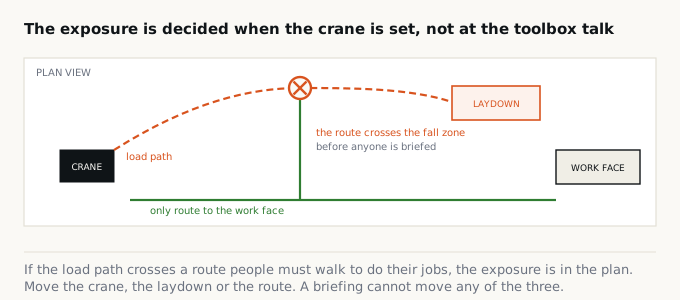
The crane goes where the ground will take it. On a tight site that is usually one patch of compacted fill near the gate, which puts the laydown on the far side of the work face, which means the load swings across the middle. The middle is where the gravel lane runs, the one every crew uses to reach the work face, because it is the only lane that exists.
Then the pre-lift briefing says do not stand under the load. Twenty people sign the sheet. All twenty of them will walk that lane four times before lunch.
Nobody in that sequence is careless. The exposure was created when somebody decided the crane sits there and the steel lands over there. Everything after is people absorbing a geometry problem with attention.
The rule already knows this
Read 29 CFR 1926.1425 in United States construction, Subpart CC, from the top rather than from the part everyone quotes. Paragraph (a) comes first: where available, hoisting routes that minimize the exposure of employees to hoisted loads must be used, to the extent consistent with public safety. That is a routing duty, discharged on a drawing before anybody is on the hook.
Paragraph (b) is the one that gets recited. While the operator is not moving a suspended load, no employee may be within the fall zone, with narrow exceptions for hooking, unhooking, guiding, initial attachment and concrete bucket work. Paragraph (d) limits the fall zone during landing to employees needed to receive the load.
29 CFR 1926.1401 defines the fall zone as the area, including but not limited to the area directly beneath the load, in which it is reasonably foreseeable that partially or completely suspended materials could fall in the event of an accident. That is a swept volume, not a footprint, and its size and position are fixed by where the crane sits and where the load has to go.
So (a) is a design control and (b) is an exclusion control, and the design control is written first. Most sites audit the second. A signature sheet proves the exclusion was announced. Nothing on it tells you whether the routing duty was ever attempted.
What the plan has to show, and what nothing requires it to show
Federal construction rules make you draw exactly one boundary on the ground. 29 CFR 1926.1424 requires control lines, warning lines, railings or similar barriers marking the swing radius hazard area where the rotating superstructure could strike or pinch someone.
That protects the tail swing. It does nothing about the hundred feet of load travel between the pick and the set.
For the load path itself there is no general federal requirement in United States construction for a written lift plan. 29 CFR 1926.1432 requires planning by a qualified person only when more than one crane or derrick supports the load. Ordinary single-crane picks get no such trigger. ASME B30.5 covers the operation of crawler, locomotive and wheel-mounted cranes and is written to sit alongside the local regulator, but it binds you only where a contract or a jurisdiction adopts it.
So the load path drawing is something your organisation chose to produce, or chose not to. Where it exists, read it as a safety document. Four things.
Where the crane is set, and whether it was set for ground bearing or for load path. Those two rarely agree, and ground bearing wins by default.
The laydown and rigging areas, and the straight line between them and the set point. Draw that line yourself if the plan does not.
The routes people must walk during the lift window to reach the work face, the welfare unit and the gang box. Overlay them. The intersections are your exposures.
The tag line plan, meaning where the tagged worker stands through the swing rather than where they start. Subpart CC defines a tagline as a rope for controlling load spin and pendular motion. Its value is distance. Walk the tag hand through the pinch between the laydown and the wall and that value is gone.
For scale: the 2024 Census of Fatal Occupational Injuries recorded 357 United States workers killed by a propelled, falling or suspended object, out of 5,070 fatal work injuries. Lifting is one slice of that, and it is the slice where the hazard is scheduled in advance and drawn on paper.
A Washington State FACE fatality narrative, case 08WA06001, describes a rigger with more than twenty years in the trade steadying a 49,000 pound gantry leg by hand as it came off a trailer. The slings failed and the load fell on him. Among the state’s findings was that a tag line or guide rope should have been used, because it puts the worker further from the load. Experience did not create that exposure. Standing position did, and that followed from the setup.
The diagnostic
Take your next lift plan and trace the load path with a finger, then trace the route your crews walk to the work face. At how many points do those two lines cross, and who decided that was acceptable? If the answer is nobody, the crossing is not a control failure on the day, it is an unreviewed design decision.
The fix is rarely exotic. Move the laydown. Shift the set point twenty feet. Sequence the lift for a window when the route is not in use, and close the route rather than warn about it. Each is cheaper than the exposure, and each has to be decided before the outriggers go down. After that the load path is fixed by physics, and all you have left is asking people to be careful in a place you designed to be dangerous.
Ask for the load path drawing before the crane is set. If there is not one, that is the finding.