The JSA That Was Already Written
A job safety analysis pulled from a binder and signed before the tailgate meeting protects the paperwork, not the crew, when the equipment, the area, or the sequence in front of them today doesn't match the one the form describes.
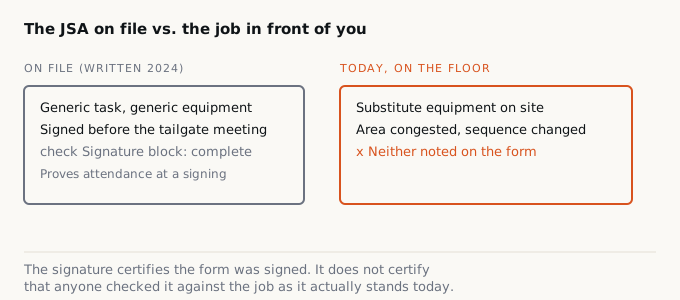
Watch a crew gather for a tailgate meeting and you’ll usually see the same choreography. Someone pulls a laminated sheet or a tablet screen, reads off a task name, and passes around a pen or a stylus. Names get signed. The crew walks to the job. The whole exchange takes ninety seconds, and it produces a document that will hold up in an audit, a client walk-through, or an OSHA inspection. It looks like hazard recognition happened. What it actually recorded is attendance.
That gap matters because a job safety analysis, or job hazard analysis in OSHA’s own terminology, is not supposed to be a form. It’s supposed to be a method: break the job into steps, identify what could hurt someone at each step, and decide what controls that hazard before work starts. OSHA 3071, the agency’s Job Hazard Analysis guide, is explicit that the analysis has to focus on the relationship between the worker, the task, the tools, and the environment as they actually exist for that job, not a generalized version of the task. A JSA written eight months ago for “confined space entry, tank cleaning” and pulled out of a binder today wasn’t built around today’s ventilation setup, today’s substituted equipment, or today’s crew composition. It was built around whatever conditions existed the day someone typed it up.
What a signature actually certifies
A signature block on a JSA form certifies one thing reliably: that a person was present when the sheet was passed around. It does not certify that the person compared the written hazards to the physical scene in front of them, noticed that the scissor lift got swapped for a boom lift, or clocked that a second crew is now working directly below the platform. Those are the details a generic or reused analysis cannot contain, because they didn’t exist when it was written. The form can be word-for-word accurate about the task category and still be silent on the one variable that determines whether someone gets hurt today.
This is where the practice quietly inverts its own purpose. A JSA exists to force a specific kind of attention: look at the job as it is about to happen, not as it was imagined when someone last drafted a template. Human-factors researchers describe this general failure mode as the gap between work-as-imagined and work-as-done, the difference between the version of a task that lives in a procedure and the version that actually unfolds on the floor, with its substitutions, workarounds, and site-specific noise. A stale JSA is a work-as-imagined document wearing a work-as-done signature. The paperwork closes the loop that the walkthrough was supposed to close.
What the standard actually asks for
OSHA doesn’t publish a rule that says “JSAs must be rewritten daily.” What it publishes, in OSHA 3071 and in the agency’s broader Recommended Practices for Safety and Health Programs on hazard identification and assessment, is a description of hazard identification as an ongoing process, one that has to account for new or changing conditions and be revisited when a task, tool, material, or work area changes from what the analysis originally described. A JSA that hasn’t been checked against today’s actual sequence of steps isn’t a lapsed formality. By the agency’s own framing of what a job hazard analysis is for, it has stopped functioning as one.
Monday morning check
Before the crew signs anything, walk the actual task with the JSA in hand and compare it line by line against what's physically in front of you: the equipment, the area congestion, the weather, the sequence. If nothing on that sheet has to change to match what you're looking at, ask **has anyone actually checked, or did the form just get signed again?**
Why the stale sheet keeps winning
Rewriting a JSA for every task variation costs time that a pre-filled template doesn’t. A binder of standing JSAs, or an app library of them, lets a supervisor produce a signed document in the time it takes to read a task name off a work order. That speed is exactly what makes the practice durable: it satisfies the audit trail, it satisfies the client’s site-access paperwork requirement, and it satisfies whatever KPI counts “JSAs completed” as a leading indicator. None of those consumers of the document can tell, from the signature sheet alone, whether the crew actually looked at today’s conditions or just recognized the task title and signed. The incentive structure rewards producing the artifact, not doing the walkthrough that the artifact is supposed to represent.
The failure compounds because a stale JSA doesn’t fail loudly. Most days, the generic version is close enough that nothing goes wrong, which reinforces the shortcut. The exposure sits dormant until the one day the analysis’s assumptions and the day’s actual conditions diverge in a way that matters, a piece of equipment that changes the pinch points, a second crew that changes the drop zone, weather that changes footing. On that day, the signed form is worse than no form, because it creates the appearance that hazard recognition already happened.
What actually holds up
None of this argues against having a written JSA on file, and it doesn’t argue for reinventing the wheel on every routine task. A standing analysis for a stable, unchanging task is legitimate groundwork. The failure point is specific: treating that standing document as sufficient on its own, without a brief, deliberate comparison against today’s actual conditions before the crew signs. That comparison doesn’t need to be long. It needs to be a real look at the equipment on site, the people and traffic in the area, the weather, and whether the sequence changed, followed by a note on the form for anything that doesn’t match, not a fresh essay.
The distinction a supervisor can actually enforce is simple: did the crew sign what they read, or did they sign what they saw. A JSA that reflects the first is a compliance record. A JSA that reflects the second is the hazard-recognition tool it was designed to be. They can look identical on paper. They stop looking identical the first time conditions on the ground have moved and the paperwork hasn’t.