The Three-Year Line Most Forklift Files Never Cross
Refresher training and the triennial performance evaluation are two different obligations under federal OSHA rules, and sites that satisfy one while quietly skipping the other can carry a compliance gap for years without anyone noticing.
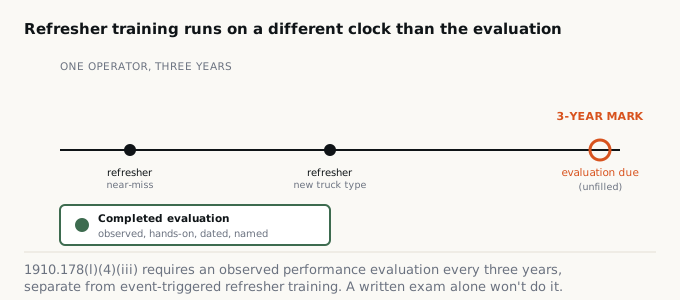
An EHS director pulls the personnel file for a forklift operator ahead of a corporate audit. The file has a training certificate from an online refresher module, completed fourteen months ago after the operator was reassigned to a different truck class. It looks current. It looks clean. Nobody checks the date of the operator’s last performance evaluation, because nobody at the site distinguishes “refresher training” from “evaluation” as two separate obligations. They are not the same thing, they run on different clocks, and federal OSHA has been explicit about the difference since at least 2005.
Two obligations, not one
29 CFR 1910.178(l)(4) covers what the standard calls “Refresher training and evaluation,” and it is worth reading as two separate rules bolted into one paragraph, because that is how OSHA enforces it.
The first rule is 1910.178(l)(4)(i): refresher training, “including an evaluation of the effectiveness of that training,” must be conducted as required by (l)(4)(ii) “to ensure that the operator has the knowledge and skills needed to operate the powered industrial truck safely.” Paragraph (l)(4)(ii) then lists the events that trigger it: the operator has been observed operating unsafely, has been in an accident or near miss, has received an evaluation showing unsafe operation, has been assigned to a different type of truck, or a workplace condition has changed in a way that could affect safe operation. This is event-triggered. No triggering event, no refresher training requirement under this clause.
The second rule sits in its own subsection, (l)(4)(iii), and it reads in full: “An evaluation of each powered industrial truck operator’s performance shall be conducted at least once every three years.” No trigger. No exception for an operator who has had a clean three years with no incidents and no reassignments. The clock runs regardless.
Sites that treat “refresher training” and “the evaluation” as one bucket, satisfied whenever a training record exists, are reading a rule that OSHA wrote as two.
What “evaluation” is supposed to look like
The word “evaluation” does a lot of work in this standard, and OSHA has clarified exactly what it does not mean. In standard interpretation letter 2005-08-01, a questioner asked directly whether a written exam alone, without practical operation of the truck, would satisfy the evaluation requirement. OSHA’s answer: “The ‘evaluation’ of ‘performance’ required by the standard cannot be met by a written exam alone.”
The letter describes what an adequate evaluation looks like in practice: the evaluator observes the operator “during normal operations to determine if the operator is performing safely,” and separately asks questions to confirm the operator “has the knowledge or experience needed to operate a truck safely.” OSHA’s reasoning is that the triennial evaluation exists “to ensure that the operator has retained the necessary knowledge and skills for safe operation of the vehicle,” and a written test, or by extension a self-paced video or e-learning module with a quiz at the end, cannot confirm retained physical skill. It can confirm recall. It cannot confirm that the operator still executes a controlled stop, a load tilt, or a pedestrian check correctly with a truck under them.
This is the gap that swallows a lot of operator files. A completed LMS module generates a clean, dated, easily filed certificate. An observed, hands-on evaluation generates nothing automatically. It requires someone with authority to evaluate, physically present, watching an operator run a truck, and then it requires someone to write that down. Sites with strong training compliance and weak evaluation compliance tend to look identical on paper until you ask the second question: who watched this person operate the truck, and when.
The paper trail OSHA actually wants
The standard does not leave the recordkeeping vague. 1910.178(l)(6) requires the employer to certify that each operator “has been trained and evaluated as required by this paragraph,” and specifies what the certification must contain: “the name of the operator, the date of the training, the date of the evaluation, and the identity of the person(s) performing the training or evaluation.”
Read that list against a typical operator file. Most sites can produce the name and the training date without effort, because that is what the LMS spits out. Fewer can produce a distinct evaluation date and the name of the person who conducted it, because that record has to be created by hand, on a form, after someone actually watched the operator drive. If your file has one date and one certificate covering both “training” and “evaluation,” that is worth treating as a flag rather than a pass, because the regulation is written to expect two dates and, in many cases, two different named participants.
The diagnostic
Pull ten powered industrial truck operator files at random. For each one, look past the training certificate and find a separate, dated record of an observed performance evaluation: one that names who conducted it and describes what was observed, not just a completion timestamp from a training platform. Now check the date on that record against today. The falsifiable question is not whether the operator has a training certificate on file. It is: does every operator have a dated, named, observed performance evaluation record less than three years old, and is that record distinguishable from a training completion certificate? If you cannot answer yes for all ten, you likely have operators who are trained and certified on paper but who have not been evaluated within the interval the standard sets, regardless of how recent their last training session looks.
The fix is not more training. It is a second line item on the recertification calendar, a named evaluator, and a form that records what was watched. That is a smaller lift than most sites assume, and a much smaller one than explaining a three-year gap to a compliance officer holding the same regulation you just read.