The 2036 Ladder Deadline Isn't Gone. It's Only Proposed to Die.
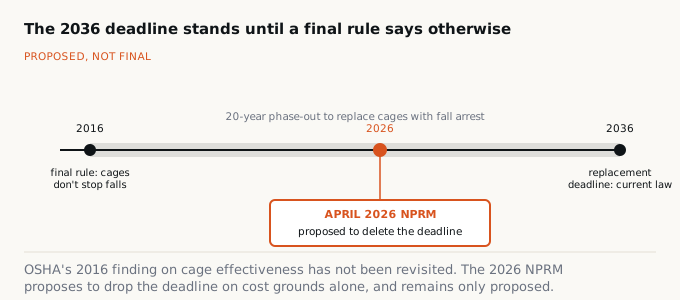
OSHA's own 2016 record found that cages and wells on fixed ladders do not stop a fall. In 2026 the agency proposed to let that acknowledged-inadequate protection stand indefinitely, without revisiting the safety finding, only the cost. As of this writing the 2036 replacement deadline is still current federal law.
A facilities manager tells a multi-site EHS director that the tower ladder retrofits budgeted for 2027 can come off the capital plan. “OSHA killed the 2036 cage rule,” he says. “Read it in a trade newsletter.” The director, juggling forty other line items, takes the note, reallocates the money, and moves on.
Nobody at that company has looked at the actual docket. Nobody has looked at the actual regulation text currently in force. That gap, between what people assume OSHA did and what OSHA has actually done, is where a fall protection program quietly goes soft.
What the rule actually requires, right now
Under 29 CFR 1910.28(b)(9)(i)(D), any fixed ladder that extends more than 24 feet above a lower level and was installed after November 19, 2018 must be equipped with a personal fall arrest system or a ladder safety system. A cage or well alone is not sufficient for new installations. For ladders that already had a cage or well in place, the 2016 final rule gave employers a 20-year phase-out: those existing cages and wells could stay until November 18, 2036, at which point they too would need a personal fall arrest system or ladder safety system.
That deadline is not a proposal. It is the codified text of the standard today, and it remains so as this piece is being written.
Why OSHA set the deadline in the first place
The 2016 rulemaking did not treat cages as a lesser-but-acceptable option. OSHA’s own Walking-Working Surfaces FAQ states the finding plainly: “There is wide recognition that cages and wells do not prevent workers from falling from fixed ladders or protect them from injury if a fall occurs.” A cage does not arrest a fall. A worker who loses grip inside one can still fall the length of the cage and strike the rails or the rungs on the way down. A personal fall arrest system or ladder safety system is designed to stop the fall itself. That distinction, passive containment versus active arrest, is the entire reason the phase-out exists. OSHA gave employers two decades to comply because it estimated that most fixed ladders would reach normal replacement age within that window, not because it doubted the underlying hazard.
What changed in 2026, and what the change actually says
On July 28, 2025, chemical and petroleum industry trade groups petitioned OSHA to repeal the personal fall arrest requirement for existing cage- and well-equipped ladders entirely, or at minimum to eliminate the 2036 deadline. Their filing argued the retrofit cost, more than $1.2 billion across roughly 22,000 ladders by their estimate, was disproportionate to the safety gain.
OSHA responded on April 6, 2026 with a proposed rule that would strike the 2036 deadline from the standard, allowing existing cages and wells to remain in service indefinitely, until a ladder reaches the end of its own service life, rather than by a fixed calendar date. The proposal keeps the requirement for ladders installed or replaced after November 2018 unchanged. Comments closed June 5, 2026, and OSHA held a public hearing beginning August 19, 2026.
Here is the part an EHS director should sit with. The proposal reconsiders the 2016 rule’s assumption about how quickly ladders get replaced through normal capital cycles. It does not reconsider, or even meaningfully re-litigate, the 2016 rule’s finding that cages fail to arrest a fall. OSHA states in the proposal that it “does not have evidence to suggest that removal of the deadline… will significantly impact the safety benefits,” and then asks the public to submit evidence on “whether cages and wells provide equivalent safety outcomes compared to personal fall arrest systems or ladder safety systems.” In other words, the agency that built an entire regulatory finding on cages being inadequate is now treating that inadequacy as an open question, on the record, while the removal of the compliance date is driven by cost data supplied by the regulated industry, not by a new safety analysis.
That may still be the right policy call. Retrofit cost and ladder condition are legitimate variables. But “OSHA reconsidered the pace of a deadline” and “OSHA reconsidered whether cages are safe” are two different claims, and the trade press coverage of this story has mostly collapsed them into one.
Where the docket stands as of this writing
As of this writing, no final rule has been published. The comment period closed and a hearing was held in August 2026; the rulemaking record has not closed and OSHA has not issued a final action. The current, binding text of 1910.28(b)(9)(i)(D) still carries the November 18, 2036 deadline. An employer that stops planning for that deadline based on a headline about the proposal is making a bet on an outcome that has not happened, while remaining, today, fully subject to the rule as written. Falls remain a leading cause of fatal workplace injury: the Bureau of Labor Statistics recorded 844 fatal falls, slips, and trips in 2024, down from 885 in 2023, with roughly 11 percent of those falls from a height over 30 feet, per the BLS Census of Fatal Occupational Injuries. Fixed ladders over 24 feet sit squarely inside that exposure band.
The diagnostic
Pull your site's fixed-ladder inventory and isolate every ladder over 24 feet. Tally how many rely on a cage or well alone versus a personal fall arrest system or ladder safety system, and separately confirm who owns the actual docket status of this rulemaking, not the trade newsletter summary of it. If your capital plan has already dropped the 2036 retrofits, ask the person who made that call: are you relying on a final rule that exists, or on one you expect to exist?
The honest answer, for most sites checked today, will be that the deadline is still the law and the rollback is still a proposal. Plan capital and program timelines to the regulation that is actually in force, and revisit the plan when, and if, a final rule changes it.