A year of inspection reports tells you nothing about whether the system was on
Pull last year's fire protection impairment register and total the hours each system was actually out of service. If it is empty or near-empty while maintenance and project records show closed valves and pumps down, your program is measuring scheduled condition, not availability.
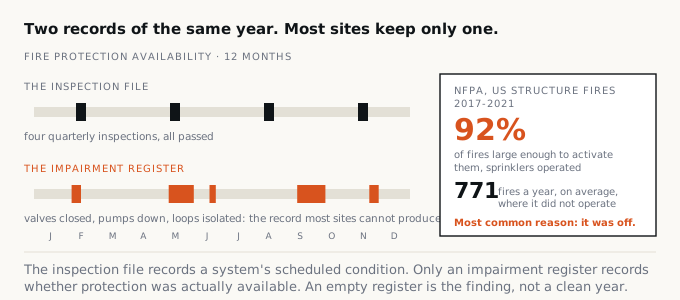
A contractor has to tie a new branch line into the sprinkler main feeding the east half of the warehouse. The control valve gets closed Thursday at 14:00. The tie-in runs long, the fitter leaves at shift end, and nobody wants to charge an unfinished line over the weekend, so the valve stays shut. It reopens Monday at 08:00. Sixty-six hours.
Now go looking for those sixty-six hours in the fire protection file. The quarterly inspection report records the valve as open and sealed. The annual main drain test is signed. The work order says the tie-in is complete. Nothing says half a building sat unprotected across a weekend. The file describes what the system was scheduled to be, not what it was.
Most sites manage fire protection as an inspection contract with a service interval attached. But the dangerous state is not a failed inspection. It is an impairment: a control valve closed for a tie-in, a fire pump pulled for bearing work, a detection loop isolated because construction dust keeps tripping it, a hydrant bagged and forgotten after a paving job.
The record you can produce, and the one you cannot
Ask a well-run plant for twelve months of inspection and testing reports and you will have a binder within the hour. Ask for its impairment register for the same period, with system, start time, end time and hours, and the answer is usually a pause. Sometimes there is a folder of undated tags. Often there is nothing.
Both can be true at once. A site can pass every inspection on schedule and still accumulate hundreds of unprotected hours. Inspection frequency measures diligence. Impairment hours measure exposure.
NFPA 25 already asks for the missing record
NFPA 25, Standard for the Inspection, Testing, and Maintenance of Water-Based Fire Protection Systems, devotes a full chapter to impairments, Chapter 15 in recent editions. It requires the property owner or designated representative to assign an impairment coordinator, and if nobody is named, the owner is the coordinator by default. It separates preplanned impairments from emergency ones such as a burst pipe or a failed pump, and preplanned impairments must be authorized by the coordinator before the system comes out of service.
It also requires a tag showing the system has been removed from service, posted at each fire department connection and at the system control valve. The program has to cover the extent and expected duration of the outage, an inspection of the affected area to determine the increased risk, recommendations to mitigate it, and notification of the fire department, the insurer, the alarm company, the owner, other authorities having jurisdiction, and affected supervisors. When a system is out of service more than ten hours in a twenty-four hour period, the standard requires compensating measures: evacuation of the affected portion, an approved fire watch, a temporary water supply, or an approved program to remove ignition sources and limit fuel. NFPA’s own technical staff set this out plainly, including restoration: confirm the tests, tell the supervisors, tell the fire department, tell the insurer, pull the tags.
Every one of those steps generates a record. A program that runs Chapter 15 properly cannot help but produce an impairment register, because the register is the residue of doing the work. An empty register is not evidence that nothing was impaired. It is evidence that the chapter is not being run.
Check the edition before quoting a clause number. Chapter numbers and thresholds have shifted across editions, and what your authority having jurisdiction enforces is whichever edition it adopted.
Impairment is not deficiency, and sites conflate them constantly
NFPA 25 draws a line most field conversations blur. A noncritical deficiency does not materially affect whether the system will work in a fire. A critical deficiency can. An impairment means the system, or part of it, is out of order such that it may not function at all. NFPA has published the definitions and the difficulty of classifying anything in between.
The classification decides whether a fire watch starts today or a line item drops into next quarter’s repairs. Label a closed control valve a deficiency and you have quietly downgraded an outage into a to-do.
Where this actually bites in the United States
NFPA 25 is a consensus standard, not federal law. It is enforceable where a state or local authority having jurisdiction adopts it, and commonly imposed as a condition of property insurance. Absent adoption, an impairment program is contractually binding rather than federally mandated.
Federal OSHA is narrower but sharper. 29 CFR 1910.159 applies only to sprinkler systems installed to meet a particular OSHA standard, and explicitly exempts sprinklers installed in workplaces but not required by OSHA. Within that scope, paragraph (c)(4) requires an auxiliary water supply or equivalent protection when the automatic water supply is out of service, except for systems of twenty or fewer sprinklers. That is availability logic, written into a federal rule in 1980.
The hot work rule is blunter. 29 CFR 1910.252 lists prohibited areas for cutting and welding, and paragraph (a)(2)(vi)(B) prohibits it in sprinklered buildings while such protection is impaired. Not permitted with extra precautions. Prohibited. The same rule still incorporates NFPA 51B, 1962 edition, by reference, which tells you how settled this is. And 29 CFR 1910.165 at (d)(3) requires back-up means of alarm, runners or telephones, when employee alarm systems are out of service.
These are federal standards; state-plan states run their own, which must be at least as effective. None of them requires a register of outage hours. They require you to behave differently while the system is off, which you cannot do if you do not know it is off.
The consequence shows up in the loss data. NFPA’s analysis of 2017-2021 US structure fires found sprinklers operated in 92 percent of fires large enough to activate them, with an estimated annual average of 771 fires where the system failed to operate, and the most common reason for failure was the system having been shut off before the fire. Not corroded. Not obstructed. Off.
The diagnostic
Ask for two things separately, and do not let anyone merge them. First, the fire protection impairment register for the last twelve months, with system, start time, restore time, and hours. Second, a list from maintenance and projects of every work order in the same period that closed a sprinkler control valve, took a fire pump offline, isolated a detection zone, or removed a hydrant from service. Lay them side by side. Does every outage in the maintenance record appear in the impairment register, with matching hours? If they reconcile, you have a real availability record and can argue about whether the total is acceptable. If maintenance shows outages the register never saw, your inspection program is intact and your impairment program does not exist, and any hot work permit issued during an unlogged outage went out against a prohibition nobody knew applied.
What the register changes
A register turns three questions from opinion into arithmetic. Total unprotected hours per system per year, the only honest denominator for “how protected is this site.” The split between preplanned and emergency outages, which reads on how much exposure is scheduling and how much is asset condition. And mean time to restore, which decides whether your compensating measures are a control or a form somebody signs on the way to lunch.
It also enables one interlock: no hot work permit issues in an area logged as impaired, checked against the register rather than against memory.
A clean twelve months of inspection reports proves your contractor showed up on schedule. It proves nothing about whether the building was protected on any given Tuesday. Those are different claims, and only one of them is about fire.