The Trigger Height Is a Classification, Not a Measurement
In United States workplaces the height at which fall protection becomes mandatory is set by which OSHA standard classifies the task, so any program that publishes one site-wide trigger height is wrong for part of its own work.
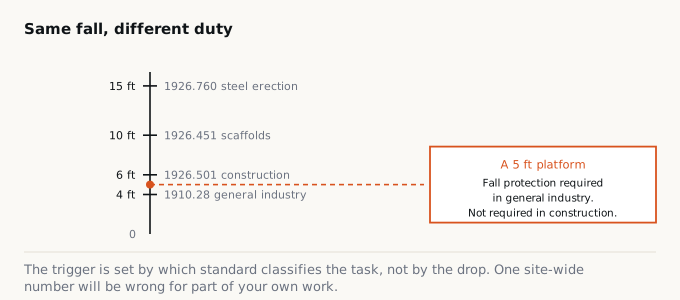
A worker steps onto a platform 8 feet above a concrete floor. Whether the employer must provide fall protection depends on what that platform is called.
In a plant, under United States federal general industry rules, the duty attached 4 feet ago. On a construction site, 2 feet ago. On a scaffold, not yet. During steel erection, not for another 7 feet. Same body, same 8 feet, same floor.
Four standards, four numbers
29 CFR 1910.28(b)(1)(i) requires general industry employers to protect each employee on a walking-working surface with an unprotected side or edge 4 feet or more above a lower level.
Construction sets the same duty at 6 feet. 29 CFR 1926.501(b)(1) covers unprotected sides and edges 6 feet or more above a lower level.
Scaffolds are carved out again. 29 CFR 1926.451(g)(1) requires protection for each employee on a scaffold more than 10 feet above a lower level.
Steel erection goes higher, and the shorthand mangles it. 29 CFR 1926.760(a)(1) sets the general trigger at more than 15 feet. Connectors are handled separately at 1926.760(b): a connector must be protected from fall hazards of more than two stories or 30 feet, whichever is less, and over 15 and up to 30 feet must be provided with a personal fall arrest, positioning device or fall restraint system and wear the equipment needed to tie off. A controlled decking zone may be established only over 15 and up to 30 feet. So 15 feet is not where a connector’s arrest duty begins, only where the duty to carry and wear tie-off equipment does.
All of that is US federal OSHA. State Plan states must be at least as effective, which permits stricter. California is the documented case: Title 8 section 3210(a) requires guardrails on open sides of unenclosed elevated work locations in buildings more than 30 inches above the floor. Thirty inches, not four feet.
The number is not the hazard
Nothing physical changes at these boundaries. A fall from 4 feet is not safer than a fall from 6. In 2024 the Bureau of Labor Statistics counted 666 fatal falls to a lower level among 5,070 fatal work injuries in the United States.
Trigger heights are enforcement thresholds. They encode assumptions about mobility, temporary surfaces and anchorage feasibility. They do not encode survivability.
Both standards concede this where something dangerous sits underneath: there, the duty runs below the trigger height. Section 1910.28(b)(6)(i) requires a guardrail or travel restraint for an employee less than 4 feet above dangerous equipment unless that equipment is covered or guarded. Section 1926.501(b)(8)(i) requires guardrails or equipment guards below 6 feet over dangerous equipment. The slogan is “any height over dangerous equipment.” The text is narrower and more useful: the trigger height stops being a floor when the landing is itself a hazard.
So the first control decision on a mixed site is not “what height” but “which standard classifies this task.” A blanket 6-foot rule is stricter than the scaffold and steel erection triggers and looser than the general industry one. It quietly under-protects the plant maintenance work it was written to cover.
Restraint, arrest, and the part after
Restraint keeps a worker from reaching the edge. Arrest catches the worker afterwards. They sit at different levels of the hierarchy, and the regulations separate them in text: 1910.28(b)(1)(i)(C) lists travel restraint alongside personal fall arrest and positioning, 1926.760(a)(1) lists fall restraint systems, and the Subpart M list at 1926.501(b)(1) names only guardrails, safety nets and personal fall arrest.
A guardrail is passive. It protects the untrained, the tired and the distracted without asking anything of them. A personal fall arrest system is active. It requires the right harness worn correctly, the right anchorage, adequate clearance and a correct connection, every exposure, every person. A guardrail fails once, at design. An arrest system has to succeed every time.
An arrested fall is not a finished incident. 1926.502(d)(20) requires the employer to provide for prompt rescue of employees in the event of a fall, or to assure that employees can rescue themselves. OSHA’s bulletin on suspension trauma and orthostatic intolerance states that research indicates suspension in a fall arrest device can result in unconsciousness followed by death in less than 30 minutes. A rescue plan that is just calling emergency services is a phone number, not a control.
The hierarchy answer does not move when the number moves. Eliminate the need to be at height. Then guard the edge. Then restrain. Then arrest, and only with a rescue someone has actually timed. Classification decides when the law starts caring. It never decides what works.
Monday morning check
Open your fall protection program, find its trigger height, then list the task categories on your largest mixed site: plant maintenance, construction, scaffolds, steel erection. Mark every one where your number is looser than the standard governing it. Then ask which tasks did we classify by the standard, and which by the number we already had?