The eyewash on the wall is not a control until someone has run it
An installed, inspected, unactivated plumbed eyewash fails on water quality, temperature, and flow, and every one of those failures is invisible from the outside. The weekly activation is the control, not the fixture.
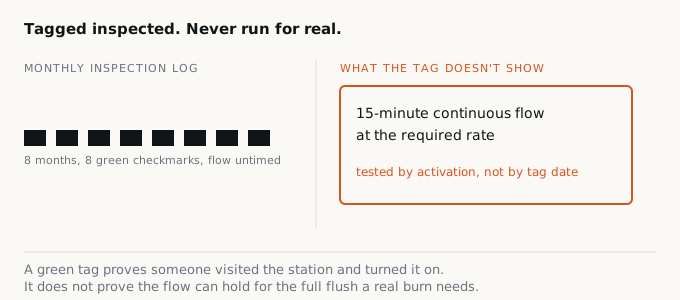
Emergency eyewash equipment is one of the few controls on an industrial site that is judged almost entirely by its presence. It is mounted, it is signed, it is on the inspection walk, and the tag on the side has a tick for this month. On a walkthrough it reads as done.
The problem is that everything that makes an eyewash work sits on the other side of a valve nobody has opened. Water sitting in a dead leg of pipe for months is not the same water that comes out of the main. A unit fed from an uninsulated outdoor line in winter is not delivering what it delivered in September. A strainer slowly loading with scale does not announce itself. None of that is visible on the fixture, and none of it is caught by looking at the fixture. It is caught by running it.
What is actually required, and by whom
The jurisdictional split here matters, because a lot of sites cite the wrong document and end up defending the wrong thing.
In the United States, the mandatory federal requirement is short. 29 CFR 1910.151(c) says that where the eyes or body of any person may be exposed to injurious corrosive materials, “suitable facilities for quick drenching or flushing of the eyes and body shall be provided within the work area for immediate emergency use.” That is the whole of it. The standard does not define suitable, does not set a flow rate, does not set a temperature, and does not set a test frequency.
The detail comes from the consensus standard, ANSI/ISEA Z358.1, maintained by the International Safety Equipment Association. Z358.1 is not incorporated by reference into the OSHA standard and is not itself mandatory. OSHA has been explicit about this and equally explicit about how it uses it: in its interpretation on using Z358.1 as guidance for 1910.151(c), OSHA describes the consensus standard as a source of guidance for determining whether facilities are suitable. In practice that means a unit that badly misses Z358.1 is difficult to defend as suitable, even though Z358.1 compliance is not the citation.
Among the provisions Z358.1 sets, three decide whether the fixture does anything: a flushing duration of 15 minutes, delivery of tepid water (the standard defines this range as 60 to 100 degrees Fahrenheit, roughly 16 to 38 Celsius), and placement reachable within 10 seconds of travel on the same level along an unobstructed path. It also calls for plumbed units to be activated weekly, for long enough to clear the supply line and verify operation, with a fuller inspection annually.
Why the weekly activation is the whole game
Each of the three failure modes is silent.
Water quality. A plumbed eyewash branch is a dead leg. Stagnant water in that branch can carry sediment, scale, and microbial growth. Flushing an eye that has just taken a chemical splash with water off a stagnant line adds an infection risk to a chemical injury, in the one organ least able to tolerate it. The weekly run exists to move that water out.
Temperature. Tepid is not a comfort provision. Water that is too cold makes it nearly impossible for a person to hold their eyes open and stay in the stream for the full 15 minutes, and the flush duration is what actually dilutes the chemical. A person who leaves the fixture at 90 seconds because the water is painful has used a compliant fixture and received an inadequate flush. Water that is too hot can accelerate absorption. Outdoor and unheated locations are where this fails, and it fails seasonally, which is why an annual check in June tells you nothing about February.
Flow and function. Valves seize. Strainers clog. Isolation valves get closed during unrelated maintenance and not reopened. A closed upstream valve is completely invisible at the fixture, and it is one of the more common findings on sites that start activating weekly after years of visual inspection only.
The pattern is consistent: visual inspection confirms the equipment exists, activation confirms the equipment works, and only one of those is a control.
Field check
Pick the three eyewash or drench shower units nearest your highest corrosive-exposure task and run them, in place, for a full cycle while someone times and watches. Ask: does it deliver tepid water at usable flow for a full 15 minutes, does the first water out run clear rather than discoloured, and can a person with their eyes shut reach it in 10 seconds from where the exposure would actually happen? Walk that path yourself with your eyes closed and a hand on a rail, counting. Then check the seasonal case: what does the outdoor or unheated unit deliver in the coldest month, not in the month you inspected. If your records show inspections but no activation duration, temperature, or flow observed, you have a documented fixture and an untested control.
The fixture is cheap and the compliance is easy. The part that decides whether a worker keeps their sight is the 15 minutes of usable water, and the only way to know you have it is to have run it recently enough for the answer to still be true.