The Log Is Now a Public Download
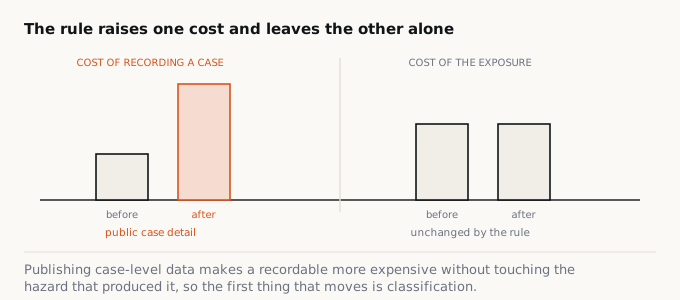
Publishing case-level injury data raises the cost of recording a case and leaves the cost of the exposure untouched, so the first thing that moves at most sites will be classification, not hazard control.
Three obligations, not one
29 CFR 1904.41 holds three separate submission duties, routinely collapsed into one.
Form 300A only: an establishment with 250 or more employees at any time during the previous calendar year, in an industry required to keep records. Also an establishment with 20 to 249 employees in an industry listed in Appendix A to Subpart E.
Case detail: an establishment with 100 or more employees in an industry listed in Appendix B to Subpart E submits information from Forms 300 and 301 as well as the 300A. That is the change made by the final rule published 21 July 2023, which states: “This final rule becomes effective on January 1, 2024.”
Submission on notification: under 1904.41(a)(3), any covered employer must submit records when OSHA notifies it in writing.
Two details decide coverage more often than the industry list does. The threshold is establishment-level, not enterprise-level. And under 1904.41(b)(2), “each individual employed in the establishment at any time during the calendar year counts as one employee, including full-time, part-time, seasonal, and temporary workers.” That is peak headcount across twelve months, not an average. A site that ran a heavy seasonal crew crosses 100 without noticing.
Names are withheld at submission. Paragraph (b)(9) excludes employee name from the 300, and name, address, treating physician and treatment facility from the 301.
2 March, then the download
Paragraph (c) sets one date: 2 March of the year after the calendar year covered. OSHA’s Injury Tracking Application page adds that establishments which miss it must still submit, and can do so until 31 December.
The enforcement clock runs separately. OSHA’s March 2026 non-responder memorandum sets 2 September 2026 as the six-month date to cite CY2025 non-submission, and notes that OSHA “will not create a list of potential non-responders with respect to the Forms 300 and 301 reporting requirements.” The automated pressure is on the summary, not the case detail.
Publication is the point. OSHA posts both files on its ITA data page, and 2025 case detail is downloadable now. Five 301 fields are held back: age, sex, date hired, emergency room treatment, and overnight inpatient admission. The rest, narrative included, is public and tied to a legal company name. OSHA’s own caveat on that page: it “does not validate the employee or injury and illness counts reported by establishments.”
This is a United States federal rule. It reaches State Plan states directly under 1904.41(b)(7), and recordkeeping is the corner where State Plans must be substantially identical rather than merely as effective. OSHA’s adoption table lists adoption as required and records Connecticut, Oregon and the Virgin Islands as non-identical adopters.
What publication actually prices
OSHA’s stated rationale is that sunlight drives improvement. Public case-level access, the agency says, lets employees, customers and the public “make more informed decisions about workplace safety and health at a given establishment,” and “will ultimately result in the reduction of occupational injuries and illnesses.”
Read the rule as a price change and something else falls out. Recording a case now carries a cost it did not carry before: a public line item, attributable, with a narrative attached. The cost of the exposure that produced the case is unchanged. No new abatement duty, nothing tied to the hazard itself.
Raise the price of an output, leave the price of the input alone, and the cheapest response is at the output. Here the output is a judgement: recordable or first aid, restricted duty or days away, work-related or not.
The prediction is testable. If a site’s recordable count falls while first-aid-only volume, restricted-duty cases and near-miss reports stay flat or rise, the number moved and the exposure did not. Hazard control pulls all four down together, with a lag. Reclassification pulls one.
The honest caveat: no OSHA or peer-reviewed evaluation of how case-detail publication changes recording behaviour appears to exist yet, and CY2024 was the first collection year. After a decade of data quality research, BLS concluded its survey “fails to capture some cases” but “could not determine the leading cause of an undercount,” citing a GAO finding of “numerous disincentives for both employers and employees to report a workplace injury.” Grounds to watch the mechanism, not proof it is running.
The standard that holds the line
1904.35(b)(1)(i) requires a reasonable reporting procedure and adds that “a procedure is not reasonable if it would deter or discourage a reasonable employee from accurately reporting.” Paragraph (b)(1)(iv) prohibits discharging or discriminating against an employee for reporting.
Both bind the reporting end. Neither binds classification, which is where this rule’s pressure lands, and which is decided by people who now know the answer gets published. The defensible response is not a lower number. It is a written classification standard applied case by case before anyone looks at the total, and a second review by someone whose performance is not measured by the site’s rate.
Monday morning check
Pull twelve months of case decisions for one site and count four lines side by side: recordables, first-aid-only entries, restricted-duty cases and near-miss reports. Then ask if the recordable line is the only one that moved, what changed, the exposure or the judgement?