Direct-reading dust monitors are a control loop, not a sample
Pull a month of real-time dust traces and match every peak to an action taken. If the peaks generated charts and no work changed, you bought a recorder.
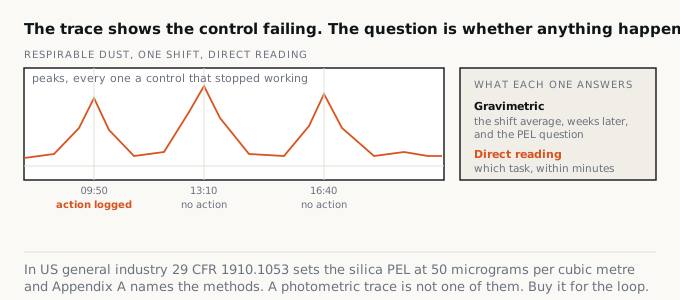
A bagging line runs three shifts. The respirable dust trace from a personal real-time monitor clipped to an operator sits flat through most of the morning, climbs hard for about eleven minutes around 09:50, then settles again. It does the same thing the next day, and the day after. On the fourth day a supervisor stands on the line at 09:48 and watches the answer happen: the changeover includes a hopper purge, the local exhaust hood is swung clear so someone can reach the clamp, and nobody swings it back until the purge is finished.
Nothing about that finding required a laboratory. It required a timestamp.
Direct-reading dust and aerosol instruments, photometers, optical particle counters and personal real-time monitors, have come down far enough in price that they can hang on a crew rather than on a study. What changes is not the accuracy of your exposure numbers. What changes is the latency of your knowledge.
The filter answers a different question
Filter-based sampling is built to characterise a shift. NIOSH Method 0600 draws air through a cyclone onto a pre-weighed PVC membrane and reports respirable particulate by weight gain, with a stated working range of 0.5 to 10 mg/m3 for a 200 litre sample. For crystalline silica, NIOSH Method 7500 ashes and redeposits the sample and reads it by X-ray powder diffraction, which is what allows quartz, cristobalite and tridymite to be told apart.
Both are good at what they do, and both give you one number for a whole shift, after the sample has travelled to a laboratory and been queued. By the time the result lands, the shift it describes is weeks old, the crew has rotated, and the hood is either still swung out or it is not.
A direct-reading instrument gives you a time series instead. It will not tell you the eight hour average to any standard a regulator would accept. It will tell you that something happens between 09:50 and 10:01, every day, on this line. Those are different products, and buying one expecting the other is where deployments go wrong.
What the US standard requires, and what it does not
In the United States, OSHA’s general industry standard for respirable crystalline silica, 29 CFR 1910.1053, sets a permissible exposure limit of 50 µg/m3 as an 8-hour time-weighted average at paragraph (c), and defines an action level of 25 µg/m3 as an 8-hour TWA at paragraph (b). Construction work falls under 29 CFR 1926.1153 instead, with its Table 1 route of specified controls for listed tasks.
Exposure assessment under 1910.1053(d) runs on one of two options. The performance option at (d)(2) lets the employer characterise the 8-hour TWA using any combination of air monitoring data or objective data sufficient to do so accurately. The scheduled monitoring option at (d)(3) requires initial personal breathing zone sampling for each shift, job classification and work area, then repeat monitoring on a fixed clock: within six months where results sit between the action level and the PEL, within three months where they exceed it.
Then comes the provision that decides the question. Paragraph (d)(5) requires that all samples taken to satisfy paragraph (d) be evaluated by a laboratory following Appendix A, which names a closed list of analytical methods: OSHA ID-142, NMAM 7500, NMAM 7602, NMAM 7603, MSHA P-2 and MSHA P-7. Appendix A also requires a quantitative limit of detection no higher than 25 percent of the PEL based on sample air volume.
A photometric trace is not on that list and cannot be put on it. So the honest position, for US general industry, is this: a direct-reading instrument does not settle whether you complied with the PEL. It was never going to.
Why the correction factor is not paperwork
The physics is straightforward and NIOSH has written it down twice. In the NIOSH Manual of Analytical Methods chapter on real-time optical monitors, the response of the sensing element is described as a complex function of particle size, shape, refractive index and the wavelength of light used, with particle density entering the algorithm as well. Because mass is not measured directly, the chapter states that these monitors require calibration for reliable use as mass concentration monitors, and that a factory calibration against a generic test dust does not ensure accuracy in the field with any other aerosol. An earlier NIOSH chapter on aerosol photometers puts a size on the problem: aerosols with different refractive indices can produce responses differing by more than a factor of ten, and at high humidity, water droplets persist long enough to be counted.
The fix NIOSH describes is a correction factor, derived by running the monitor side by side with a filter-based reference sample of the same dust, in the same environment, during a realistic activity, and taking the ratio. The chapter recommends at least three independent tests, treats a spread within 10 to 15 percent of the average as consistent, and advises against setting a field-calibration factor at all if the monitor cannot get inside that spread. It also reports that factory-calibrated monitors can read up to a factor of ten away from paired filter-based gravimetric samples.
Read that as a specification, not a warning. Uncalibrated, the instrument is a reliable detector of change. Calibrated to your dust, it is also a rough estimator of level. Neither is a compliance sample, and both are useful.
The diagnostic
Export the last thirty days of traces from every real-time dust monitor you own, sort by peak concentration and take the top twenty events. For each one, find the record of what happened next: a work order, a hood repair, a changed task sequence, anything dated after the peak. Then answer how many hours passed between the peak and the first action that addressed it? A median measured in hours means the instrument sits inside a control loop and is earning its keep. A median measured in days means the trace is reaching someone with no authority to fix anything, and the problem is routing, not hardware. If most peaks have no action at all, you are paying for a recorder and calling it a monitor.
The metric that justifies the spend
Stop treating time-weighted averages as the output of a real-time programme. The output is time from control failure to control restored, and that is a number you can put on a dashboard and drive down. A quarter where median closure time falls from four days to four hours is a quarter where less dust was inhaled, whether or not a laboratory result moved.
The regulation gives you a second reason to run the loop, at least in US general industry. Paragraph (d)(4) of 1910.1053 requires reassessment whenever a change in production, process, control equipment, personnel or work practices may reasonably be expected to produce new exposures at or above the action level, or when the employer has reason to believe such exposures have occurred. A trace showing that a hood stopped capturing is precisely that kind of reason to believe. The instrument does not replace the sample. It tells you when to take one, and which shift, task and person to take it from, which beats the calendar as a way to spend a sampling budget. Workers can see the display too, which teaches the control during the movement that causes it.
So the buying decision is not photometer versus filter. Keep the filters for the limit, scheduled by 1910.1053(d) and analysed under Appendix A. Add direct-reading instruments where you have a control you already do not trust, and give the trace an owner with a spanner. If nobody on site holds both the trace and the authority to stop the task, do not buy the instrument yet. Buy the escalation path first.