Zero is a vision, not a scoreboard
Attach recognition and pressure to a zero-injury number and you give everyone a reason to keep injuries off the log rather than out of the workplace, so the reported figure can fall while the real risk holds or climbs.
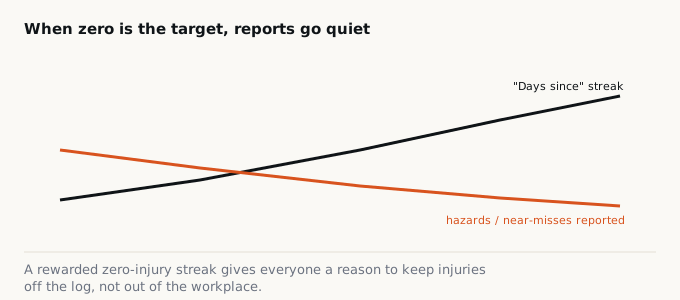
The number on the banner is the number people will manage
Walk into most plants and you will find a sign near the door: so many days since the last recordable. On its own it is harmless. It becomes a problem the moment recognition, bonuses, site-versus-site rankings, or executive attention get bolted onto keeping that count at zero. Do that and you have not told the organization to be safer. You have told it that a recordable is the enemy.
There are two ways to protect the streak. One is to eliminate the hazard that would produce the injury. The other, far cheaper and faster, is to keep the injury off the log: first aid where medical treatment was warranted, “light duty” that quietly substitutes for days away, a supervisor who lets a worker know that reporting will not go well for anyone. The second path moves the number without touching the risk. Under pressure, it is the path many sites drift toward, and they rarely decide to do it on purpose.
Aspiration versus a metric people are held to
The distinction that matters is between an aspiration and a metric with consequences attached. “We want everyone to go home whole” is a value. Nobody games a value. Trouble starts when zero becomes a threshold a bonus, a ranking, or a promotion depends on. That is Goodhart’s problem: once a measure becomes a target, it stops being a good measure. Rare, noisy outcomes like injuries are especially easy to move by changing what gets counted rather than what gets built.
The safety literature has put numbers to this. Sherratt and Dainty, examining UK Health and Safety Executive fatal-accident data against the safety approaches of the largest contractors, found that working under a formal zero program appeared to slightly increase the likelihood of a serious or fatal accident, a result they named the “zero paradox”. Sidney Dekker’s critique runs parallel: hold people accountable for an outcome that is statistically near-impossible and the predictable response is to underreport, reclassify, and manage the numbers while the serious hazards, which are the hardest to drive to zero, get the least attention.
What the regulator actually worries about
OSHA’s recordkeeping rule is built around exactly this failure mode. 29 CFR 1904.35 requires that you “establish a reasonable procedure for employees to report work-related injuries and illnesses,” and it adds that “a procedure is not reasonable if it would deter or discourage a reasonable employee from accurately reporting.” The same section states plainly: “You must not discharge or in any manner discriminate against any employee for reporting a work-related injury or illness.”
In the preamble to that rule, OSHA identified three mechanisms that can be used to punish reporting: disciplinary policies, post-incident drug testing, and incentive programs. A zero-injury bonus is not banned. But if the reward evaporates the moment someone files a recordable, OSHA treats that as adverse action against the reporter. Read that the right way: the agency’s stated concern is that your target will suppress the report.
Point the target at the behavior you want
If you want the banner to help, put a leading indicator on it. Reports filed. Hazards found and closed. Near-misses surfaced. These are things a worker can choose to do more of, and doing more of them is good news. A hazard-report count that jumps in the first months of a new program usually means the channel is finally trusted, not that the plant got more dangerous. Reward the finding, fund the fixing, and let the recordable rate be a quiet lagging output you watch without waving around.
The target test
Look at what happens to the person who reports the injury that breaks the streak. If the honest reporter costs their crew a bonus, drops their site in the ranking, or sets off an investigation aimed at the worker rather than the hazard, your zero target is buying silence. Ask: in the last twelve months, did anyone get recognized for surfacing a hazard or a near-miss, and did anyone quietly pay a price for filing a recordable? If recognition only ever flows toward low numbers and never toward high-quality reporting, the target is working against the people it claims to protect.