A low TRIR isn't a safe site. It's a small number.
Because the recordable rate is a low-count figure shaped by case management and the first-aid line, a falling TRIR can sit right alongside rising fatality exposure, so benchmarking budget to an industry average can steer money away from what kills people.
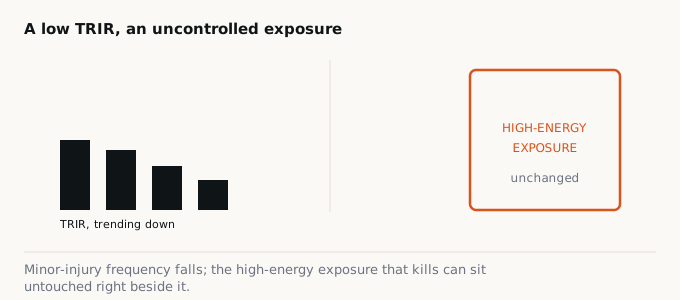
Total Recordable Incident Rate is the number every board understands and almost no board interrogates. It is clean, it benchmarks against an industry average, and a low one feels like proof. It is also one of the easiest numbers in your entire safety program to move without touching the actual risk. Worse, a low TRIR does not predict the event you most need to prevent: the one that kills someone.
That is not cynicism. It is arithmetic and recordkeeping, and both are worth walking through before you tie a budget to a benchmark.
The line that decides everything is drawn by hand
TRIR is built from the OSHA 300 Log, and the log’s central judgment call is one line in 29 CFR 1904.7: is the case medical treatment beyond first aid, or is it first aid? Cross that line and it counts. Stay on the first-aid side and it does not. And 1904.7 defines first aid as a closed, specific list: non-prescription medication at non-prescription strength, wound cleaning, a finger splint, and so on, regardless of who provides it. A physician can deliver a listed treatment and it remains first aid for recordkeeping purposes.
That single boundary hands you enormous discretion, most of it entirely legal. Keep treatment on the first-aid list and the case vanishes from the rate. Manage an injury as restricted duty rather than days away and its character on the log changes. None of this is fraud. It is case management, and it means TRIR reflects how you administer injuries at least as much as how many occur.
Small counts move for reasons that are not safety
Most sites record few cases, so the rate is statistically twitchy. A facility with a handful of recordables a year can swing its TRIR by a large percentage on two or three cases, which is well inside the noise of normal variation and classification choices. When the number is that small, a good year and a lucky year look identical, and both look like the year your program worked.
Now zoom out to the national picture, where the trend is genuinely down. BLS put the 2023 total recordable case rate in private industry at 2.4 per 100 full-time-equivalent workers, among the lowest in the series. A real improvement. And yet the United States recorded 5,283 fatal work injuries in 2023. The frequency of small injuries and the frequency of fatal ones do not track each other. In construction especially, recordable rates have fallen for years while fatality counts have refused to follow.
Why the safe-looking site still has a fatality
The reason is that fatalities and minor injuries come from different physics. The serious-injury-and-fatality body of work starts from a blunt premise: a serious injury or fatality happens when a person contacts a high-energy source, generally on the order of 1,500 joules or more, without a direct control between them and that energy. A twisted ankle and an unguarded 480-volt contact are not points on one severity scale. They are different failure modes with different precursors. Driving down the count of the first tells you almost nothing about your exposure to the second. This is why organizations report their first fatality during their statistically safest year on record. The metric they were steering by was never watching the thing that killed the worker.
The exposure audit
Set TRIR aside and answer a different set of questions with data you can produce this quarter: How many high-energy tasks do we run (electrical, height, mobile equipment, stored energy, traffic)? For those tasks, what fraction have a verified direct control in place, not just a procedure on paper? How many potential-SIF events, high-energy incidents where a control was absent and we got lucky, did we log? If a fatality happened here tomorrow, could you name the uncontrolled high-energy exposure today, or would it be a surprise? If it would be a surprise, your low TRIR is hiding the risk, not managing it.
What to do with the number
Keep TRIR. It is a required record and a legitimate lagging indicator of your low-severity injury frequency. Just stop asking it to be something it is not. Do not benchmark your safety budget to an industry-average TRIR, because the average is built from the same soft classification line and the same small counts, and matching it tells you only that you are ordinary at counting minor injuries. Judge real risk by exposure to high-energy hazards and the presence of controls on them. A low recordable rate is a small number. Whether it is also a safe workplace is a separate question, and TRIR was never designed to answer it.