The trench that was safe yesterday
Cave-in protection is not the trench box in your yard; it is today's competent-person inspection matching the protective system to the soil as it actually is right now.
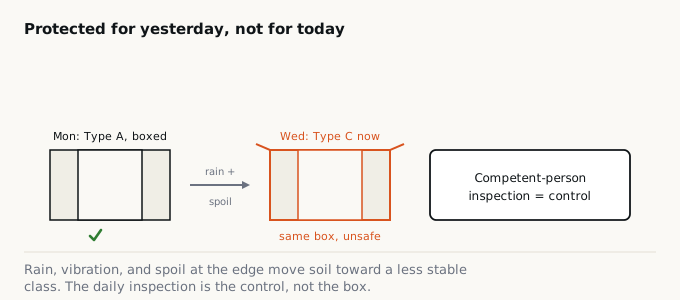
A trench is not a stable object. It is a temporary hole in a material that changes hour to hour, and the protective system that made it safe at 7 a.m. can be worthless by early afternoon. Rain saturates the walls. A passing loader vibrates them. A spoil pile grows at the edge and quietly loads the face. None of that shows up in the equipment log, and none of it is fixed by the fact that you own a trench box. The control is not the box. The control is the person who looks at the ground today and decides what today’s ground needs.
Soil is heavier than anyone standing next to it believes
Cave-ins are so lethal because people misjudge the weight. OSHA’s guidance puts one cubic yard of soil at up to roughly 3,000 pounds, about the weight of a small car, in a volume you could fit on a pallet. A worker buried to the waist is not “stuck” in any recoverable sense; the load on the chest prevents breathing, and coworkers cannot dig fast enough or pull hard enough to beat it. This is why the standard treats prevention, not rescue, as the entire game. You do not get a second attempt.
What Subpart P actually requires
The federal rules live in 29 CFR 1926 Subpart P. Two sections carry most of the weight. 1926.652 sets the trigger: each employee in an excavation “shall be protected from cave-ins by an adequate protective system,” and in practice that protection is required at a depth of five feet or greater unless the excavation is made entirely in stable rock. Below five feet, protection can be waived only where a competent person examines the ground and finds “no indication of a potential cave-in.” Five feet is not a safe depth. It is the depth at which the law stops trusting your judgment to skip protection.
The protective system itself has to match the soil. Subpart P recognizes four categories, classified by a competent person: Stable Rock, Type A, Type B, and Type C, defined in Appendix A by unconfined compressive strength (Type A at 1.5 tons per square foot or greater, Type C at 0.5 tsf or less). The same trench can hold a steep slope in Type A and demand a far flatter cut, or a shield, in Type C. Rain, previously disturbed ground, or water seeping from the face pushes soil toward Type C regardless of what it was yesterday.
The competent person is the actual control
1926.651 names the mechanism that keeps the system matched to reality: the daily inspection. OSHA requires that “daily inspections of excavations, the adjacent areas, and protective systems shall be made by a competent person,” conducted “prior to the start of work and as needed throughout the shift,” and, critically, “after every rainstorm or other hazard increasing occurrence.” A competent person is defined as someone able to identify existing and predictable hazards and “authorized to take prompt corrective measures.” Authority is part of the definition. An inspector who can spot the danger but cannot stop the work is not a competent person under the standard.
The same section handles the quiet killer: spoil. Excavated material and equipment must be kept “at least 2 feet from the edge of excavations,” or restrained. Two feet is a minimum, not a target. Spoil piled at the lip is surcharge load on the trench wall, and it is the change most likely to happen after the morning inspection, when the dirt has nowhere else to go.
Read the trench for today, not for yesterday
The failure pattern is almost never “we had no protection.” It is “we had protection sized for conditions that no longer exist.” A box rated and placed on Monday sits in a trench that took on water Tuesday night and had spoil crowded to the edge Wednesday morning. The paperwork still says protected. The soil says otherwise.
Field check
Walk the trench and ask, for the conditions in front of you right now: has anything changed since the last competent-person inspection that would move this soil toward a less stable class, and does the protective system still match that class today? Check for water in or seeping from the walls, tension cracks at the top edge, spoil or equipment inside the two-foot setback, vibration sources that started after the morning look, and previously disturbed ground. If any answer is yes and the system was sized before that change, the trench is protected for yesterday, not today. Get people out until a competent person re-evaluates the soil and the system.
The trench box in the yard protects no one. The inspection that matches the box to this morning’s soil is the safety. Everything else is a record that looks like safety.