Your '100% trained' dashboard measures clicks, not competence
A completion rate proves people advanced through modules; it does not prove anyone can perform the task safely, and OSHA has said so for decades.
Somewhere in your safety management system is a number you are proud of. It is probably 98 or 99 or, on a good quarter, 100 percent. It is the completion rate for your computer-based training, and it is the first slide you show when someone asks whether the workforce is trained. It is also, on its own, close to meaningless as evidence that anyone can work safely.
A completion rate records one event: a user account advanced through a sequence of screens and, usually, passed a short knowledge check. That is an administrative fact. It tells you the module was assigned, opened, and closed. It does not tell you the person can lock out a machine, don a respirator that seals, or recognize the hazard the module described when it appears on the floor at 2 a.m. Completion is a record. Competence is a demonstration. Confusing the two is the most comfortable error in the field, because the record is easy to produce and the demonstration is not.
OSHA never asked for attendance
The most important thing to understand is that the “seat time equals trained” model is not what the standards require, and the agency has said this plainly. In its 2010 Training Standards Policy Statement, OSHA told its own regional administrators that the terms “train” and “instruct” mean to present information in a manner that employees receiving it are capable of understanding. The memo is explicit that inspectors should look beyond any basic paper documentation; an employer may have training records but employees may not have been able to understand the elements included in the training.
Read that again. The federal position is that a training record and demonstrated understanding are different things, and that the record can exist while the understanding does not. A completion dashboard is exactly the basic paper documentation the memo warns against treating as proof.
The point sharpens inside specific standards. Lockout/tagout, at 29 CFR 1910.147(c)(7)(i), requires the employer to provide training to ensure that the knowledge and skills required for the safe application, usage, and removal of the energy controls are acquired by employees. Acquired, not delivered. The respirator standard at 1910.134(k)(5) requires retraining when inadequacies in the employee’s knowledge or use of the respirator indicate that the employee has not retained the requisite understanding or skill. Both standards assume the employer is measuring whether something stuck, not whether a video finished playing.
What the dashboard cannot see
A module completion cannot distinguish the electrician who genuinely understands stored hydraulic energy from the one who clicked “next” through the animation while eating lunch and then guessed his way to a passing score on a four-question quiz. Both produce the same green checkmark. The dashboard has no view into whether the training was even comprehensible: OSHA’s policy statement is built around the reality that instruction delivered in the wrong language or at the wrong vocabulary level satisfies no standard, no matter how many people completed it.
None of this is an argument against e-learning. Computer-based training is a fine way to deliver information and a reasonable way to test recall of that information. The failure is not the tool. The failure is treating the delivery record as the safety outcome. Recall of a fact and the ability to perform a task under real conditions are different capabilities, and only one of them keeps a hand out of a press.
The click-or-capability test
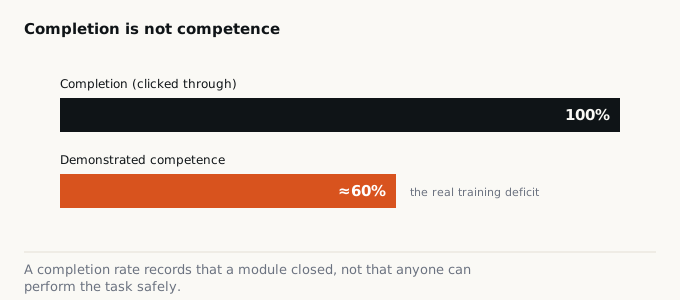
Pick five people who show as "trained" on a specific high-hazard task. Do not open the LMS. Walk to the floor and ask each of them to either perform the task or talk you through it step by step, including the failure modes. If your completion dashboard says 100 percent but you cannot watch a randomly chosen "trained" worker demonstrate the task correctly, what exactly is the number measuring? The gap between the dashboard figure and the demonstration pass rate is your real training deficit.
Measure the thing you actually care about
The fix is not more modules. It is a second number that lives next to the completion rate and is allowed to embarrass it: a demonstrated-competency rate, captured at the task by a qualified observer using a checklist, on a real or realistic setup. For lockout, that means watching the isolation and the verification. For respirators, it means the fit and the user seal check, not the quiz score. This is closer to what the standards already contemplate, and it is the only figure that answers the question the completion rate only pretends to answer.
Keep the dashboard. It is a legitimate administrative record and you need it for recordkeeping. Just stop letting it stand in for capability. A workforce that is 100 percent complete and 60 percent demonstrably competent is not a trained workforce with a paperwork quirk. It is a 60 percent trained workforce with a very good filing system.