The signed roster proves attendance, not awareness
A toolbox-talk signature sheet documents who stood in the room, not whether anyone understood the hazard or that the day's actual risks were named.
The artifact everyone keeps and the outcome nobody checks
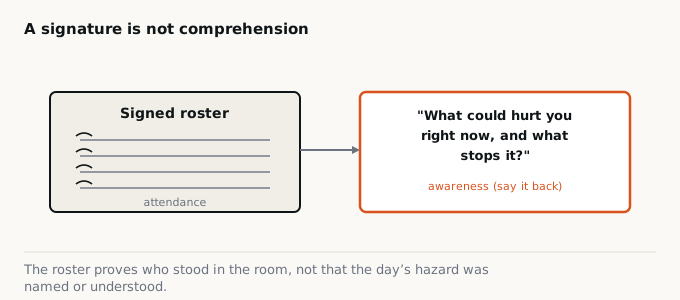
A toolbox talk produces one durable thing: a roster with signatures. It is easy to file, easy to audit, easy to wave at an inspector. That is exactly why it drifts into becoming the point. The signature is evidence that a person stood in a room while words were spoken near them. It is not evidence that the person can now recognize the hazard they are about to work next to, and it is certainly not evidence that the hazard was even mentioned.
Read the verb in the standard
OSHA’s construction training rule is short and specific. 29 CFR 1926.21(b)(2) requires that “the employer shall instruct each employee in the recognition and avoidance of unsafe conditions and the regulations applicable to his work environment.” The operative verb is “instruct,” and its object is “recognition and avoidance.” Neither word is “attend” and neither is “sign.” The standard sets an outcome, a worker who can recognize and avoid a hazard, and a roster measures none of it. You can satisfy the paperwork and miss the standard entirely.
How the ritual forms
Generic and repeated is how a briefing dies. A card titled “Slips, Trips, and Falls,” read aloud for the fortieth time to a crew that is about to do a confined-space entry, addresses a hazard nobody in the room will meet that shift. Everyone knows it. So attention leaves, the reader speeds up, the sheet goes around, and the meeting’s real function becomes collecting signatures before the actual work starts. The talk and the work have quietly divorced. What remains is a compliance artifact that runs on a schedule of its own, disconnected from the tasks it was supposed to be about.
What turns a talk into a control
A pre-task briefing earns the word “control” only when it has three properties.
It is task-specific and built from the day’s actual work. OSHA’s own guidance on job hazard analysis tells you to identify the hazards “before a job begins and at each step in the job.” A briefing assembled from that breakdown names the energy sources, the pinch points, and the exposures the crew will touch in the next few hours. A briefing pulled from a generic card names none of them.
It is tied to this shift’s conditions. A crew short a person, the weather, the adjacent contractor, the one valve that is still live: these change the hazard, and they change every day. A talk that would read identically yesterday and tomorrow is not describing today.
It is two-way. This is the property a signature sheet actively hides. A briefing is an administrative control, and NIOSH ranks that tier among the least reliable precisely because it “require[s] significant and ongoing effort by workers and their supervisors” and depends on human behavior rather than a physical barrier (hierarchy of controls). An administrative control that is delivered but not absorbed controls nothing. The only way to know it was absorbed is to ask the worker and hear it back.
The say-it-back check
Walk up to a worker two hours into a shift, after the toolbox talk, and ask: what is the single worst thing that can happen on the task you are doing right now, and what is protecting you from it? If a worker who signed this morning's sheet cannot name the hazard and its control, the talk filled a binder and changed nothing. If most of your crew can answer without hesitation, and their answers match the actual task, the briefing is doing its job.
Keep the record, change the meeting
The roster is fine as a record. It becomes a problem the moment it becomes the goal. Two low-cost changes break the ritual. Build the talk from the specific tasks on the schedule, not from a stack of evergreen cards, so the content is about work that is actually happening. And close every briefing by having a worker, not the supervisor, state the top hazard and the control in their own words. That single habit converts a monologue into a check, and a signature into evidence that recognition, the thing the standard actually requires, was present in the room. Attendance you can prove with a pen. Awareness you can only prove by listening.