A stop-work program with zero stoppages is the warning
Stop-work authority written into a policy is not a control; the only evidence it is real is that people actually invoke it and pay no lasting cost when they do, so a clean record of zero stoppages is a warning sign, not a trophy.
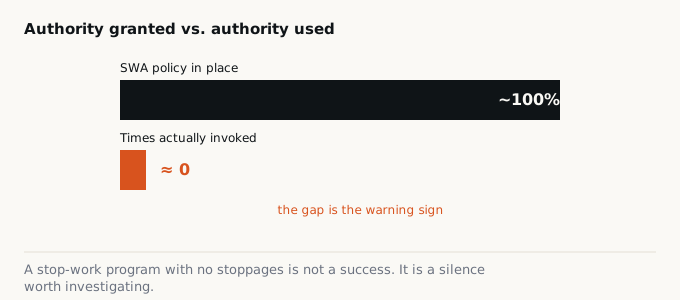
Every site I walk has a stop-work authority policy. It is in the handbook, on a laminated card, sometimes stenciled on the wall: anyone, any level, can stop any job they believe is unsafe. Then I ask the safety lead how many times it got used last quarter, and the honest number is often zero, or close to it. And the tone is proud, as if zero were the goal.
It is not. A stop-work program that never gets used is not a program that has eliminated hazards. It is a program nobody trusts enough to invoke. The authority on paper and the authority people actually exercise are two different things, and only the second one is a control.
What the guidance actually says, and does not
Start with what stop-work authority rests on legally, because it is thinner than most people assume. OSHA has no standard titled “stop-work authority.” What exists is narrower and broader at the same time.
The narrow piece is the right to refuse dangerous work. OSHA recognizes it, but the bar is high: a reasonable person must agree there is a real danger of death or serious injury, the worker generally must have asked the employer to fix it, and there must not be time to correct it through normal enforcement channels. That protects a worker walking away from an imminent-danger situation. It is not a broad license to pause any task that looks off.
The broader piece is OSHA’s Recommended Practices for Safety and Health Programs, which call for meaningful worker participation and a reporting process workers can use “without fear of retaliation,” including anonymous options. And backing all of it is Section 11(c) of the OSH Act, which makes it illegal to retaliate against a worker for raising a safety concern to a supervisor or to OSHA.
Put those together and the design intent is clear. Stop-work authority is not primarily a legal instrument. It is a cultural one. The law protects the worker who speaks up; whether they actually speak up is decided by what happens on the floor, not in the code.
Authority granted versus authority used
Here is the finding that should reframe how you read your own program. In a survey reported by the National Safety Council’s Safety+Health, nearly all workers said their workplace had a stop-work authority policy, yet more than 60 percent said they would not speak up or intervene if they saw something unsafe.
Sit with that gap. The policy was nearly universal. The willingness to use it was a minority position. The stated reasons were not confusion about the rule. They were social and economic: peer pressure, not wanting to contradict a supervisor, a desire to get the job done, fear of being ostracized, and the practical knowledge that if their department slowed down, another department would just have to speed up to compensate. The authority was granted. It was not used, because using it carried a cost the policy never addressed.
That is why a stoppage count of zero is diagnostic. In a real operation, hazards occur. Jobs go sideways. If nobody ever pulls the cord, the most likely explanation is not that your site is uniquely hazard-free. It is that people have quietly priced out the cost of stopping and decided to keep working.
How to tell if it is real
Do not audit whether the policy exists. Audit whether the authority gets used and what happened to the person who used it.
Field check
Pull every stop-work invocation from the last twelve months, then trace two things for each one: how fast work actually resumed, and what happened to the person who called it. Then ask a frontline worker directly: "Walk me through the last time you or someone near you stopped a job, and what happened to them afterward." If there are no invocations to trace, or if the answer is a long pause and "I can't think of one," your program is a poster, not a control.
The tells are in the aftermath, not the announcement. A healthy program produces a steady, unremarkable trickle of stoppages, most of them small and quickly resolved, with the people who called them treated as having done their job. An unhealthy one produces either silence or a handful of stoppages followed by a subtle chill: the person who stopped the line gets the worse shift, the harder route, the quiet reputation for being difficult. Watch how supervisors talk about the last stoppage. If it is framed as lost time rather than caught risk, the workforce has already heard the message, and the next hazard will run to completion.
Measure invocations. Measure what happened after. If both numbers are honest and the second one shows no penalty, you have a control. If the first is zero, you have a warning sign someone painted on the wall and called a success.