The saw is still cutting, so everyone assumes the dust control is still working
Table 1 protection is conditional on operating and maintaining the control as the manufacturer specifies. An empty water tank or a loaded filter removes the protection without stopping the tool, and nothing on the job tells you it happened.
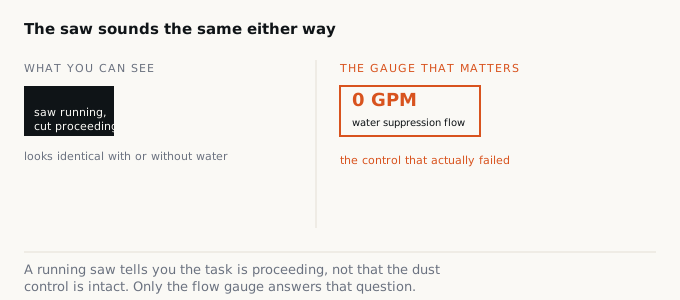
Silica is a slow hazard on a fast job. Nobody goes home injured from a shift of cutting block. The exposure accumulates over years, and the disease arrives long after the crew, the site, and often the employer have moved on. That timing shapes the behaviour on the floor: dust controls are the first thing to lapse, because lapsing produces no consequence anyone will see this week.
The control that matters is not the standard, and it is not the written exposure control plan. It is the water reaching the blade and the vacuum pulling at the shroud, on this tool, right now. Both of those fail quietly, and a tool with a failed dust control looks and sounds exactly like a tool with a working one.
What Table 1 actually promises, and what it asks in return
In the United States, construction silica sits in 29 CFR 1926.1153. The permissible exposure limit is 50 micrograms per cubic metre as an 8-hour time-weighted average, with an action level of 25.
Most contractors do not manage against those numbers directly, and the standard is designed so they do not have to. Table 1 lists common construction tasks (handheld saws, drills, grinders, jackhammers, rig-mounted core saws, and others) and, for each, the specified engineering controls, work practices, and respiratory protection. Implement Table 1 fully and properly for a listed task and you are relieved of the exposure assessment obligations that otherwise apply. That is a genuinely practical piece of regulation. It converts an industrial hygiene problem into a set of things you can see on a tool.
The catch is in the words “fully and properly,” and the standard spells out what they mean. An employer following Table 1 must operate and maintain the tool in accordance with the manufacturer’s instructions to minimize dust emissions. OSHA’s guidance on the construction silica standard is direct that this covers the instructions related to dust control: water supply and flow rates, installation and maintenance of integrated water delivery systems, when to change reused water, and the use, installation, and maintenance of dust collectors, including recommended airflow, filter efficiency, and filter cleaning. For wet methods, the instruction is to apply water at flow rates sufficient to minimize the release of visible dust. For several dust-collection entries, Table 1 specifies that the collector provide the airflow recommended by the tool manufacturer or greater, with a high-efficiency filter and a filter-cleaning mechanism.
So Table 1 protection is conditional. The condition is maintenance. Break the condition and you have lost the protection twice over: the worker is breathing dust, and the legal shelter that let you skip exposure assessment no longer applies.
The five quiet failures
Walk any active cutting or drilling task and these are what you find.
The water tank ran dry. A pressurised bottle feeding a saw lasts a fraction of a shift under real cutting. When it empties the cut continues, the blade still turns, and the operator is now dry-cutting. Refilling is somebody’s job and it competes with production.
The water is on but not on the blade. A partly blocked nozzle, a kinked line, or a flow set low to avoid slurry means water is technically flowing and dust is visibly escaping. Visible dust is the standard’s own trigger phrase, and it is the cheapest indicator on site.
The filter is loaded. A vacuum with a clogged filter loses airflow gradually. The motor still runs at the same pitch. Nothing warns the operator. Many systems have a filter-cleaning mechanism that only works if someone actually uses it on the schedule in the manual.
The wrong vacuum is on the tool. A general shop vacuum on a shrouded saw looks like compliance from ten metres away. The airflow and filtration are not what Table 1 specifies, and the pairing is usually the result of the correct unit being broken, in another truck, or never bought.
The shroud does not seal. Damaged, missing, or held back to see the cut line. The collection system can be perfect and it will capture very little if the hood is not against the work.
The common thread: every one of these is invisible in a photograph of the task and obvious in thirty seconds of looking at the tool.
Field check
Stand at an active cut, drill, or grind and watch for one full minute before speaking to anyone. Ask: is visible dust leaving the tool, and if the answer is no, can the operator show me the water level, the filter condition, and the manufacturer's instruction this setup is supposed to follow? Check the tank level against how many hours are left in the shift. Put a hand at the shroud edge to feel whether the vacuum is actually pulling. Ask when the filter was last cleaned or changed and who owns that. Ask whether the vacuum on the tool is the one specified for it or the one that was available. If nobody on the crew can say who refills the water or cleans the filter, the control has no owner, and a control with no owner is already failing on some tools today.
The exposure control plan on the truck is not the control. The water and the airflow are the control, they degrade within a single shift, and the only way to know their state is to look at the tool rather than at the paperwork.