One Chain, One Cause, and the Operator at the End of It
A single-chain investigation stops at the first plausible cause it reaches, and you can test whether yours does by giving the same incident to two independent teams and comparing what they name.
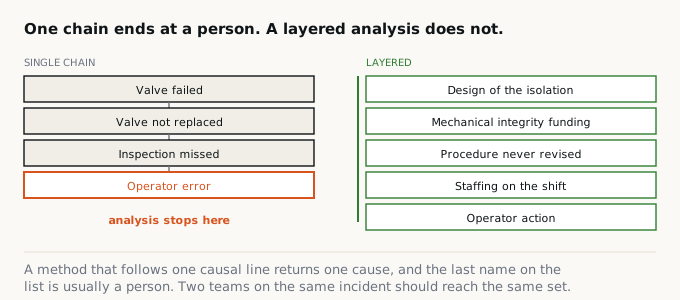
Ask why five times and you get one answer. That is not a discovery about the incident. That is a property of the method.
Sequential why-chaining is the default in most investigation programs because it is cheap, teachable in an afternoon, and tidy. The chain runs backwards from the injury until the team decides it has gone deep enough, then stops. Whatever it stopped on goes in the box marked root cause.
The problem sits in the word “the.” A chain has one end.
A chain has one end
United States federal guidance is unusually direct about this. The joint OSHA and EPA fact sheet on root cause analysis states that a successful analysis identifies all root causes, and that there is often more than one (OSHA, 2016). OSHA’s incident investigation guidance goes further, warning that it is far too easy, and often misleading, to conclude that carelessness or failure to follow a procedure alone caused an incident, and that a team must discover and correct all the factors contributing to it, which nearly always involve equipment, procedural, training and program deficiencies (OSHA). Those are US expectations, framed for employers covered by the process safety management standard at 29 CFR 1910.119 and the EPA risk management program at 40 CFR 68. The reasoning is not jurisdiction-bound, but the obligation is.
Look at how federal investigators structure their own output. NIOSH’s fatality investigation program states that occupational injuries and fatalities are often the result of one or more contributing factors or key events in a larger sequence, and its reports list them as a set. A 2025 firefighter fatality report names six: strategy and tactics, wind-driven fire and structural collapse, divisions and incident safety officers, rapid intervention crew, personnel accountability system, and vacant buildings and arson (NIOSH FACE F2025-03). Not a chain. A list, spread across layers.
The US Chemical Safety Board organises findings the same way, separating technical from organisational, emergency response, safety culture and standards findings, and treating root causes as usually deficiencies in safety management systems (CSB). If one linear chain were sufficient, the investigative bodies with the largest budgets and no commercial stake in the answer would use one. They do not.
”Operator error” is a stopping rule
The OSHA fact sheet carries a case worth reading twice. A facility had repeated flammable releases from a relief valve system. None ignited. Each was investigated, and each time the conclusion was operator error. A later release ignited and killed workers. The deeper analysis found funding cuts that had produced a deficient mechanical integrity program and malfunctioning instrumentation, a situation operators could not have prevented.
The earlier investigations were not wrong about the operator. They were incomplete, and the incompleteness had a direction. Operator error is a satisfying terminus because it is proximate, easy to evidence, and cheap to correct. A chain that reaches it has no internal reason to keep going.
This is not a story about lazy investigators. A 2023 study ran simulated investigation interviews with 34 experienced construction investigators and found confirmation bias, anchoring and fundamental attribution error emerging inside the interview itself (Journal of Safety Research). Fundamental attribution error is exactly the habit of explaining another person’s behaviour by their disposition rather than their situation. A method with one stopping point does nothing to counteract that. It rewards it.
The test is reproducibility, not satisfaction
Take one incident. Give it to two teams working independently. Compare the causes they return.
A published version of that experiment exists. Separate analysts applied three structured analysis methods independently to the same fatal incident and produced significantly different outputs, with the more systemic methods identifying more contributory factors (Safety Science, 2012). The mechanism has a name in the literature: what-you-look-for-is-what-you-find, from a review of eight accident investigation manuals showing that each manual embeds an accident model that shapes what its users can find (Safety Science, 2009).
Do not push that further than it goes. Those studies compare methods, not two teams running the same method, and I have not found a solid published agreement statistic for single-chain root cause analysis in industrial practice. The narrower claim still holds and still hurts: the method you hand an investigator constrains the causes they can return, and you can measure that constraint this week.
What the corrective action inherits
Every corrective action is downstream of the causal structure. One cause yields one action, and that action inherits whichever layer the chain stopped on. Stop at the operator and you get a conversation and a signature. Stop at the equipment and you get a repair. Neither touches the inspection interval that let the leak persist, the staffing level that made the shortcut rational, or the design that made the error easy.
Monday morning check
Pull your last twenty closed investigations, count causes per incident, then count how many name a person. If the answer is one cause, every time, ask are we describing twenty incidents, or describing our form?