'Retrained the employee' is the corrective action that corrects nothing
Closing an incident with counseling and retraining treats a system failure as a personal one, and it leaves every condition that produced the incident exactly where it was.
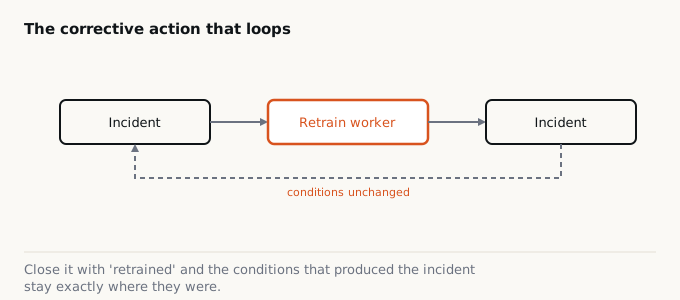
Open your incident log and read the corrective-action column. Count how many entries resolve to some version of “counseled and retrained the employee.” In most programs it is the plurality, and often the majority. It is also, dependably, the weakest corrective action available, because it changes nothing about the workplace and everything about the paperwork. The incident is closed. The conditions that produced it are untouched. The next person to stand where the last one stood inherits the same trap.
“Retrained the worker” feels like an answer because it names a person and assigns them a fix. But it is almost never a root cause. It is the place the investigation stopped.
Human error is a question, not a conclusion
OSHA has been unusually direct about this. In its joint fact sheet with the EPA on root cause analysis, the agency defines a root cause as a fundamental, underlying, system-related reason why an incident occurred that identifies one or more correctable system failures. Then it walks through a real pattern: an employer investigated a series of flammable releases from a relief valve system, determined that operator error was the cause, and moved on. The releases continued until one ignited and killed multiple workers. A proper investigation, OSHA writes, would have looked deeper and found that funding cuts had produced a deficient mechanical integrity program and malfunctioning instrumentation, a dangerous situation that operators could not have prevented.
That is the whole trap in one example. “Operator error” was not the root cause. It was the label that let the investigation end before it reached the mechanical integrity program and the budget decision behind it. OSHA’s own framing is blunt: correcting only an immediate cause may eliminate a symptom of a problem, but not the problem itself.
When “human error” appears as your root cause, you have usually found the last human in the chain, not the reason the chain failed. The useful question is not “did the worker make a mistake.” It is “why did the system allow, invite, or fail to catch that mistake.” Retraining answers neither.
The hierarchy does not disappear after the incident
Every EHS director can recite the NIOSH hierarchy of controls for hazard prevention: elimination, substitution, engineering controls, administrative controls, and, last, PPE. NIOSH is explicit that elimination, substitution, and engineering controls are more effective because they control exposures without significant human interaction, while administrative controls and PPE require significant and ongoing effort by workers and their supervisors.
The hierarchy does not stop being true because the hazard has now produced an injury. A corrective action is just a hazard control chosen after the fact, and the same ranking applies. Retraining is an administrative control. It sits near the bottom of the pyramid, in the tier that depends entirely on a human performing correctly every time, forever, under production pressure. Choosing it as your default corrective action is choosing the least reliable option in the toolkit and calling the case closed.
If a guard can be redesigned so the pinch point cannot be reached, that is elimination and it protects everyone who ever works that station, including the ones who were not counseled. If a valve can be reconfigured so the wrong sequence is physically impossible, that is an engineering control that does not decay when attention wanders. Those actions survive turnover, fatigue, and the third shift. Retraining survives until the next distracted moment.
The recurrence test
Take any corrective action written as "retrained" or "counseled" and run the substitution test: imagine the exact same conditions, a different worker, a bad day. Would your corrective action have stopped the incident, or would it only have given you a better-trained person to injure? If the honest answer is the second one, you have documented a symptom, not fixed a cause. Then push the action up the hierarchy: what could you eliminate or engineer so that the mistake becomes harmless or impossible rather than merely discouraged?
What a real corrective action looks like
None of this means training is never appropriate. If the investigation genuinely establishes that a competent, unpressured worker could not have known the correct procedure because it was never taught, then training is a legitimate corrective action, and OSHA’s own training standards require that it produce actual comprehension rather than a signed roster. That is a narrow and specific finding, arrived at after asking why, not a default reached to close the ticket.
The tell is repetition. When the same incident type keeps recurring in your log, each one dutifully closed with “retrained,” the log is telling you the corrective action never touched the cause. A corrective action that reduces recurrence is one you can point to on the floor: a changed guard, a reconfigured line, a removed chemical, a redesigned task. If your fix lives only in a personnel file, the hazard is still out there, exactly where you left it, waiting for someone competent and unlucky.