The fit test is not the program
A passing annual fit test proves a seal on one face on one day; if you cannot name your cartridge change schedule and your medical clearance process, you do not have a respirator program.
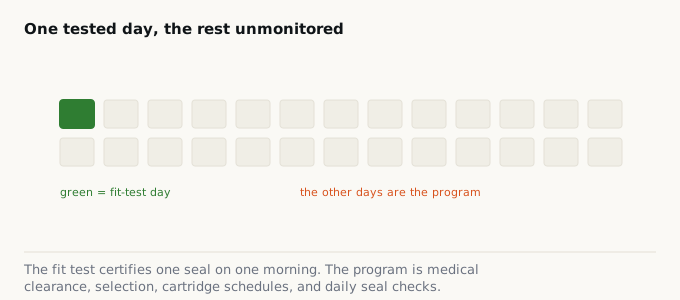
Walk any plant during fit-test week and you will feel the relief. The mobile unit shows up, faces get tested, records get signed, and a folder gets thicker. The number that comes out the other end feels like proof. It is not. A passing fit test tells you one thing: that one respirator, on one face, held a seal on one morning. Everything that determines whether the worker is actually protected happens on the other 250 days, and most of it is invisible on the day the tester visits.
OSHA’s respiratory protection standard, 29 CFR 1910.134, is not a fit-testing rule with some paperwork attached. Fit testing is one paragraph. The rest of the standard describes a program: medical evaluation, correct selection for the actual exposure, cartridge change schedules, seal checks on the day of wear, and a named person accountable for all of it. When protection fails, it usually fails in one of those gaps, not on the test stand.
The gaps the test cannot see
Start with the seal on the day of wear. The annual fit test certifies a clean-shaven face against a specific make, model, style, and size. But 1910.134(g)(1)(i) prohibits a tight-fitting facepiece whenever facial hair comes between the sealing surface and the skin. Beard texture and density change day to day, which is exactly why OSHA has held repeatedly that stubble or a beard crossing the seal area disqualifies the respirator that morning, no matter what the annual record says. The standard also requires a user seal check, positive and negative pressure, every single time the respirator is donned. That check is the worker’s job, on the floor, unwitnessed. If nobody trained it and nobody watches for it, the annual number is measuring a discipline that no longer exists.
Then the cartridge. Air-purifying cartridges do not last forever, and they give little warning. Unless a cartridge carries an end-of-service-life indicator suited to the contaminant, 1910.134(d)(3)(iii) requires the employer to set a change schedule based on objective data, and to document in the program what data was used and why. Temperature, humidity, work rate, and other chemicals present all shorten service life, and OSHA specifically warns that a conservative estimate is the safe one. A program that changes cartridges “when they smell something” or “at the end of the week, usually” has no schedule at all. It has a habit, and the habit is downstream of a breakthrough nobody can see.
Selection and clearance are upstream of everything
A respirator that fits perfectly can still be the wrong respirator. Selection under the standard flows from the actual exposure: the contaminant, its form, and its concentration against the assigned protection factor of the device. A half-mask that passed a fit test does not become adequate for an exposure that demands more. If nobody reassessed the exposure when the process, the solvent, or the production rate changed, the fit test is certifying protection against a hazard that may no longer be the one in the room.
And all of it sits on medical clearance. Section 1910.134(e) requires a medical evaluation before an employee is fit tested or required to wear a respirator, because breathing through a respirator is a physiological load. Clearance is not one-and-done: the standard requires re-evaluation when a supervisor, the health care professional, or the program administrator observes a change, or when workplace conditions raise the burden. A worker who was cleared three years ago and has since developed a cardiac or respiratory condition may be wearing a device the standard no longer permits for them.
Who owns it
The connective tissue is the program administrator. The standard requires the employer to name a qualified person to run and evaluate the program. That is the person who should be able to answer, without opening a binder, what the change schedule is, how clearance gets refreshed, and how seal-check discipline is verified. If that person does not exist, or exists only on an org chart, the fit test is not the top of your program. It is the whole of it.
Field check
Pull one respirator user at random and, without touching the fit-test file, try to answer four things: what cartridge change schedule applies to their exposure and what data sets it, when their medical clearance was last reviewed, whether they can demonstrate a user seal check, and whether the device still matches the exposure they actually work in. If the only document you can produce is a current fit test, you do not have a respirator program, you have a fit-test event.
Compliance week ends when the mobile unit drives off. The exposure does not.