Rate-based safety bonuses buy silence, not safety
If your incentive pays out for a low recordable rate, you are rewarding non-reporting alongside actual safety, and OSHA has formally warned that such programs can unlawfully discourage reporting.
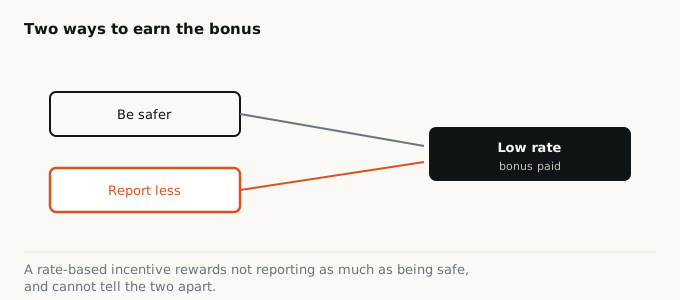
Tie a bonus to a low injury rate and you have created two ways for a worker to earn it. One is to get hurt less. The other is to report less. The program cannot tell the difference, and neither can your recordable rate. That is the whole problem with rate-based safety incentives: they pay out on an outcome that a worker can improve either by being safer or by staying quiet, and staying quiet is faster, cheaper, and available to everyone on the crew.
The suppression mechanism
A recordable injury rate is a reported number. It reflects the injuries that made it into the OSHA 300 log, not the injuries that happened. Anything that discourages reporting therefore lowers the rate without touching the underlying risk, and a bonus contingent on that rate is a direct financial reason not to report. The pressure does not have to be a policy; it is often the crew that loses the pizza party or the quarterly payout because one person spoke up. Peer suppression is more effective than any manager could be.
We know the reported number already runs low. A capture-recapture study by Boden and Ozonoff, published in the Annals of Epidemiology, estimated that the Bureau of Labor Statistics Survey of Occupational Injuries and Illnesses captured only about half to three-quarters of lost-time injuries, with state-level capture ranging from roughly 51 to 76 percent. State linkage studies comparing survey cases to workers’ compensation claims have found the survey missing anywhere from a quarter to more than three-quarters of eligible cases. Nearly every study of survey accuracy concludes the same direction: the count understates the burden. A rate-based bonus pushes on exactly the number that is already too low.
What OSHA has actually said
This is not a fringe concern. In the preamble to the 2016 recordkeeping rule, OSHA identified employee incentive programs, alongside disciplinary policies and post-incident drug testing, as practices that can be used to retaliate against workers for reporting and thereby discourage accurate recordkeeping. The agency’s position was blunt: incentive programs that deny or withhold a benefit because of a recordable injury may be retaliatory, because employees may be tempted not to report for fear of losing the benefit.
The controlling regulation is 29 CFR 1904.35. At (b)(1)(i) it requires employers to keep a reporting procedure that is reasonable, meaning one that would not deter or discourage a reasonable employee from reporting. At (b)(1)(iv) it prohibits discharging or in any manner discriminating against an employee for reporting a work-related injury or illness. Section 1904.36 reinforces this by tying the recordkeeping rule to the broader anti-discrimination protection of Section 11(c) of the OSH Act.
OSHA later clarified, in an October 2018 enforcement memorandum, that incentive programs and post-incident drug testing are not prohibited as such. That memo is often misread as a green light. Read it carefully: it says a program violates 1904.35(b)(1)(iv) when the employer acts to penalize reporting rather than to promote safety. A bonus withheld specifically because a recordable was reported is exactly the action the memo describes as unlawful. The 2018 clarification narrowed enforcement discretion; it did not bless rewarding low recordable rates. The same memo pointedly endorses incentive programs that reward participation in safety activity instead.
Reward the input, not the silence
The alternative is not to abandon recognition. It is to pay for leading-indicator participation: hazards reported, near-misses logged, corrective actions closed, inspections completed, toolbox talks led. These are inputs a worker controls directly and cannot improve by hiding an injury. A near-miss program that pays for reports is the exact inverse of a rate-based bonus: one buys more information, the other buys less. If your recordable rate falls while your near-miss and hazard-report volume also falls, that is not a safer plant. That is a quieter one.
The silence test
Trace your incentive to the specific act it pays for. Can a worker increase the payout by not reporting an injury or near-miss? If yes, the program is buying silence, and it is doing so in a way OSHA has warned can violate 1904.35(b)(1)(iv). Cross-check the data: if recordable rates are dropping while near-miss and hazard reports are flat or falling, you are suppressing the signal you need, not eliminating the risk it measures.
Compliance-minded leaders sometimes keep rate-based bonuses because they are legal when carefully bounded and because the falling number looks like success on a board slide. That is precisely the trap this publication exists to name. A low recordable rate you cannot trust is worse than a higher one you can, because you will manage to the wrong picture. Pay for the reporting, and the rate will tell you the truth even when the truth is unwelcome.
Correction
An earlier version of this article stated that Boden and Ozonoff found the BLS survey captured about 69 percent of injuries. That figure was wrong. The study estimated state-level capture of roughly 51 to 76 percent of lost-time injuries. The text has been corrected. The argument, that a rate-based incentive pushes on an already-undercounted number, is unchanged.