The beep is not the barrier
Proximity-detection systems can cut struck-by risk, but a system that only warns sits low in the hierarchy of controls, and its value hinges on whether it stops the machine or merely tells you it should have.
Struck-by remains one of the most stubborn ways to die at work. In construction it is one of OSHA’s Focus Four hazards, and mobile equipment, runovers, backovers, and collisions, drives a large share of those deaths. The Bureau of Labor Statistics recorded 5,070 fatal work injuries in 2024, and contact with objects and equipment, alongside transportation incidents, sits near the top of the list year after year. Underground, the pattern is just as grim: NIOSH reports that struck-by and pinning accidents involving continuous mining machines and mobile haulage equipment have killed dozens of miners over the decades, and that a large fraction of the most serious mining injuries fall into the struck-by or caught-in category.
Against that backdrop, proximity-detection systems look like an obvious win. Put a sensor on the machine and a marker on the worker, and the equipment knows when a person is too close. The technology is real and it works: NIOSH spent years developing electromagnetic, radar, and radio-based systems for mining, and MSHA’s 2015 final rule (30 CFR 75.1732) went so far as to require proximity detection on many continuous mining machines in underground coal mines. That rule is worth studying closely, because of what it demands.
Warning is not the same as control
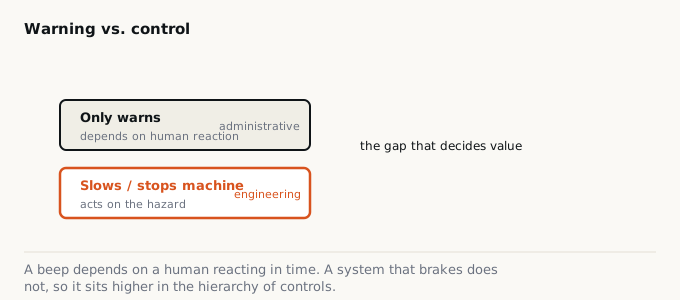
Here is the distinction that decides whether a proximity system is worth the money. The MSHA rule does not just require a beep. It requires audible and visual warnings and that the system cause the machine to stop before it contacts a miner. That second clause is the whole game.
The NIOSH hierarchy of controls ranks interventions by how reliably they protect people. Elimination and substitution sit at the top. Engineering controls, which remove or block the hazard at the source, come next. Administrative controls and warnings sit near the bottom, because they depend on a human noticing, interpreting, and reacting correctly, every single time. A system that only warns is an administrative control wearing a high-tech jacket. A system that automatically slows or stops the machine when a person enters the danger zone has crossed into engineering-control territory, because it acts on the hazard whether or not anyone reacts.
This is not a semantic quibble. A warning that fires 150 milliseconds before impact, on a machine that needs two seconds to stop, has told you nothing you can use. The alert has to arrive with enough margin, at a validated detection range, to cover the equipment’s real-world stopping distance under load, on grade, on a wet floor. If the vendor cannot state that range and that stopping distance, the system is theater.
The erosion problem
There is a subtler risk, and it is behavioral. Engineered separation, physical barriers, exclusion zones, one-way traffic patterns, keeping people and moving equipment apart in space, is a higher-order control precisely because it does not depend on attention. The danger with proximity alerts is that teams begin to trust the beep and let the barriers slip. Walkways get informal. Spotters stop spotting. The exclusion zone becomes a suggestion because “the system will catch it.” When a warning device quietly replaces engineered separation, net risk can rise even as everyone feels safer. That is the compliance-is-not-safety trap in miniature: a box gets checked while the protective logic underneath it decays.
Before you invest
Ask the vendor for the validated detection range and the equipment's worst-case stopping distance, then do the arithmetic yourself. The question that settles it: when a worker enters the danger zone, does the system stop or slow the machine automatically, or does it only warn a human who then has to react in time? If it only warns, treat it as a backup to engineered separation, never a replacement for it.
What to watch as the tech matures
The direction of travel is encouraging. NIOSH’s more recent work points toward intelligent proximity systems that continuously track worker position relative to defined safety zones and disable specific machine motions rather than issuing a blanket stop. That is the right instinct: move up the hierarchy, from warning to intervention, and make the intervention precise enough that operators do not disable it out of frustration. The systems that will earn their place are the ones that act, that are validated against real stopping distances, and that are layered on top of engineered separation rather than substituted for it.
Proximity detection is a genuine advance. Just remember what it is: a fast, tireless second set of eyes. Eyes are not a wall. Buy the ones that can also hit the brakes, and keep the wall.