Predictive safety and the base-rate trap
The rarer the incident, the more a 'predictive' model gets wrong every time it fires, and it's trained on the injuries you already have, not the ones that kill.
The pitch is irresistible: feed the platform your incident data, your inspections, your near-misses, and it will tell you where the next injury is coming from before it happens. Safety, finally moved from the rear-view mirror to the windshield. The demo shows a heat-map of “high-risk” workers and sites, and a model accuracy figure with a reassuring number of nines in it.
Two things are worth checking before that number convinces anyone. The first is arithmetic. The second is what the model was actually trained to see.
The arithmetic of rare events
A serious workplace incident is, statistically, rare. In 2023 the U.S. fatal work injury rate was 3.5 deaths per 100,000 full-time-equivalent workers, roughly one in 28,000 (BLS Census of Fatal Occupational Injuries). Recordable injuries are far more common, at 2.4 cases per 100 workers (BLS Survey of Occupational Injuries and Illnesses), but the events people most want to predict, the ones that maim and kill, sit at the thin end.
Rarity is what breaks predictive models, and it does so in a way that “99% accurate” conveniently hides. Take a workforce of 100,000 in which 100 people (1 in 1,000) will be seriously hurt this year, and a model that is 99% accurate in both directions, it correctly flags 99% of those who will be hurt, and correctly clears 99% of those who won’t. It catches 99 real cases. It also raises 999 false alarms from the 99,900 who were never at risk. More than nine in ten of its warnings point at someone who was never going to be hurt.
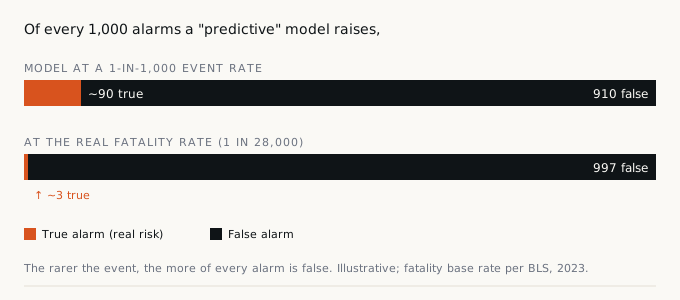
That’s the generous version. At the real fatality base rate of about 1 in 28,000, the same model is wrong roughly 997 times out of every 1,000 alarms. This isn’t a flaw in a particular product; it’s Bayes’ theorem doing what it always does when the thing you’re hunting is rare. A vendor who quotes “accuracy” instead of precision, how often an alarm is right, is quoting the number that flatters and hiding the one that matters.
Trained on the wrong injuries
The deeper problem isn’t the false-alarm rate. It’s the target.
A model learns from the data it’s fed, and the abundant data is minor: first-aid cases, recordables, near-misses. Serious injuries and fatalities (SIFs) are sparse by comparison, recordables outnumber fatalities by several hundred to one. So a model optimised on what’s plentiful becomes very good at anticipating the frequent event.
The catch, established by two decades of research, is that serious injuries are not simply minor injuries scaled up. Reviews by Fred Manuele, Tom Krause and others dismantled the old assumption, Heinrich’s pyramid, that shaving minor incidents automatically shaves fatalities. The causal factors diverge: SIFs have plateaued in many industries even as minor-injury rates fell for years. The uncomfortable proof is historical. Texas City (2005), Deepwater Horizon (2010), Piper Alpha, catastrophes that struck operations with low personal-injury rates. The U.S. Chemical Safety Board found BP Texas City watching its recordable-injury numbers while the process-safety hazard that killed 15 people went unmanaged.
A predictive model trained on minor-incident data inherits exactly that blind spot, and automates it. It will confidently forecast the sprains and slips it has seen a thousand times, and stay silent on the rare, differently-caused event that fills a CSB report.
Before you buy "predictive safety"
Ask the vendor three questions, in this order:
1. What is the base rate of the event you claim to predict, and what is your precision, not accuracy, at that base rate? If they answer with "accuracy," the number is designed to mislead.
2. Was the model trained on serious injuries and fatalities, or on the minor incidents that are causally different? If the latter, it predicts the wrong outcome by construction.
3. In live use, how many false alarms does it raise for each real event it helps prevent, and who is expected to act on them? A tool that cries wolf ten times for every real signal doesn't get acted on; it gets ignored.
None of this means prediction is worthless. It means the honest version is narrow: a model can flag known, frequent hazard patterns and route attention to them. That’s useful. It is not the same product as one that promises to see the fatal event coming, and the gap between those two claims is where budgets get spent and safety cases quietly weaken.
Compliance dashboards told you what already happened. Predictive dashboards promise the future and mostly deliver false alarms about the past, dressed as foresight. Before the demo’s nines do their work, make the vendor show you the one number they left off the slide.
Jurisdiction note: injury data cited is U.S. (BLS, CSB). The base-rate mathematics is universal; the regulatory figures are not, check your own jurisdiction’s rates before applying any threshold.