The PPE Matrix Is Not the Hazard Assessment
A site that can produce its PPE matrix but not the dated written certification behind it has documented a purchasing decision, not a hazard analysis.
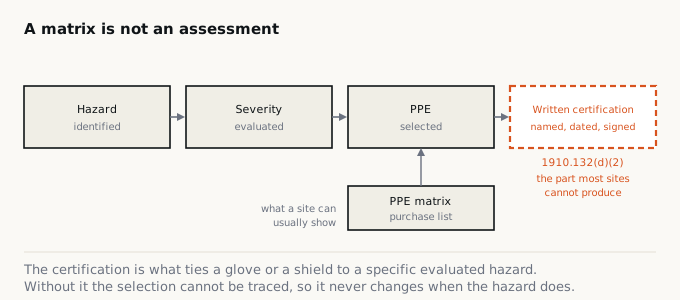
Walk any general industry floor in the United States and ask for the PPE matrix. You will get it. Laminated, color-coded, one row per area, one column per body part. Ask next for the hazard assessment the matrix came from, and the room changes temperature.
That gap is the subject here. Under 29 CFR 1910.132(d)(1), the employer shall assess the workplace to determine if hazards are present, or are likely to be present, which necessitate the use of personal protective equipment. Only if such hazards are found does the employer then select the PPE that protects against the hazards identified in that assessment, have each affected employee use it, communicate the selection decisions to each affected employee, and select PPE that properly fits each affected employee. The sequence is load bearing. Selection is downstream of assessment. A matrix with nothing behind it is a purchasing decision wearing a control’s uniform.
The certification is the part nobody writes
1910.132(d)(2) is short and specific. The employer must verify that the required assessment has been performed through a written certification that identifies the workplace evaluated, the person certifying that the evaluation was performed, the dates of the assessment, and which identifies the document as a certification of hazard assessment. Four elements. No form number, no template, no prescribed length.
The fourth element defeats more sites than the other three combined. Plenty of plants hold a walk-around report, an insurance survey, or a slide deck containing real hazard analysis. None of it says certification of hazard assessment on its face, and none of it carries a name and a date in that role. The work happened. The verification did not.
Scope matters too. 1910.132(g) limits paragraphs (d) and (f) to eye and face, head, foot, hand, and fall protection under 1910.133, 1910.135, 1910.136, 1910.138 and 1910.140. Respirators at 1910.134 and electrical protective equipment at 1910.137 run on their own requirements. A certification claiming to cover everything is usually claiming more than the standard asks and delivering less.
The functional test
Pick an item off the matrix. Ask who can name the specific hazard it was selected against, and the evaluated severity of that hazard. Appendix B to Subpart I states the expectation plainly: after gathering and organizing workplace data, determine the type, level of risk, and seriousness of potential injury from each hazard found. Appendix B is nonmandatory. The analysis it describes is what (d)(1) requires anyway.
Where nobody can answer, the PPE is inherited. Inherited PPE is unfalsifiable. Nothing about it can be shown to be wrong, because nothing about it was ever claimed. So it survives every change. A new solvent on line three, a new line speed, a new fixture that puts hands closer to the pinch, and the matrix does not move, because the matrix was never wired to a hazard to begin with.
Appendix B paragraph 7 puts reassessment squarely on the safety officer: identify and evaluate new equipment and processes, review accident records, and reevaluate the suitability of previously selected PPE. Most sites do this after an injury. The document is built to be revisited before one.
Monday morning check
Pull the PPE matrix and pick three rows at random. For each, find the document that names the hazard, records its evaluated severity, and carries a name and a date. Then ask which of these three would change if the process changed tomorrow, and who would know to change it?
Fit is a requirement, not a preference
Properly fits each affected employee, at 1910.132(d)(1)(iii), is regulatory text. Appendix B paragraph 5 is blunter still: PPE that fits poorly will not afford the necessary protection. A glove that bunches, a harness that rides, safety glasses that sit off the cheekbone on a smaller face. These are not comfort complaints. They are gaps between the hazard and the worker.
OSHA made the same point in construction. Effective January 13, 2025, 1926.95(c) requires employers to ensure all PPE is of safe design and construction for the work and is selected to ensure that it properly fits each affected employee (89 FR 100346). Note what construction still lacks. Subpart E carries no hazard assessment paragraph and no written certification requirement at all. General industry holds the stricter documentation duty. OSHA’s rulemaking FAQ says the revision was made to align construction with general industry, and that improper fit matters most for smaller construction workers who may not be able to use standard size PPE.
Four rungs, skipped
The NIOSH hierarchy of controls puts PPE fifth, below elimination, substitution, engineering controls, and administrative controls. The first three work without significant human interaction. PPE requires ongoing effort from workers and supervisors, every shift, indefinitely.
So read the assessment as a distribution, not a list. If every identified hazard resolves to an item of PPE, the assessment did not evaluate controls. It sorted hazards into a catalogue. Appendix B opens on exactly this point: PPE alone should not be relied on, but used together with guards, engineering controls, and sound manufacturing practices. The certification is where that reasoning is supposed to be visible. On most sites it is where nothing is.