Overhead Crane Inspection Is Two Duties, Not One Checklist
Under US federal OSHA general industry rules, a pre-use operator checklist covers at most the frequent duty; it does not satisfy the periodic inspection or the certification records the standard names.
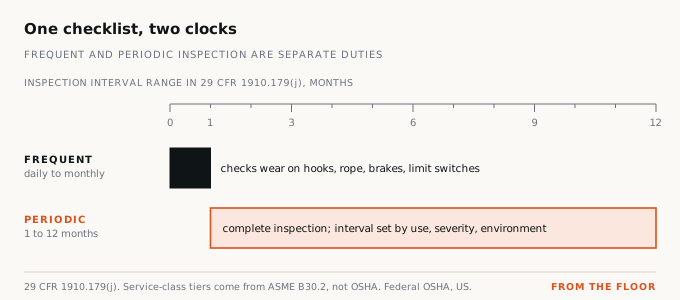
Ask a plant how it inspects its overhead cranes and you usually get one answer: the operator checks it before use. There is a form, it is signed, it is filed. For many sites that is the whole program.
The standard asks for more than that. Paragraph (j) of US federal OSHA general industry 29 CFR 1910.179 splits inspection into two classifications, and a form built for one does not cover the other. This piece applies to overhead and gantry cranes under that standard only. Other jurisdictions, and construction cranes, are governed elsewhere.
Two duties, two clocks
Paragraph (j)(1)(ii) divides inspection of cranes in regular service into frequent and periodic. The text defines them by interval. Frequent inspection is daily to monthly. Periodic inspection is at 1 to 12 month intervals. Before any of that, (j)(1)(i) requires new and altered cranes to be inspected before initial use.
Frequent inspection under (j)(2) is a list of items checked for defects. It covers operating mechanisms, hooks, hoist chains, and rope reeving, along with air or hydraulic leaks. Periodic inspection under (j)(3) is a complete inspection. It adds items such as deformed or cracked members, loose fasteners, worn sheaves and drums, brakes, and electrical apparatus. OSHA’s 2003 interpretation letter notes the standard does not define “complete inspection” or “periodic inspection” beyond this text, and leaves it to the employer to decide, during frequent and periodic inspections, whether disassembly or other methods are needed.
Where the service class fits, and where I could not confirm it
The common shorthand is that intervals depend on service class. The OSHA text I could verify does not set tiers by class. It gives the ranges above and says in (j)(3) that periodic intervals depend on the crane’s activity, severity of service and environment. Tying those to named classes such as normal, heavy and severe is the work of the consensus standard, ASME B30.2. I did not read B30.2 for this piece, so I am not stating its intervals. Your interval must come from a written decision about each crane’s actual duty, not from the longest number in the range.
What the standard says to write down
Here is the part programs get wrong in both directions. Some keep nothing. Some assume everything must be recorded.
Reading the text, three places call for certification records. Paragraph (j)(2)(iii) on hooks, (j)(2)(iv) on hoist chains, and (m)(1) on ropes each require a monthly inspection with a certification record. The record carries the date of inspection, the signature of the person who performed it, and an identifier for the item inspected. OSHA’s 1997 letter on certification records addresses these monthly records and discusses electronic equivalents. Paragraph (m)(2), on ropes idle for a month or more, also calls for a certification record. Rated load test reports under (k)(2) are to be kept on file where readily available to appointed personnel. The 2009 rated load test letter confirms that.
What I did not find: a stated dated-record requirement for the periodic inspection in (j)(3). The standard I read does not say one is required. OSHA’s 1997 letter does not say either. That is not a reason to skip it. Good practice, and likely your insurer and your own audit, will want the periodic inspection documented. But do not tell an auditor the standard demands a record it does not name.
Why the operator checklist falls short
A pre-use check is a reasonable fit for part of the frequent duty. It is usually visual, and it is done by the person with the pendant in hand. It fits the daily end of the range.
It does not reach the other things. Brakes under periodic inspection, sheave and drum wear, and structure are not things an operator sees from the floor in two minutes. The monthly certification records name a signer and an item identifier. A generic “crane OK” tick does not show that a hook, chain or rope was individually inspected and tied to a date. And the periodic inspection is a different event, done on a different clock, that nobody sees on a shift sheet.
There is a related duty worth keeping separate: the upper limit switch of each hoist is to be tried out under no load at the beginning of each operator’s shift. I am confident of the requirement from the OSHA page but did not confirm its exact paragraph number. Check it in the text before citing it.
What holds up on a real site
Three habits hold up. First, one register per crane, with the frequent items, monthly hook, chain and rope certifications, and periodic inspection as separate lines. Second, a written interval for the periodic inspection, with the reason. Third, a named person for each line, since the standard leaves the choice of who performs inspections to the employer and I could not find text assigning it to the operator.
The diagnostic
This week, pull the last 12 months of crane inspection paperwork. Sort every record into one of four piles per crane: operator pre-use checks, monthly hook, chain and rope certifications, periodic inspections, and rated load test reports. For each crane, mark the date of each periodic inspection and compare the gap between dates with the interval you wrote down for that crane. Flag any crane with no written interval, any gap longer than the interval, any month missing a hook, chain or rope certification, and any certification without a date, signature or item identifier. A crane with a full stack of daily checks and an empty periodic pile is the finding. For each crane on your site, when was the last complete periodic inspection, who did it, and where is the record?