The Light Curtain Is Only as Safe as the Last Time Someone Timed the Press
Pull the last measured stopping time and the installed mounting distance for every press and guarded machine, then recompute the distance. If a press has no dated stop-time measurement, its safety distance is unverified, whatever the light curtain's certificate says.
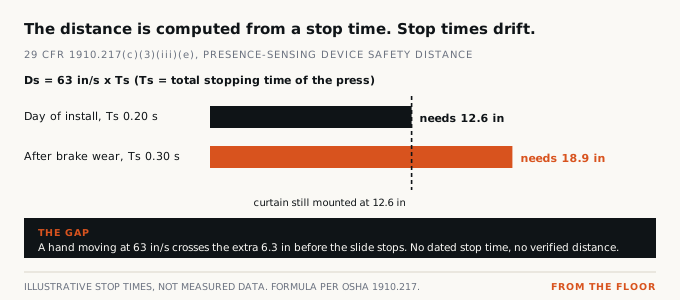
A light curtain does not stop anything. It detects. The machine stops, and it takes time to do so. The only thing that makes the detector a safeguard is the gap between the sensing field and the hazard, because that gap has to be longer than the distance a hand can travel before the machine comes to rest.
That gap was calculated once, at installation, from a stopping time measured once. Brakes wear. The number on the commissioning sheet is a snapshot of a machine that no longer exists.
What the federal rule actually says, and where it stops
Scope first. 29 CFR 1910.217 covers mechanical power presses, in federal OSHA general industry. It is not a rule for every machine with a light curtain. Hydraulic presses, robot cells and packaging lines are outside it, so check the scope of 1910.217 against each machine before citing it. The general machine guarding duty is in 29 CFR 1910.212: guarding “shall be provided” to protect the operator, and the point of operation of a machine that exposes an employee to injury “shall be guarded.” Beyond that, 1910.212 gives no formula, which is why a documented risk assessment has to supply the distance logic for non-press machines. What follows quotes 1910.217 because it is the one place federal OSHA writes the arithmetic down.
For presence sensing devices on a mechanical power press, the safety distance is in 1910.217(c)(3)(iii)(e). It is Ds = 63 inches/second × Ts. Ds is the minimum distance from the sensing field to the point of operation. Ts is the press stopping time, measured at approximately the 90 degree position of crankshaft rotation. The 63 inches per second is OSHA’s stated hand speed constant, and OSHA’s machine guarding eTool repeats it.
Two notes on citation hygiene. The two-hand control distance in 1910.217(c)(3)(vii) uses the same arithmetic, and that is where the formula is often mis-cited from. And 1910.217(c)(3)(iii)(a) says the device may not be used on machines with full revolution clutches. Confirm what clutch you have before you trust any distance.
The eTool also describes a longer consensus-standard formula (ANSI B11.1, as presented by OSHA) that adds response times for the control system, the sensing device and the brake monitor, plus a penetration allowance tied to the curtain’s detection capability. This article does not reproduce that standard. The point is that the simple federal form is a floor in the sense of its arithmetic, not a complete engineering answer for modern controls.
Why a distance set at installation is a snapshot
Run the arithmetic with invented numbers, for illustration only. A press stops in 0.20 seconds: 63 × 0.20 = 12.6 inches. After years of brake wear the same press takes 0.30 seconds: 63 × 0.30 = 18.9 inches. If the curtain is still mounted at 13 inches, the original installation passed and the current condition does not. Nothing visible changed. The curtain still lights up green.
The standard anticipates this. Under 1910.217(c)(5), where an operator places a hand in the point of operation and a presence sensing device is the safeguard, the employer must use a control system and a brake monitor meeting (b)(13) and (b)(14). The brake monitor must indicate when braking performance has deteriorated and monitor performance on each stroke. OSHA has said in an interpretation that the purpose is to ensure the brake can stop the press.
So the rule builds in a drift alarm. The teardown question is what that alarm is set against. A brake monitor trips against a limit someone entered. If that limit was keyed in from a stopping time measured years ago, or never revisited after a clutch or brake rebuild, the monitor guards a number that may not match the safety distance on the floor. The eTool says a stop-time measuring unit “must be used” to check Ts, and that it can be used to recheck stopping time periodically so the distance matches the machine’s current condition.
Separate point: the inspection duty in 1910.217(e)(1) requires periodic inspection of the press, auxiliary equipment and safeguards, with a certification record carrying the date, signature and press identifier. A certified inspection that says “guard in place, curtain operational” is not a stop-time measurement. Functional checks prove the detector works. They say nothing about whether the gap is long enough.
What the data can and cannot tell you
OSHA treats amputations from machinery as a priority. Its machine guarding page lists a National Emphasis Program on Amputations in Manufacturing Industries (OSHA instruction dated June 27, 2025). We did not find a national count of amputations specific to presence-sensing failures or to stale stopping-time data in public BLS or OSHA material, and this piece offers no figure to make the argument feel stronger. The case rests on the arithmetic and the regulation: the distance is a function of a measurement, and a measurement has a date.
Where this goes wrong in practice
Three patterns recur in the way programmes are built, not in individual lapses.
- The distance is treated as a property of the curtain. It is recorded in the safeguarding file next to the curtain model, as if it were a spec. It is a property of the press at the moment of measurement.
- The audit checks function, not geometry. Reviewers test the device by breaking the beam. Nobody puts a tape on the gap and compares it to a current Ts.
- Maintenance events do not trigger a re-measure. A brake or clutch rebuild, a change in die weight or a change in speed can change stopping time. Unless the work order system forces a new measurement, the old distance silently carries over.
None of this requires bad faith. It requires only that nobody owns the question “is the number still true?”
The diagnostic
List every mechanical power press and every other machine guarded by a presence-sensing device. For each, record three things: the installed distance from sensing field to hazard (tape measure, today), the most recent measured stopping time with its date and method, and the date of the last brake or clutch work. Multiply each stop time by 63 and compare with the installed distance. For non-press machines, use the distance method in your documented risk assessment and the manufacturer's data, and treat the same three records as required. Any machine with no dated stop-time measurement is unverified. Any machine whose measurement predates brake or clutch work is stale. Any machine where the installed distance is shorter than the recomputed one is out of position now. For each guarded machine, can you name the date its stopping time was last measured and show that the mounted distance still exceeds it?
If the answer is “we have the commissioning report,” the programme is certifying an installation, not protecting an operator.