The relief valve passed its test. That is not the same as protecting the vessel.
Pull five relief devices and ask for the documented relieving case behind each. If nobody can produce it, or it assumes a feed rate, heat input or composition today's plant routinely exceeds, the proof test record is measuring the wrong thing.
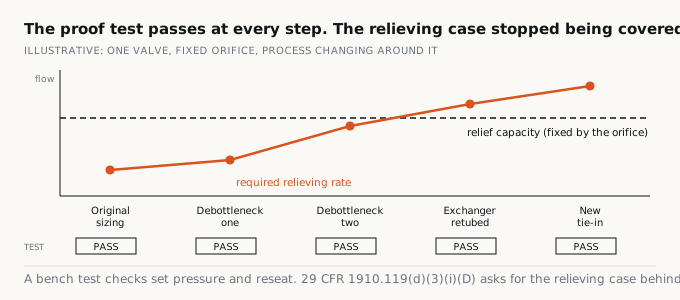
The folder is two inches thick and it is all about one valve. Tag number, nameplate orifice designation, set pressure 285 psig, bench test every three years, last recorded lift at 281 psig, reseat clean, no corrosion on the seat. Signed, dated, scanned, filed. Green on the dashboard.
Now ask the folder a different question. What scenario is this valve sized to relieve, at what flow, at what temperature, with what fluid?
The paper runs out. There is an original project data sheet with a line that says “fire case.” There is no calculation behind it. Nobody has seen the feed rate assumed when the orifice was picked, and the unit has been debottlenecked twice since.
Two questions that sound like one
A proof test answers a narrow question: does this device open near its set pressure, reseat, and show no damage. That is device integrity, and United States OSHA puts it under 29 CFR 1910.119(j), which lists relief and vent systems and devices among the equipment covered and requires inspections and tests that follow recognised and generally accepted good engineering practice.
The other question is whether the device can pass enough mass, fast enough, at the pressure and temperature of the worst credible upset, to keep the vessel below its allowable accumulation. That is design adequacy. It lives somewhere else entirely, in the process safety information at 1910.119(d)(3)(i)(D), which requires the employer to hold “Relief system design and design basis.”
Four words carry the whole argument: and design basis. The regulation does not ask for a valve list. It asks for the reasoning that produced the valve. The EPA Risk Management Program requirement is word for word the same at 40 CFR 68.65(d)(1)(iv), so for a facility covered by both, there is no jurisdictional gap to hide in.
Mechanical integrity is grading against a number it did not check
Here is the part most programmes miss. 1910.119(j)(5) says deficiencies must be corrected when equipment is “outside acceptable limits (defined by the process safety information in paragraph (d) of this section).” Mechanical integrity does not define its own pass criterion. It imports it from process safety information.
So if the design basis is missing, the acceptance criterion is an assumption. If the design basis exists but describes a plant that no longer runs, the acceptance criterion is stale, and every proof test since then has faithfully confirmed that a device still performs correctly against the wrong number. The record is real. The conclusion drawn from it is not.
OSHA’s own compliance directive points inspectors at this seam. The audit guidelines in CPL 02-02-045 tell inspectors to review a representative sample of devices such as pressure relief devices “for proper sizing according to the maximum anticipated pressure.” Sizing. Not testing.
The good engineering practice being imported is not silent either. The vessel itself is built to ASME Boiler and Pressure Vessel Code Section VIII, Division 1, which carries its own overpressure protection requirements, and API Standard 521 covers examining the principal causes of overpressure and determining individual relieving rates. OSHA’s 2016 memorandum on RAGAGEP in Process Safety Management Enforcement bridges those documents to 1910.119(d)(3)(ii), which requires the employer to document that equipment complies with RAGAGEP. Documenting compliance with API 521 means holding the relieving rate calculation. A test certificate is not that artefact.
Drift is quiet by construction
Nobody decides to invalidate a relief calculation. It happens in fragments. Feed rate creeps up because the unit got good at running. An exchanger is retubed and comes back with slightly more surface. A control scheme changes so a valve that used to fail closed now fails in place. A tie-in adds an inlet that was not in the original blocked outlet case. The product slate shifts and the relieving fluid is heavier than the one on the sizing sheet.
Management of change at 1910.119(l)(4) does require process safety information to be updated when a change alters it. That helps, and it is not the point here. Even a disciplined MOC asks whether the change needs a new relief device. It rarely asks what flow the existing device assumed, because retrieving that number costs a day and the reviewer does not have one. Drift also accumulates below the threshold of any single change, which is precisely where MOC has no hook.
The five year revalidation at 1910.119(e)(6) is supposed to keep the hazard analysis “consistent with the current process.” In practice a revalidation team re-reads scenarios and carries forward the safeguard line that says a relief valve protects the vessel. Carrying it forward is not verifying it. Do that three cycles running and an unchecked assumption has fifteen years of documented review behind it.
The diagnostic
Pick five relief devices from different units, chosen by consequence rather than convenience: one on a vessel that has been debottlenecked, one downstream of a retubed exchanger, one on a line with a tie-in added in the last decade, one protecting stored inventory, one at random. For each, ask the process safety information owner for the relieving case, the assumed flow, the assumed inlet temperature and the assumed composition. Then pull twelve months of historian data for those same variables and put the two side by side. For each device, can someone produce the relieving case and its numbers, and does today's normal and upset operation stay inside them? If the basis cannot be found, the mechanical integrity record for that device is evidence of function and nothing else, and you do not currently know whether the vessel is protected. If the basis is found and today's operation exceeds it, you have a documented deviation from process safety information, which is an integrity deficiency under 1910.119(j)(5), not a paperwork task. If all five come back with a traceable basis that still bounds the plant, that is a real result and this failure mode is closed.
When the file finally gets read, it usually reads badly
The CSB investigation into the 2007 runaway reaction at T2 Laboratories in Jacksonville, Florida found the pattern in its purest form. The final report records that the reactor relief devices were sized “based on anticipated normal operations, without considering potential emergency conditions,” that the company “could not provide any documents related to the sizing and set point of the rupture disk,” and that there was no evidence a runaway reaction was ever evaluated as an overpressure source. The CSB listed as a contributing cause that the reactor vessel relief system “was incapable of relieving the pressure from the runaway reaction.” A device was installed. It was the wrong device for the case that arrived. Four people died.
The 2013 reboiler rupture at the Williams olefins plant in Geismar, Louisiana makes the adjacent point. The CSB concluded that the reboiler was offline and isolated from its pressure relief device when heat was introduced, and it recommended that API strengthen its pressure relieving and depressuring requirements. The relief device existed. It was not protecting anything.
Both cases share a property that should bother anyone running a mechanical integrity programme. No proof test would have caught either one. The device would have lifted at set pressure every time.
The uncomfortable part
None of this requires a study. The design basis either exists as a retrievable document with numbers in it or it does not, and the answer is available this week from records you already hold. OSHA has a standing interpretation on training the mechanics who repair and test pressure relief devices. There is more attention on the person turning the wrench than on the number the wrench is turned against.
A tested valve tells you the device works. It tells you nothing about whether it is the right device. Those are separate claims, and only one of them is in your files.