Who Sited the Turnaround Trailers? Logistics, Usually
Temporary trailers and portable buildings are occupied buildings the permanent siting study never assessed, so logistics, not hazard analysis, usually decides where people sit.
Disclosure: the publisher’s affiliated business works in process hazard analysis. This piece names a practice, not a service.
A turnaround brings people, and people need somewhere to sit. Trailers for supervisors, contractor offices, a break area, a tool crib, a laydown yard with a canopy. They arrive on a truck, get craned into a gap, and are plugged into temporary power within days.
Here is the claim. At many sites, those structures are occupied buildings that the permanent facility-siting study never assessed. Their position is set by where there is flat ground, power and a short walk to the work. That is a logistics decision. Nobody has run it as a hazard decision, and often nobody has signed it as one.
I cannot prove how common this is across industry. It is a claim you can test on your own site in a day, which is the point.
The case that settled the argument
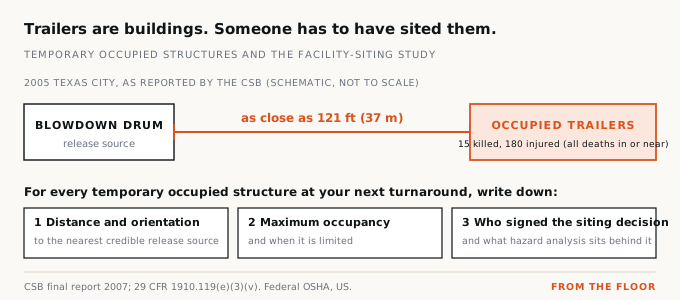
On March 23, 2005, explosions at the Texas City refinery killed 15 people and injured 180, according to the CSB final investigation report (approved March 2007). The report states that all of the fatalities occurred in or near office trailers close to the blowdown drum. It describes the dead as contractors working in and around temporary trailers, sited as close as 121 feet (37 m) from the drum.
One of the report’s key technical findings is blunt: occupied trailers were sited too close to a process unit handling highly hazardous materials. The CSB case page records the recommendation that followed. The CSB asked the American Petroleum Institute to develop guidance so that occupied trailers and similar temporary structures are placed safely away from hazardous areas, and to treat them separately from permanent buildings, because trailers are easier to damage and usually have no need to sit near the hazard. The CSB lists that recommendation as closed with acceptable action.
I did not read the full text of the report’s trailer chapter, so I am not summarizing its detailed analysis of how the siting decision was made. The finding and the counts above are what I verified.
What the regulation says, and does not say
For US federal OSHA general industry, process safety management applies to covered processes under 29 CFR 1910.119. Paragraph (e)(3)(v) lists “facility siting” among the matters the process hazard analysis must address.
That is the whole text of the requirement. It does not name a method, a distance, or a standard. It does not say API 752 or API 753 is mandatory. Anyone who tells you OSHA requires compliance with those documents is going beyond the regulation, and you should ask for the primary source.
It also does not say, in terms, whether a trailer placed for a six-week outage is inside the siting review. That is a gap in practice, not a loophole in the law. If the study was done for the permanent site map, a trailer that is not on that map was not assessed. OSHA’s national emphasis program directive CPL 03-00-014 (effective November 2011, now marked archived) told inspectors to look at “unit or control room siting and trailer location” during the initial walkaround. So trailer location has been on an inspector’s checklist. I could not verify any current OSHA directive that addresses temporary structures more specifically, and I did not confirm what CPL 02-02-045 says about siting, so I am not relying on it.
The two industry documents
API publishes two recommended practices on this subject. RP 752 covers permanent buildings. RP 753, “Management of Hazards Associated with Location of Process Plant Portable Buildings”, covers the portable ones, and API lists a second edition. Both are paid documents, so I am citing them by number and title only and not describing their criteria. Read them before you adopt their language in a procedure.
What matters for this article is the structure they reflect, which matches the CSB’s reasoning: portable buildings get their own evaluation, because they move, they are weaker, and they are optional.
Why the gap persists
In a typical arrangement, the siting study belongs to the process safety team and is tied to the permanent drawings, while turnaround logistics belongs to the outage planner and contractors. Check whether your two groups ever sit in the same meeting. The planner is asked for a site plan with trailers on it. The process safety engineer is asked to review the work scopes. Nobody is asked to review the trailer plan against the credible release sources.
Occupancy is the other half. A trailer that is a poor place for forty people at shift start can still be tolerable for two people at midday. If the limit is not written down, the number of people in the trailer is whatever the work happens to put there.
The diagnostic
The diagnostic
Before the next turnaround, build one list of every temporary occupied structure: trailers, portable buildings, tents, canopies, break and laydown areas where people gather. For each, record its distance and orientation to the nearest credible release or blast source, the maximum number of people it may hold, and when occupancy is limited (for example during start-up or a hot-work window). Then record who signed the siting decision and what they assessed. If a structure has no signature, move it or restrict it before people arrive. Can you name, for every trailer on that list, the person who decided it could go there and the hazard analysis behind the decision?